Last one
Used
Back in stock
This model is currently sold out. Enter your email and we'll let you know when it's back in stock.
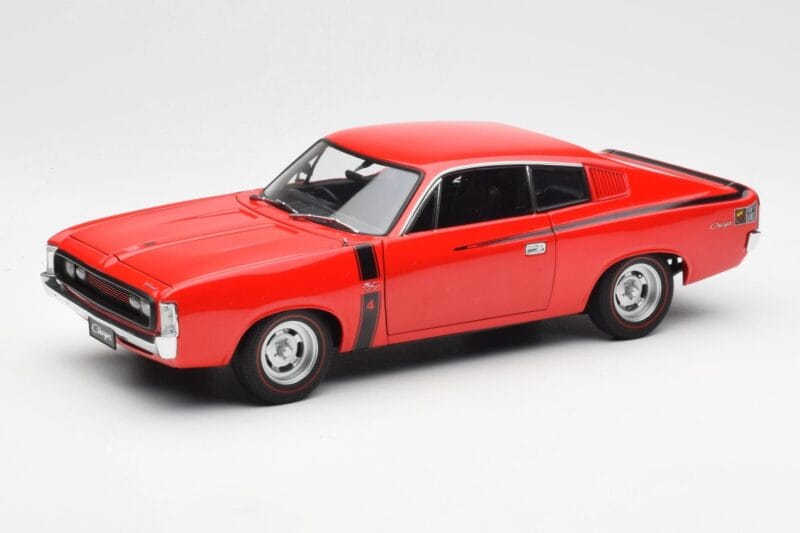
TL;DR: AUTOart's 1:18 diecast Charger E49 reproduces Chrysler Australia's homologation special in red, with opening doors, hood and trunk. This is a used model; the box shows traces of storage, the casting itself intact. A muscle-car chronology anchor built for a market that prized straight-line speed above all.
The E49 Charger holds a specific place in Australian performance history: built to satisfy Group C homologation rules, it briefly stood as the fastest locally produced car of its era. That backstory gives this diecast real weight beyond its color.
AUTOart builds this Charger from zinc-alloy diecast, and the mass in the hand is immediate the moment it clears the tray. The doors, hood and trunk all open on this example, letting a collector inspect the triple-carb induction the E49 relied on and the plain, function-first cabin Chrysler Australia fitted to keep weight down. Panel gaps run tight for a diecast at this tier, and the red paint sits with real gloss depth under a display lamp, picking out the Charger's long hood and fastback roofline. This particular copy is a used model rather than a fresh one, and the outer box carries visible traces of storage. Neither affects the casting itself, and both are worth knowing before it takes its place on a shelf.
Chrysler built the E49 in small numbers specifically to legalize its 265 Hemi-six for touring car racing, and the road car inherited a genuine competition edge rather than a marketing badge. It slots into a global muscle-car story usually dominated by American V8s, giving a collection built around that era a distinctly Australian entry with its own homologation pedigree.
Set beside American muscle from the same period, the Charger's fastback roofline and long hood read as a regional variation on a shared performance ethos. It works equally well as a standalone talking point for a collection built around homologation specials and touring-car heritage rather than showroom volume.