Used

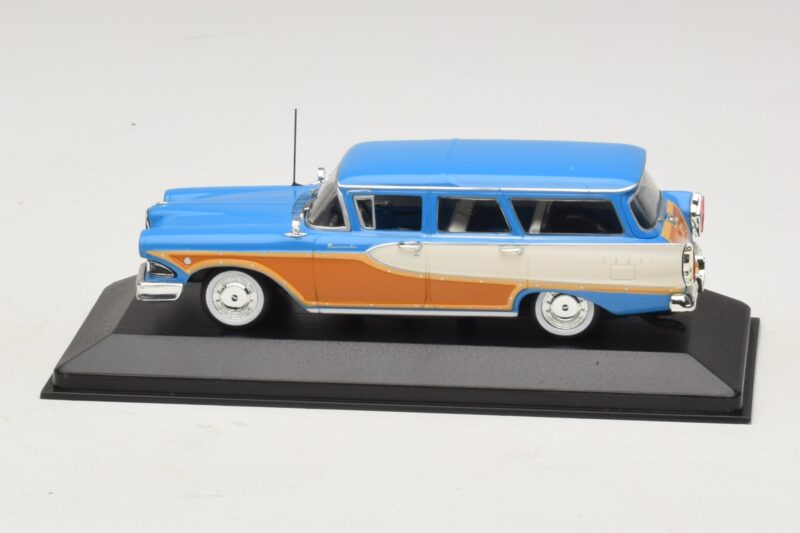
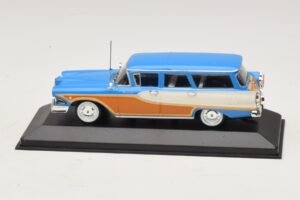
TL;DR: Minichamps' 1:43 diecast Edsel Bermuda station wagon reproduces the 1958 model in Caribbean Turquoise, as a sealed one-piece body with crisp shutlines and chrome-heavy 1950s detailing. The Bermuda was one of the rarer wagon variants from Ford's famously short-lived Edsel division.
Few American cars carry more curiosity value than the Edsel. Ford's mid-market gamble lasted barely two model years before the name became shorthand for commercial failure, which makes a well-detailed Bermuda wagon less a common collectible and more a conversation piece. Minichamps treats the subject with the same seriousness it gives cars that actually sold in volume.
With no doors, hood, or tailgate set to open, Minichamps puts the full tooling effort into the exterior, and a 1958 wagon rewards that approach more than most. The grille, a heavily chromed, horizontal affair unique to the Edsel line, holds crisp definition, and the shutlines running the length of the body stay consistent because there is no hinge tolerance for the die to accommodate. Tailgate trim, roof rails, and the chrome strip running along the lower body all read with the kind of edge sharpness that a one-piece casting makes possible. At 1:43, that exterior focus matters even more, since there is simply less surface area for fine detail to hide in.
Two-tone paint was a defining visual signature of late-1950s American cars, and Minichamps' Caribbean Turquoise finish, paired with contrasting roof and lower body trim, carries real depth under direct light despite the model's compact size. The factory color break follows the real car's design lines rather than an arbitrary split, and the paint sits smoothly across the wagon's long, flat flanks. Chrome accents along the beltline and around the headlamps catch light cleanly, a detail that separates a carefully finished small-scale casting from a flatter, less considered one. For a car this historically unusual, getting the color right matters as much as getting the shape right.
Ford launched the Edsel brand for the 1958 model year with ambitions to fill a perceived gap between its mainstream and premium offerings, introducing several trim lines including the Ranger, Pacer, Corsair, and Citation, alongside wagon variants like the Bermuda, Villager, and Roundup. Poor timing, an economic downturn, styling that drew mixed reactions, and a rushed launch combined to doom the brand almost immediately, and Ford discontinued Edsel entirely after the 1960 model year. The Bermuda wagon, built in relatively small numbers even within an already low-volume brand, survives today mostly in collector circles and automotive history discussions rather than on the road.
Minichamps built its reputation largely on fine-scale European subjects, but its catalog extends into American classics with the same attention to proportion and trim accuracy that defines the brand's broader work. A subject as commercially obscure as the Edsel Bermuda would rarely justify a premium 1:18 tooling investment, but at 1:43 it fits naturally alongside other historically significant but low-volume American cars. For collectors building a shelf around automotive history's footnotes rather than its icons, that niche positioning is exactly the appeal.
Caribbean Turquoise is a distinctive enough color to stand out immediately next to the more common Edsel reds and creams seen in period photography, giving this casting real shelf presence despite its small scale. At 1:43, the Bermuda's footprint stays compact enough to build a deep bench of niche American subjects without consuming cabinet space the way a 1:18 collection would. Judge fidelity first at the grille and the two-tone paint break, the details most collectors use to confirm an Edsel casting's accuracy at a glance. Pair it with other commercial failures or short-lived nameplates to build a shelf organized around automotive history's curiosities rather than its greatest hits.