Used

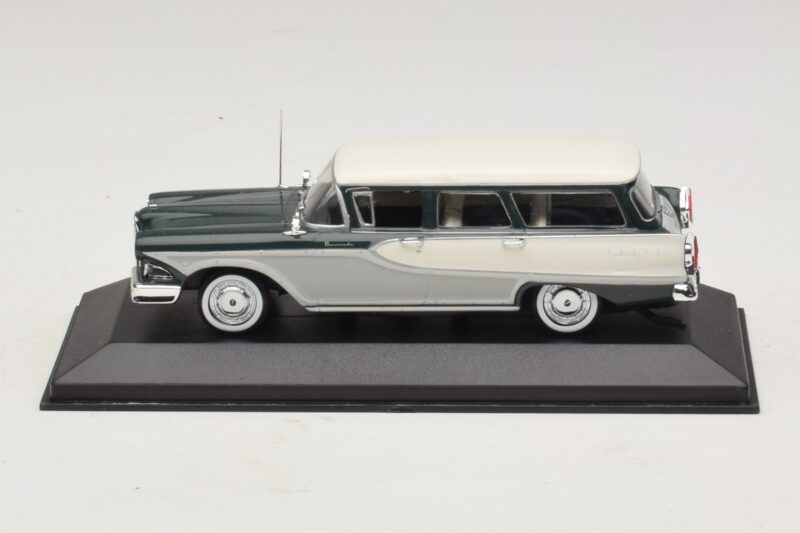
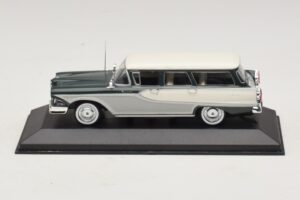
TL;DR: Minichamps' 1:43 Edsel Bermuda reproduces the short-lived 1958 station wagon in dark green and white, cast as a sealed one-piece body with the model's signature horse-collar grille and push-button transmission controls molded in. A collector's piece built around one of Detroit's most famous commercial failures.
Few American cars carry a story as well known as the Edsel's, a brand Ford launched with enormous fanfare in 1958 and quietly folded two years later. The Bermuda wagon was part of that brief run, and Minichamps renders it with the vertical grille and chrome detailing that made the car instantly recognizable, for better or worse.
This Bermuda is cast as a single, fixed body, with no doors, hood, or tailgate that open. At 1:43 that is the standard construction approach, and it works in the car's favor: the vertical, horse-collar-shaped grille, the detail that defined the Edsel's controversial styling, holds a crisp, unbroken edge instead of a seam running through it. The diecast shell is zinc alloy, giving the small model real heft in the hand, while the dark green over white two-tone paint is applied with a clean separation line along the beltline, a detail that is easy to blur at this scale but holds here.
Minichamps builds its 1:43 line around exactly this kind of small-scale precision, and the wagon's rear roofline and tailgate pressing come through accurately, including the slab-sided taillight assemblies that sat below the Edsel's chrome bar. Glazing is thin and sits flush, letting the two-tone dashboard show through rather than disappearing behind thick plastic. Wheel covers carry the correct period hubcap pattern rather than a generic stand-in. For a car this visually distinctive, getting the grille shape and the paint break right matters more than interior access would, and that is where this casting puts its effort.
Ford introduced the Edsel brand for 1958 with one of the largest marketing campaigns in American automotive history, positioning it between Ford and Mercury in the corporate lineup. The timing could not have been worse: the car arrived just as a recession hit car sales hard, and its vertical grille, intended to look distinctive, was widely mocked in the press. Ford pulled the plug after the 1960 model year, and the Edsel name has stood ever since as a shorthand for a product launch gone wrong, studied in business schools as a cautionary tale about market research and timing.
The Bermuda was Edsel's station wagon, built on the same platform as Ford's full-size wagons of the period but wearing Edsel's own grille, trim, and badging. Production numbers across the whole Edsel range were modest even in the brand's first year, and wagons made up a smaller slice of that total than the sedans and hardtops, which keeps surviving originals and well-detailed replicas of the body style a point of interest for collectors who focus on commercial failures and short-lived nameplates rather than sales leaders. That short production run is exactly why a well-executed 1:43 Bermuda carries more interest than its modest sales figures would suggest.
A brand that lasted barely three years leaves a narrow window for any collection built around it, which makes an accurately detailed Bermuda wagon a meaningful anchor rather than one of many options. At 1:43, the model sits comfortably on a standard shelf alongside other full-size American wagons of the era, and its sealed body keeps focus on the grille and paint break that define the car visually. This is a piece for the collector drawn to automotive history's footnotes and failures as much as its successes, a shelf conversation piece more than a volume purchase. Paired with other short-run or one-generation nameplates, it rounds out a collection built around stories rather than sales charts.