Last one
Used
This model is currently sold out. Enter your email and we'll let you know when it's back in stock.
TL;DR: Maisto's 1:18 diecast Ferrari F50 Cabriolet in red reproduces the 1995 open-top supercar built around a V12 engine derived directly from Ferrari's Formula 1 program. Entry-tier zinc construction makes this race-bred flagship accessible without hand-built resin pricing.
The F50 stands apart from most 1990s supercars because its engine did not start life on a road car development bench, it came from Ferrari's F1 program almost intact.
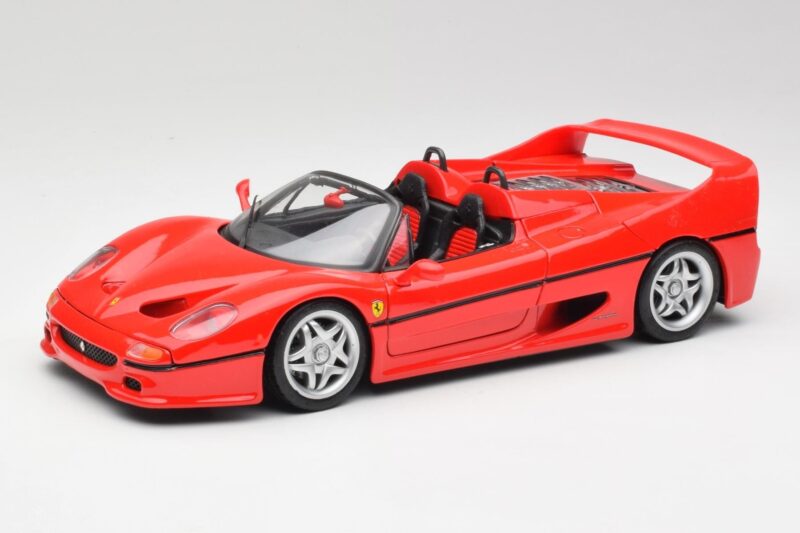
The zinc alloy body captures the F50's low, wide stance and exposed engine cover with correct proportion, and the removable roof panel reproduces the real car's targa-style configuration. Panel gaps around the rear engine bay louvers run wider than a premium build would allow, and the red finish is applied evenly without the layered depth of costlier clear coats. The interior shows a simplified cockpit rather than the carbon fiber texture of the original, in keeping with the entry tier. What the casting gets right is the F50's aggressive, almost skeletal rear haunches, a shape defined by the need to cool a genuine race-derived V12 rather than styling for its own sake.
Ferrari built the F50 in 1995 with a naturally aspirated V12 based on the engine used in its early-1990s Formula 1 cars, mounted in a carbon fiber chassis structurally bonded to the engine rather than isolated with rubber mounts, a genuine race-car construction technique applied to a road car. That direct F1 lineage set the F50 apart from its F40 predecessor and gave it a raw, mechanical character that later Ferrari flagships moved away from.
This F50 works well displayed alongside the F40 and later Enzo to trace Ferrari's flagship evolution across three decades, showing how the marque's halo car philosophy shifted from turbocharged aggression to naturally aspirated race-engine purity and eventually into modern hybrid performance. At an accessible price point, it offers a practical entry into that lineup without committing hand-built resin money to every piece.