Last one
Used
This model is currently sold out. Enter your email and we'll let you know when it's back in stock.
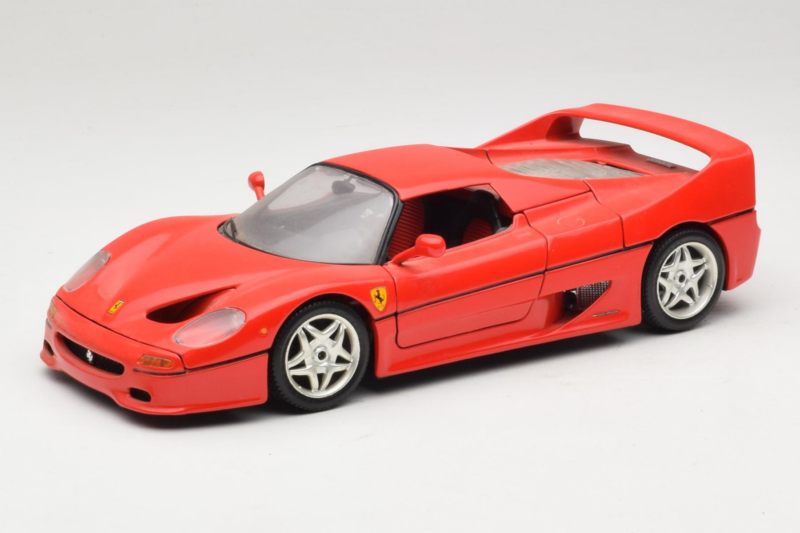
TL;DR: Bburago's 1:18 diecast Ferrari F50 reproduces the F1-derived V12 supercar in red, the targa-roofed successor to the F40. Entry-tier diecast construction with opening features brings Ferrari's mid-1990s flagship within reach, a practical way to add a V12 Ferrari to a supercar shelf without investment-tier pricing.
Ferrari built the F50 around a V12 descended directly from its Formula 1 program, a rare case of a road car borrowing so literally from the race team, and Bburago's diecast keeps that lineage in view.
Bburago positions its Ferrari catalog at the accessible end of the diecast market, and this F50 reflects that approach honestly: a diecast metal body with opening doors, a simplified engine bay visible through the rear glass rather than a fully detailed V12 replica, and red paint applied evenly without the tampo-printed micro-detail a costlier resin piece would carry. Panel gaps run wider than premium alternatives, and the interior uses molded rather than upholstered-look surfaces, trade-offs that come with the price point rather than manufacturing shortcuts specific to this piece. Collectors choosing Bburago over a premium resin F50 are trading ultimate surface precision for a real, opening diecast model at a fraction of the cost.
The F50's V12 traces its architecture directly to the 3.5-liter engine Ferrari raced in Formula 1 during 1990, detuned and enlarged for road use but still spinning to a genuinely race-derived character few road car engines of the era could match. Ferrari also gave the F50 a targa-style removable roof panel, letting owners run it open or closed, a configuration distinct from the fixed-roof F40 it replaced. Production stayed deliberately limited, positioning the F50 as a bridge between the F40 and the later Enzo in Ferrari's flagship supercar lineage.
Set beside an F40, this F50 completes a two-car snapshot of Ferrari's flagship supercars bridging the late 1980s and mid-1990s, each one representing the most extreme road car Maranello could build in its moment.