Last one

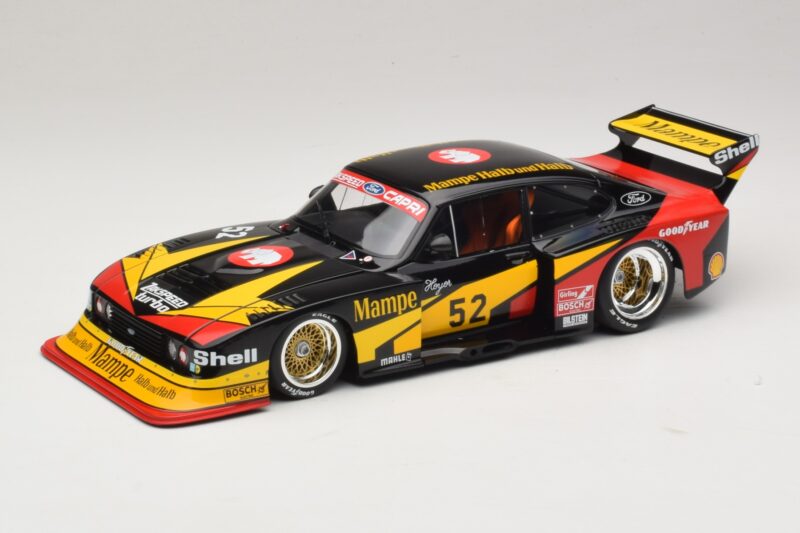
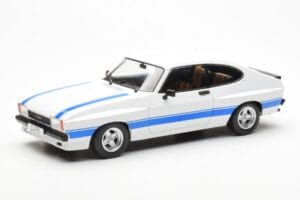
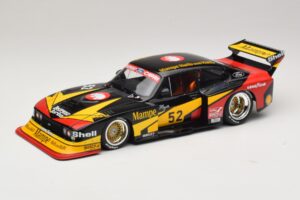
TL;DR: Minichamps' 1:18 diecast Ford Capri Turbo recreates Hans Heyer's Mampe-sponsored Group 5 racer from the 1978 DRM season, with opening doors revealing a stripped cockpit and roll cage. The widened silhouette bodywork and turbo-era flared arches separate this from any road-going Capri on the shelf.
Group 5 silhouette racing took the shape of a showroom car and discarded almost everything underneath it, and the Capri Turbo shows that approach at its most extreme. Zakspeed's turbocharged conversion and the Mampe sponsorship made this a recognizable fixture of the 1978 DRM season, and Minichamps' diecast keeps that livery accurate down to the sponsor placement.
Pop the door open on this Capri and the real story is underneath: no plush road-car trim, just a roll cage, a competition seat, and the stripped dash a Group 5 car actually carried. Diecast construction lets the hinge hold the door at whatever angle it's left, a practical point when the appeal of this model is being able to see into a cockpit built for racing rather than comfort. The engine bay access tells the same story, exposing the turbocharged plumbing that defined this era of DRM racing far more than anything bolted to a stock Capri.
Zinc alloy construction gives the model the mass to feel substantial off the shelf, with the kind of durability that keeps decades-old liveries from chipping under normal handling. Minichamps built its reputation on race-liveried diecast at this exact scale, and the sponsor decals here carry the sharp edges and correct color separation that distinguish a well-printed livery from a smudged one. Panel gaps run slightly wider than a resin casting would allow, the trade every diecast at this price tier makes for the strength that lets doors and hoods open and close for years without the hinges loosening.
Group 5 regulations let manufacturers keep only the silhouette of a production car while rebuilding almost everything else, and Ford's partner squad Zakspeed pushed that latitude as far as it would go on the Capri. A turbocharged engine, a tube-frame chassis, and dramatically flared bodywork sat under a shell that only vaguely resembled the car in Ford showrooms. That gap between appearance and engineering is exactly what made Group 5 racing compelling to watch, and it's what a model like this one has to communicate through stance and bodywork alone.
Hans Heyer campaigned this Mampe-liveried Capri through the 1978 Deutsche Rennsport Meisterschaft season, one of several factory and semi-factory entries that kept Ford competitive against BMW's own turbocharged silhouette cars. Mampe, a German spirits brand, put its name across the bodywork in the kind of period sponsorship livery that still defines how collectors identify specific cars from this era. The model reproduces that scheme faithfully, which matters more for this subject than for a plain road car, since the livery is most of what distinguishes one Group 5 Capri from another.
A Group 5 Capri like this one rewards a collector building out 1970s German touring car racing rather than someone chasing Ferrari-grade investment pieces. It pairs naturally with other DRM-era silhouette cars, especially the BMW CSL models that were the Capri's direct rivals on circuits like the Nürburgring during this period. At 1:18, the widened arches and rear wing give the model real shelf presence, larger in footprint than the road-going Capri it's based on despite sharing the same scale. Buyers drawn to opening-body diecast for the cockpit detail will get the most out of this piece, since the roll cage and stripped interior are worth the extra handling care a diecast with moving panels always demands.