Last one

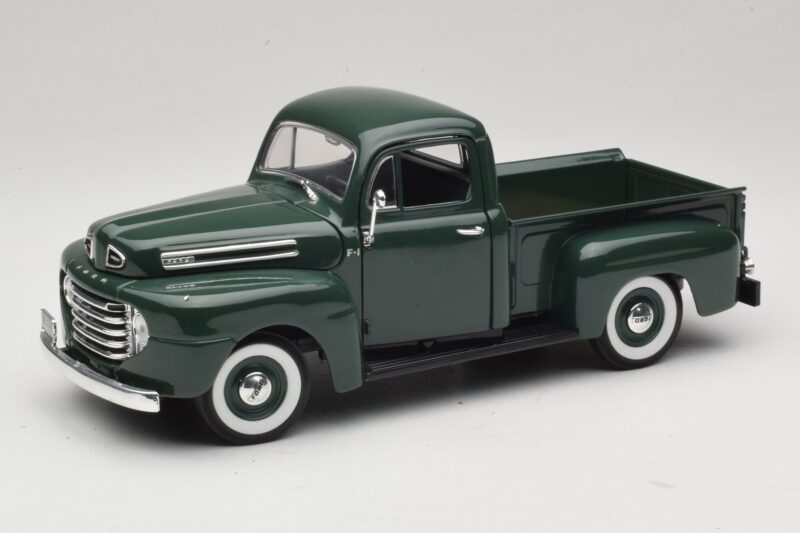
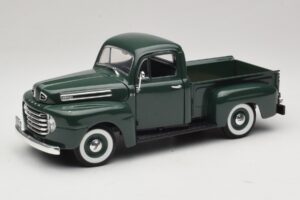
TL;DR: Road Legends' 1:18 diecast Ford F-1 reproduces the 1948 pickup that launched Ford's F-Series lineup, finished in green with chrome trim. Doors and hood open onto a flathead V8 engine bay and a simple bench-seat cabin, the truck's 'Bonus-Built' construction reflected in its upright, utilitarian body.
Ford introduced the F-Series in January 1948 as a clean break from the car-based pickups that preceded it, building the F-1 as a purpose-designed truck from the frame up. This green example carries the rounded fenders and horizontal-bar grille that defined the line's first five model years, before Ford renamed the half-ton F-100 in 1953.
Road Legends casts the F-1's body and cab in zinc alloy diecast, with doors and hood that open on this release. Lifting the hood reveals Ford's flathead V8, the engine most F-1s of this era carried, cast with its distinctive exhaust manifold routing and generator mount. The doors swing open onto a simple bench seat and a dashboard with round, deeply recessed gauges, the kind of unadorned cabin that reflected the truck's work-first purpose. Hinge tension holds the panels open at a natural angle rather than letting them swing freely, a small detail that matters on a vehicle whose doors were always built heavy.
The green finish was a common factory color on late-1940s F-1s, and Road Legends pairs it with chrome treatment on the grille bars, headlamp bezels and front bumper, picked out separately from the body paint rather than left flat. The bed rails and tailgate carry their own wood-look or body-color finish depending on trim, and the wheels wear the painted steel look with chrome hubcaps typical of the period. Panel gaps around the cab doors and hood stay consistent, and the running boards sit correctly proportioned beneath the cab.
Before 1948, Ford's pickups were largely adapted from passenger car platforms, sharing fenders, cabs and chassis components with sedans. The F-Series broke from that approach entirely, giving the F-1 its own frame, its own cab, and styling developed specifically for truck duty rather than borrowed from a car line. Ford marketed the result under the 'Bonus-Built' banner, emphasizing the truck-specific engineering buyers were getting over the car-based competition still common from other manufacturers.
Ford built the F-Series under the F-1 through F-8 naming scheme from 1948 through 1952, with the F-1 covering the half-ton class this model represents. For 1953, Ford renamed the half-ton truck the F-100 as part of a broader styling and naming overhaul, which means every F-1 on the road today predates that better-known badge by at least a year. That short five-year window gives the F-1 a distinct identity recognizable by its rounder fenders and simpler grille.
At 1:18, a half-ton pickup like the F-1 takes up noticeably less shelf depth than a full-size sedan of the same era, making it an easy addition to a crowded display case. Road Legends positions this release at an accessible diecast tier, where the value sits in honest proportions and opening panels rather than elaborate underbody detail. Collectors judging fidelity should check the grille bar spacing and fender crown first, the features that most clearly separate an F-1 from the F-100 that replaced it. Set beside a period Ford sedan or a later F-100, this truck makes a quiet but clear case for how utilitarian American design looked at the start of the postwar boom.