Last one

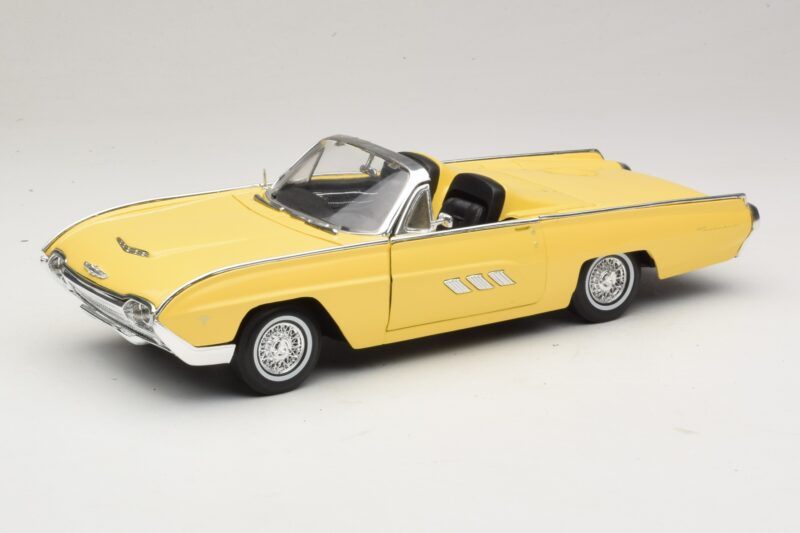
TL;DR: Anson's 1:18 Ford Thunderbird Cabriolet in yellow diecast reproduces the 1963 third-generation Bullet Bird with opening doors and hood, exposing the cabin and engine bay behind the car's distinctive bullet-shaped rear. A bold, color-forward centerpiece for a shelf built around early-1960s American convertibles.
The third-generation Thunderbird earned the nickname Bullet Bird for its tapered, projectile-like rear end, a styling signature that set it apart from both its predecessor and the cars that followed. Anson's diecast opens at the doors and hood, putting the cabin and engine bay on display beneath that unmistakable silhouette.
Both doors swing open on this Thunderbird, and the hood lifts to reveal an engine bay rendered with enough separation between block, intake, and firewall to read as a real layout rather than a flat casting. At 1:18, a convertible like this benefits from an already-open cabin, and Anson adds to that with visible seat stitching detail and a dashboard laid out with legible gauges rather than a blank panel. The yellow paint sits bright and saturated, giving the piece real presence even before accounting for the opening features.
Thunderbirds of this generation carried heavy chrome trim along the bumpers, side spears, and wheel surrounds, and this casting reflects that with plated finishes distinct from the body paint rather than a uniform silver wash. The soft-top mechanism, shown stowed behind the rear seats as it would sit with the roof down, adds another layer of period detail that a simpler convertible casting might skip. Anson's build quality sits in the accessible middle of the diecast market, solid enough to reward handling without chasing the fine detail of a premium resin specialist. That balance of chrome, color, and opening access is what gives this Thunderbird its shelf presence despite its mid-tier price point, and it is a fair trade for a car meant to be handled as much as displayed.
Ford redesigned the Thunderbird for 1961, moving away from the squared-off lines of the second generation toward the rounded, projectile-nosed shape that earned the Bullet Bird nickname. The convertible, sold as the Cabriolet in Ford's lineup, offered one of the more dramatic open-top silhouettes on the American road at the time, with a long hood, a tapered rear deck, and a retractable top mechanism that folded the roof completely out of sight. This generation ran only through 1963, making it a relatively short-lived but visually distinct chapter in the Thunderbird's history.
The Thunderbird is often credited with helping establish what the American industry came to call the personal luxury car, a two-or-four-seat model prioritizing style and comfort over outright sportiness or practicality. By the third generation, the car had moved firmly into that role, positioned above a standard Ford but short of true luxury-marque territory. That positioning gives the Thunderbird a specific place in American automotive history, distinct from both the muscle cars that followed later in the decade and the full-size luxury coupes it competed against indirectly. Understanding that context is part of what makes a Bullet Bird more than just a pretty convertible on a shelf, it is a genuine marker of a specific moment in how the American auto industry thought about style and status.
A yellow Thunderbird Cabriolet draws the eye on any shelf, which makes it a natural centerpiece rather than a background piece in an American convertible lineup. Pair it with other early-1960s open-top cars, whether rival personal luxury models or contemporary muscle-adjacent convertibles, to show the range of American styling in that transitional period between the 1950s and the muscle car era. The opening doors and hood mean this model invites handling, and the bright finish holds its own even next to larger or pricier pieces elsewhere in a display, making it a strong focal point for a themed American shelf built around color and chrome rather than historical rarity alone.