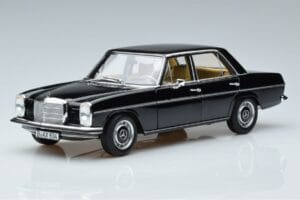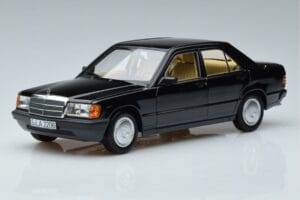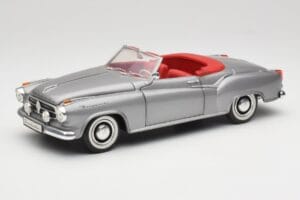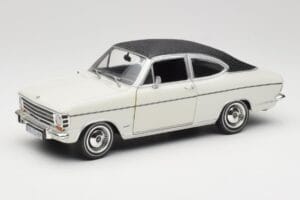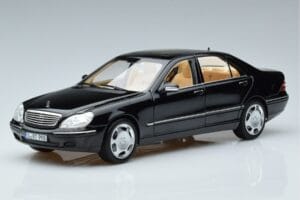
Mercedes S-Class W220 S600 Limited Edition Norev 1:18
Price:
91.00 €
This model is currently sold out. Enter your email and we'll let you know when it's back in stock.
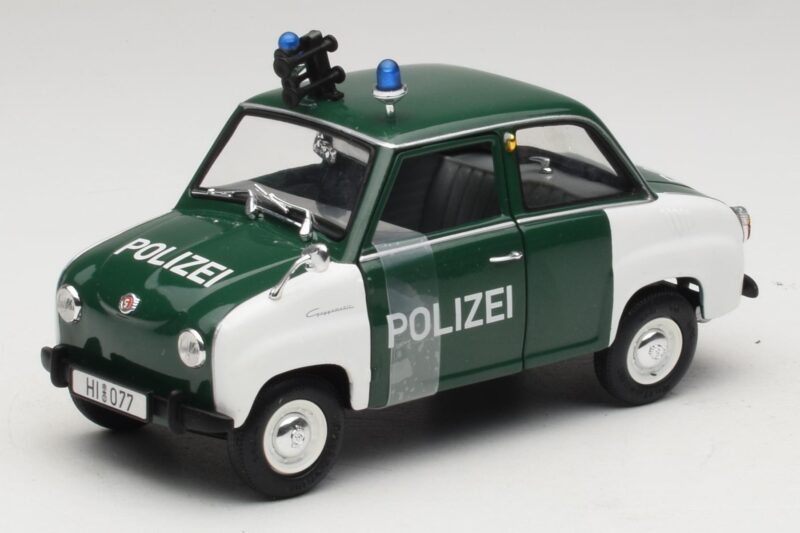
TL;DR: Revell's 1:18 diecast Goggomobil T250 reproduces Hans Glas GmbH's tiny 1960s West German microcar in police livery, complete with opening doors and a two-cylinder two-stroke profile scaled down faithfully. Zinc alloy construction gives this pocket-sized subject real shelf weight, an unusual and characterful addition to any service-vehicle display.
Hans Glas GmbH built the Goggomobil as cheap, practical transportation for a West Germany still rebuilding after the war, and the T250 became one of the most recognizable microcars of the era simply by being everywhere on the road. This police-liveried example taps into that budget-conscious history, a reminder that municipal fleets of the period often ran the smallest, most economical car available rather than anything flashier.
Hans Glas GmbH, better known for motorcycles and agricultural machinery before the war, built the Goggomobil around a rear-mounted, air-cooled two-cylinder two-stroke engine, technology borrowed more from motorcycle practice than conventional car design. The T250 designation referred to that 250cc displacement, a genuinely tiny unit that nonetheless moved a car small enough to make the numbers work. At a time when a full-size sedan remained out of reach for many West German households, the Goggomobil offered four wheels, a roof, and real weather protection at a fraction of the cost, filling a gap between the motorcycle and the family car that larger manufacturers largely ignored.
Production ran through the 1960s, and the T250 became a familiar sight on West German streets precisely because it solved a real problem: affordable personal transport during a period when household budgets were still recovering. That ubiquity is part of what makes a Goggomobil model appealing today, not because the car was fast or glamorous, but because it represents an honest, unpretentious chapter of automotive history that grander sports cars and executive sedans tend to overshadow in most collections built around prestige marques.
At 1:18, the Goggomobil's real-world compactness becomes obvious immediately, a body that measures well under 20 centimeters even at this comparatively large scale, since the original car itself was barely three meters long. Revell casts that small footprint in zinc alloy rather than resin, which means this diminutive model still carries genuine weight in the hand, a pleasant surprise given its size. Panel lines stay simple and clean, appropriate to a real car whose bodywork was itself basic and unadorned, without the compound curves that would test a diecast tool's limits at this scale.
The doors open onto an interior that makes the car's small scale obvious even without a tape measure: two seats set close together, a minimal dashboard, and almost no space behind the front row. That cramped honesty is faithful to the original rather than a limitation of the model, since the real T250 genuinely offered little more than basic transportation for a driver and one passenger. Police-livery graphics, striping, and any badge details are applied with the same tampo-printing precision Revell uses across its diecast catalog.
Police liveries on scale models tend to fall into two categories: faithful reproductions of a documented patrol vehicle, and imaginative liveries applied to a subject that never officially wore the colors. The Goggomobil sits closer to the honest end of that spectrum, since small, cheap cars genuinely did see service with municipal departments and other budget-constrained fleets across 1960s West Germany, where replacing an aging vehicle with anything larger simply was not in the budget. Whether or not this exact livery traces to a documented department, the pairing rings true to the period rather than reading as a random costume applied for novelty's sake. The white and colored panel scheme, warning markings, and any lettering are rendered in the same crisp tampo printing Revell applies to its full-size touring and rally subjects, scaled down without losing legibility. For a collector building a service-and-emergency vehicle theme, this Goggomobil offers something genuinely different from the usual Beetle or Mercedes patrol cars that dominate that category, a reminder that police fleets of the era ran whatever was affordable, not just whatever looked authoritative.
This T250 will never anchor a themed shelf the way a Ferrari or a works rally car does, and it doesn't need to. Its value lies in contrast: set beside sports cars and touring champions, a tiny police-liveried microcar draws a second look and usually a question about what it actually is. Diecast construction keeps the piece durable despite its small size, tolerant of handling in a way a delicate resin casting at this scale might not be. Goggomobils rarely turn up as scale models at all compared to the flood of Beetles and Minis representing small European cars, which makes this a genuinely uncommon find for anyone specifically collecting microcars, oddities, or post-war German economy vehicles. At an accessible price point, it rewards curiosity rather than demanding a serious collecting budget.