Last one
Used

This model is currently sold out. Enter your email and we'll let you know when it's back in stock.
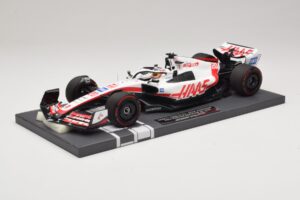
TL;DR: Minichamps' 1:18 diecast Haas VF-20 reproduces Romain Grosjean's No. 8 car from the 2020 Bahrain Grand Prix weekend, the race in which his crash and survival demonstrated the value of the halo cockpit protection device. It is a sobering but historically significant piece for a Formula 1 safety-era collection.
Not every model on a shelf marks a moment worth celebrating. Some mark a moment worth remembering instead, and this VF-20 belongs to one of the most consequential race weekends in modern Formula 1 safety history.
Early in the 2020 Bahrain Grand Prix, Romain Grosjean's Haas VF-20 left the circuit at high speed and struck the trackside barrier, a violent impact that tore the car apart on contact. It remains one of the most severe crashes in modern Formula 1, and images of the immediate aftermath were broadcast to a global audience watching live. The circuit's own safety infrastructure, including rapid-response fire crews stationed close to that section of track, also played a role in how quickly the situation was brought under control. What followed became one of the sport's most closely watched moments of the entire decade, not for the racing, but for whether the safety systems built into the car would do what they were designed to do.
Grosjean climbed out of the fire largely under his own power, suffering burns and a broken bone but avoiding the catastrophic outcome the crash's severity suggested was possible. Formula 1's technical leadership and safety experts pointed directly to the halo, the titanium hoop mounted above the cockpit that had been mandatory only since 2018 and had faced skepticism from some drivers and fans when it was first introduced, as the piece of equipment most responsible for protecting his head during the impact. The race was abandoned and Grosjean missed the remainder of the season, but the halo's case as essential Formula 1 safety equipment was settled that evening in a way no amount of testing could have argued as convincingly.
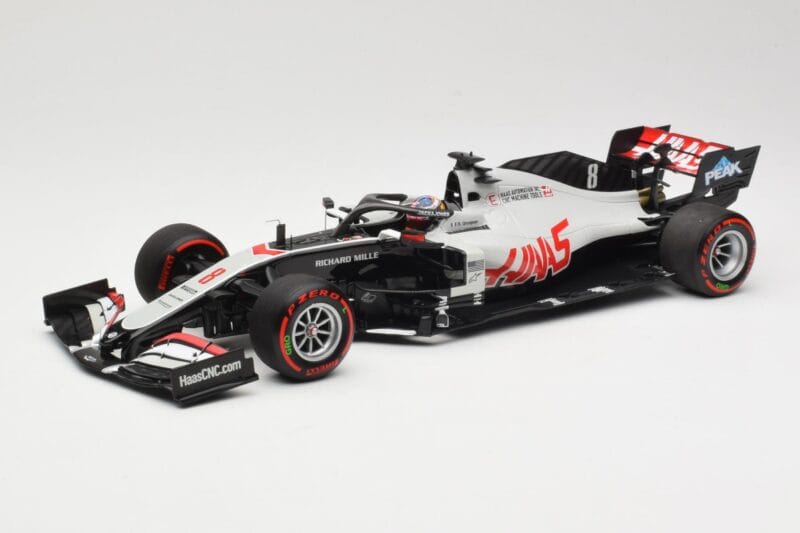
This model reproduces the VF-20 as it appeared for that Bahrain weekend rather than depicting the crash itself, built in diecast with the same halo, bargeboard, and sidepod detailing found across Minichamps' 2020 Haas range. The cockpit surround around the halo mount is molded with clean, defined edges, and the front wing's mounting pylons, an area where lower-tier castings often lose definition, hold their thin profile cleanly here.
The black-and-red Haas livery is applied evenly across the body, with Grosjean's No. 8 rendered in sharp, clean lettering on the engine cover and nose. Panel lines around the sidepods and floor stay tight and consistent, giving the diecast build the same attention to fit and finish found on Minichamps' race-winning liveries, despite this car's more sober historical association.
This is not a model bought for celebration, and it does not need to be. It belongs instead to a smaller category of collectible that marks a turning point in how the sport protects the people driving its cars, and those pieces carry a different kind of weight on a shelf. Displayed alongside other cars from Formula 1's halo era, it becomes part of a larger story about a piece of equipment that faced real doubt before proving its worth in the most public way possible. It is a reminder that the diecast hobby, at its best, preserves more than victories, it preserves the moments that changed how a sport operates. For collectors who care about the sport's history beyond race results, a car this closely tied to a genuine safety milestone earns a place that has little to do with wins or podiums.