Last one
Used
Back in stock
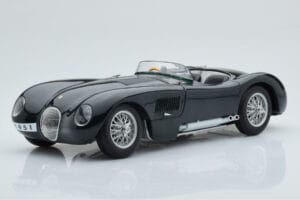
This model is currently sold out. Enter your email and we'll let you know when it's back in stock.
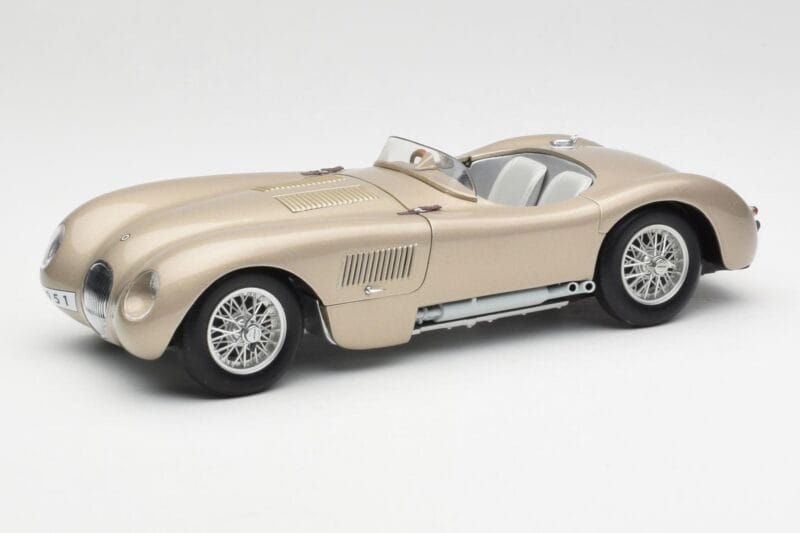
TL;DR: AUTOart's 1:18 diecast Jaguar C-Type reproduces the aluminum-bodied endurance racer in bronze, with an opening bonnet over its straight-six engine bay. This is a used example, box showing traces of storage. A foundational British sports-racer for a Le Mans-era display.
The C-Type built Jaguar's early endurance-racing reputation, its aerodynamic aluminum body wrapped around race-proven mechanicals from the road-going XK120. AUTOart's diecast treats that racing pedigree as the centerpiece rather than an afterthought.
The zinc alloy shell gives this C-Type genuine heft, appropriate for a car whose real body was hand-formed aluminum over a tubular frame, a construction diecast approximates through mass rather than material match. The bonnet opens to reveal the straight-six engine bay, and AUTOart has detailed the mechanicals with real presence rather than a flat representation. Panel lines along the curved bronze bodywork stay tight where a lesser casting would show gaps at the compound curves the C-Type's aerodynamic shape demands. The bronze finish carries depth under a display lamp, distinct from the more common British racing green liveries this subject usually wears. As a used piece, the outer box shows traces of storage while the casting is unaffected; checking the bonnet hinge and any lightweight trim after unboxing is sensible practice for a previously owned opening-panel model.
The C-Type's aerodynamic body was itself a competitive advantage in period sports-car racing, one of the earliest examples of a manufacturer treating aerodynamics as seriously as engine output. That heritage gives this model real standing among 1950s endurance subjects, alongside contemporaries from other British and Italian marques racing the same events. On a themed shelf built around early Le Mans-era sports racers or Jaguar's competition lineage specifically, the bronze finish offers a genuine variant from the expected green liveries. AUTOart's opening-bonnet diecast construction places it above simplified mass-market alternatives, and the used condition brings a well-detailed subject within reach without new-model pricing.