Last one
Used

McLaren MP4-20 Mercedes G. Paffett Interim Test Car 2006 Minichamps 1:18
Only 1 left
Price:
161.00 €
This model is currently sold out. Enter your email and we'll let you know when it's back in stock.
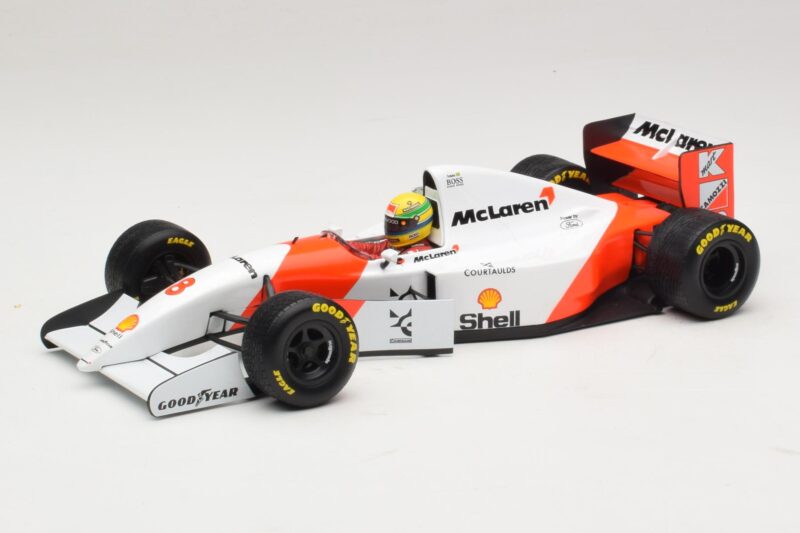
TL;DR: Minichamps' 1:18 diecast recreates Ayrton Senna's McLaren MP4/8-Ford, #8, winner of the rain-affected 1993 European Grand Prix at Donington Park. The sealed one-piece body reproduces the red-and-white livery from McLaren's transitional post-Honda season, with period-correct wing and sidepod detail, a strong anchor for a Senna or early-1990s Formula 1 collection.
Few single laps in Formula 1 history get discussed the way Senna's opening lap at Donington Park does. Starting fourth on a drying-then-flooding circuit, he passed four cars before the first corner sequence ended, a passage of driving that turned a mid-pack qualifying result into a commanding win McLaren badly needed during its difficult first season without Honda power.
McLaren spent most of the previous decade tied to Honda's engines, a partnership that delivered multiple titles. For 1993, Honda withdrew from Formula 1 entirely, and McLaren scrambled to secure Ford customer engines for what became a stopgap season built around the MP4/8 chassis. The car was a genuine step down in raw power compared to works-supported rivals, and Senna reportedly signed on a race-by-race basis rather than for the full year, uncertain whether the package could compete. That it won several races that season, some through Senna's exceptional wet-weather driving rather than outright pace, says as much about the driver as the machine. Donington was the clearest example of that gap being closed by skill alone.
Minichamps casts the MP4/8 as a sealed one-piece diecast body, standard practice for open-wheel diecast at this scale and tier. The narrow monocoque, sidepod shape, and rear wing assembly are all captured in the casting rather than as separate opening panels, since a Formula 1 car has no doors or hood to model in the first place. Zinc alloy gives the chassis real heft for its size, useful for a piece this narrow and prone to tipping if it were too light. The livery carries the red-and-white scheme and sponsor graphics from that season, printed rather than left to decals that could lift with age.
Senna started fourth in changeable conditions that shifted between wet and dry through the lap, catching several front-runners off guard on tire choice. By the end of the first lap he led the race outright, a sequence still shown as a highlight-reel example of car control in mixed conditions. He controlled the remainder of the race from the front, eventually lapping much of the field, and the win remains one of the most cited performances of his career specifically because the MP4/8 was not the fastest car on the grid that weekend. For a US collector newer to the era, this is the race that explains why Senna's reputation rests on more than raw machinery.
Formula 1 diecast splits cleanly by scale. At 1:18, a chassis this narrow gets real shelf presence, enough that the wing endplates, sidepod air intakes, and suspension geometry all read clearly without a magnifying glass. At 1:43, the same subject shrinks to a size that suits building an entire season's grid on one shelf, trading individual detail for breadth. Collectors chasing this specific race and driver combination usually gravitate toward 1:18 for exactly that reason: a car this historically significant deserves the larger format's presence rather than getting lost among two dozen smaller liveries on a single tray.
This MP4/8 works two ways on a shelf: as a McLaren piece marking the brand's difficult but eventually successful transition away from Honda, and as a Senna piece capturing one of his most technically celebrated drives. Both angles matter to different collectors, and this model satisfies either without requiring a second purchase. Diecast at this tier keeps the sealed cockpit and cast wing assembly, which is the standard approach across most 1:18 Formula 1 replicas rather than a limitation specific to this piece. Buyers should expect a display-focused build, not a mechanically detailed one, and judge it on livery accuracy and casting crispness rather than opening panels a single-seater never had to begin with.