Last one
Used
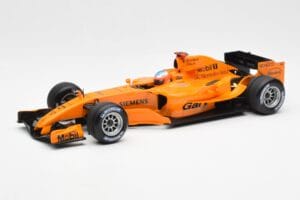
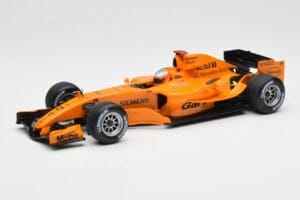
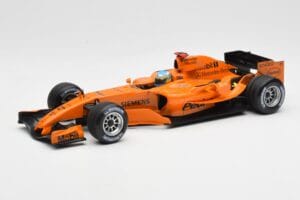
McLaren MP4-20 Mercedes G. Paffett Interim Test Car 2006 Minichamps 1:18
Only 1 left
Price:
161.00 €
This model is currently sold out. Enter your email and we'll let you know when it's back in stock.
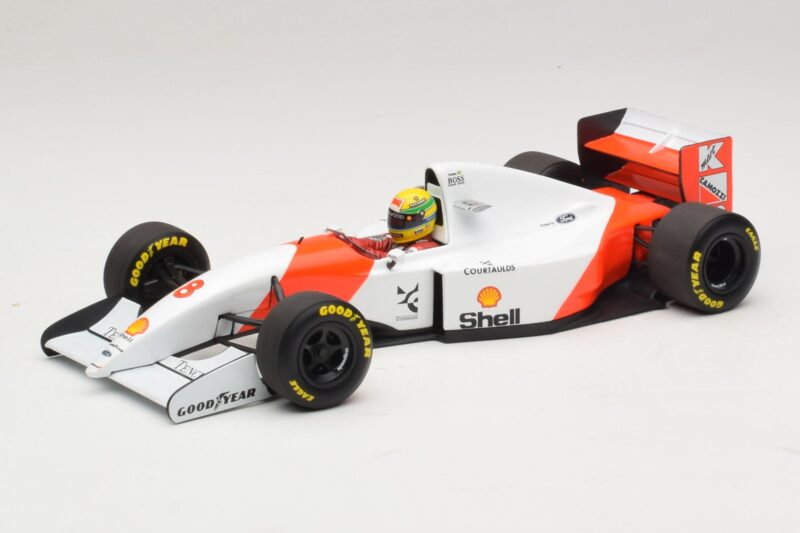
TL;DR: Minichamps' 1:18 diecast McLaren MP4/8 reproduces Ayrton Senna's #8 winning car from the 1993 Japanese Grand Prix at Suzuka, Senna's final season with McLaren before Ford power gave way to Peugeot. The sealed zinc alloy body carries the Marlboro-era livery with tampo-printed sponsor detail, a display piece for Senna collectors.
Ayrton Senna's final McLaren season produced one of his most complete performances at Suzuka, a circuit he had already made his own, winning in conditions that turned the Japanese Grand Prix into another demonstration of wet-weather mastery. This 1:18 Minichamps replica reproduces that #8 MP4/8, campaigned on Ford power in Senna's last year with the team.
McLaren entered 1993 without the Honda works engines that had powered six consecutive titles through the preceding years, running Ford's HB V8 instead as a customer team rather than a factory partner, a step down in outright power that made the season an underdog campaign by McLaren's own recent standards. Ayrton Senna, in his sixth and final year with the team, carried the #8 through a season he initially approached on a race-by-race contract before committing to see it through.
The MP4/8 nonetheless became one of the most effective chassis Adrian Newey's design group produced for McLaren, particularly in changeable conditions, and Senna's win at Suzuka showcased exactly that strength: heavy rain turned the race into a test of car balance and driver feel that favored Senna's reputation for wet-weather superiority. The win came with controversy attached, after Senna confronted Eddie Irvine post-race over what he considered dangerous driving while Irvine was being lapped. That victory was Senna's penultimate for McLaren before he left for Williams in 1994, closing out a partnership that had defined Formula 1's previous half-decade.
Minichamps casts the MP4/8 in zinc alloy, and at 1:18 the model carries the weight that signals a serious display piece rather than a toy-grade casting. The bodywork is sealed, a single molded shell without opening panels, which suits an early-1990s F1 car's simple, high-sided cockpit and narrow sidepod design. That construction lets the car's distinctive raised nose and narrow front wing, features of Newey's early-1990s aerodynamic thinking, hold their shape without a hinge line interrupting the surface.
Paint sits deep on the metal shell, and the period Marlboro-era livery, McLaren's white, red, and chrome-effect scheme of the early 1990s, holds sharp registration where the colors meet along the sidepods and nose. The #8 race number and sponsor tampo printing stay crisp under magnification, and wheel detail follows the era's narrower tire profile correctly, distinct from the wider rims of modern F1 diecast. At 1:18, the MP4/8 gives a shelf the scale and presence that smaller 1:43 grid pieces cannot match.
Senna's final McLaren season sits at a specific hinge point in Formula 1 history, the end of the Honda-powered dominance era and the last chapter before his move to Williams, a career sequence collectors often build shelf displays around chronologically. Pairing this Suzuka-winning MP4/8 with earlier McLaren-Honda releases traces that transition directly. At 1:18, it displays with the scale and detail that Senna's following expects. For anyone assembling a Senna career retrospective, this win, and its infamous post-race confrontation, marks one of the more storied entries available, a combination of triumph and controversy that makes it a conversation piece as much as a display one.