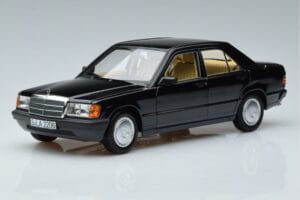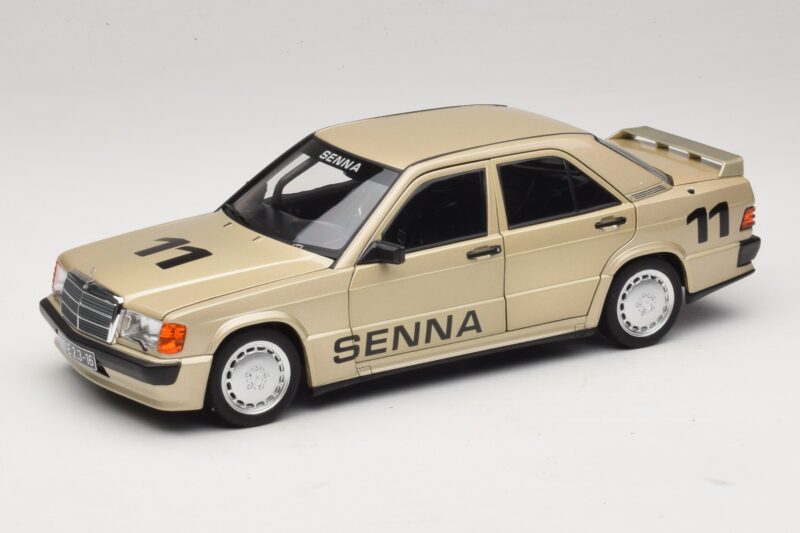
Mercedes 190E W201 2.3-16 A. Senna Race of Champions 1984 Norev 1:18

Mercedes 190E W201 2.3-16 A. Senna Race of Champions 1984 Norev 1:18
Current price: 100.00 €

VAT included

In stock
Estimated delivery: Dec 3–8, 2026
Shipping rates by country
Pay securely with
Shipping to 79 countries Worldwide delivery
Prices incl. 23% VAT No hidden costs
Shipping rates by country Tracked & insured
Pay in EUR € Local currency
Specifications
Brand
Mercedes
Manufacturer
Norev
Scale
1:18
Material
Diecast
Model Condition
New Model
SKU
183832
100% authentic Direct from manufacturers
5-layer carton Foam-filled interior
Easy returns 14 days from delivery
Secure payment 256-bit SSL encryption

About the Mercedes 190E W201 2.3-16 A. Senna Race of Champions 1984 Norev 1:18

TL;DR: The Norev Mercedes 190E 2.3-16 1:18 recreates the car in which Ayrton Senna won the 1984 Race of Champions, the Nürburgring Grand Prix circuit opening event. A zinc-alloy diecast with moving panels, it suits collectors of 1980s touring cars and Senna's early career, with production-run finish rather than hand-built resin.

On 12 May 1984 a grid of twenty identical Mercedes sedans lined up to christen the new Nürburgring Grand Prix circuit. Ayrton Senna, then a Formula 1 rookie, won. The Norev Mercedes 190E 2.3-16 Senna 1:18 puts that afternoon on a shelf and turns a compact sedan into a very specific piece of racing history.

Race of Champions 1984 at the New Nürburgring

Twenty Identical 190Es

Mercedes-Benz prepared a fleet of matching 190E 2.3-16 sedans so the field would start on equal terms, then filled it with Formula 1 drivers from several eras, world champions among them. Equal machinery meant the result came down to the driver, which is exactly why the event stuck in memory. The 2.3-16 was the right car for the job. Its Cosworth-developed 16-valve head made it the sportiest compact Mercedes of the period, and the production version already carried the aero add-ons that give the shape its purposeful look.

Senna's Win and the Shelf

Senna was in his first Formula 1 season in 1984, yet he beat a field of established stars on a circuit built for the sport's biggest occasions. Collectors tend to treat this livery as an early chapter in a career that later filled whole shelves. As a model subject it has two things going for it: a clearly documented event and a car shape that was fresh to racing at the time. The event also gives a clean reference for judging the replica, since the race cars stayed visually close to the road car.

How Norev Builds the 190E in Zinc Alloy

Metal Mass and Livery Printing

The body is cast in zinc alloy, so the model has the dense, cool weight that separates diecast from resin at first touch. That mass gives the sedan a planted look on a shelf, and metal tolerates years of careful handling. On a race replica, judge the printed graphics closely: start numbers, sponsor lettering and stripes should sit square to the body lines, with edges that stay crisp under a lamp. Registration across curved panels is the hard part, and it is where production-run diecast shows its tier most clearly.

Moving Panels on a Race-Car Replica

This casting is built with moving panels, a genuine plus on a car whose appeal is partly mechanical. Diecast hinges need clearance, so shut lines run a little wider than a sealed resin body would hold. Move the panels slowly and check that they close flush. A well-fitted example settles back into its gaps without a fight. The trade is typical of the category: some surface precision given up for the pleasure of handling a model that does more than sit still.

Reading the W201 Shape at 1:18

Designer Bruno Sacco shaped the W201 as a compact sedan with a strong, upright greenhouse and a high, flat tail, and those traits are what a 1:18 model must get right. Start in profile. The beltline should run straight and high, the glass area should look generous without being tall, and the rear deck should end in a clean, squared-off edge. On the 2.3-16 the aero parts change the silhouette: side skirts, a deeper front valance and a rear wing give the car a lower, wider visual stance than a standard 190E. Check those parts for sharp edges and correct proportion, because a wing that is too thick or too tall alters the whole character. Next, look at wheels and tires, which should fill the arches evenly with only a small, consistent gap. Compare against period event photographs rather than brochure pictures, since race preparation changes small details. Finally, note how paint and graphics read in direct light. A livery car lives or dies on the edge quality of its printing, and a single raking lamp shows that quality at once.

Placing Senna's 190E Beside Other Touring Cars

At roughly 24 to 25 centimeters, this 1:18 sedan is a compact piece that fits easily in a standard cabinet. It works as the starting point for a 1980s touring-car shelf, the era when production sedans became serious racing machines, and it sits naturally beside other Mercedes sedans and period rivals. Senna collectors can pair it with open-wheel pieces for a before-and-after story. Be clear about what you are buying: a production-run diecast with moving panels, not a hand-built resin model with ultra-fine detail. The strength is subject and handling. For American buyers who enjoy racing history without limiting themselves to stateside series, a one-off event like this gives a clear, documented reason to own a compact Mercedes.

100.00 €
100.00 €
0