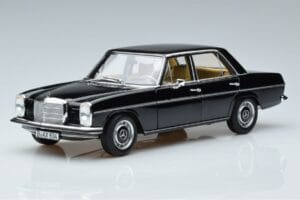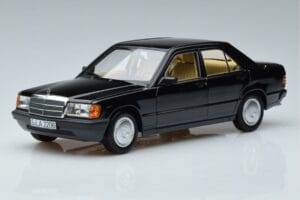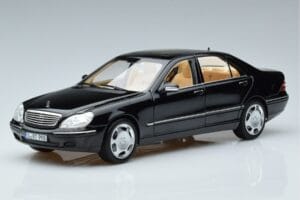
Mercedes S-Class W220 S600 Limited Edition Norev 1:18
Price:
91.00 €
This model is currently sold out. Enter your email and we'll let you know when it's back in stock.
TL;DR: Minichamps' 1:18 diecast Mercedes AMG W07 reproduces Nico Rosberg's #6 car from the 2016 Australian Grand Prix, the season opener he won en route to that year's drivers' championship. Sponsor-accurate livery, front wing detail, and zinc alloy construction capture Mercedes' dominant turbo-hybrid F1 machine. A genuine title-season anchor piece.
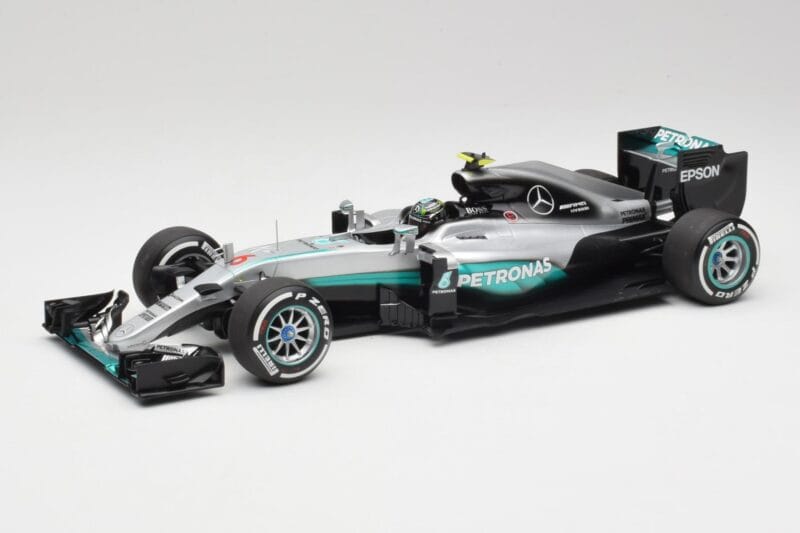
The 2016 season opener at Albert Park set the tone for what became Nico Rosberg's only Formula 1 title, and Minichamps builds this W07 around that specific race weekend's sponsor placement rather than a generic season livery.
Formula 1 liveries carry dense sponsor graphics that shift slightly race to race, and Minichamps tools this W07 to the Australian Grand Prix's specific placement rather than a composite season livery that blurs several races together. The front wing, one of the most visually complex parts of a modern F1 car, is molded with its multi-element endplates and cascade winglets rather than simplified into a single flat blade, and the printed sponsor decals sit flat against those contoured surfaces without wrinkling at the wing's compound curves. That level of wing detail matters because it's the part of the car photographed most often from the pit lane and grid, and it's where a simplified diecast usually cuts corners first.
The body and monocoque are cast in zinc alloy, giving the model a dense, substantial feel that suits a car built around genuine engineering rather than styling. The cockpit opening reveals a detailed seat and halo-free cockpit surround correct for the 2016 regulations, the season before Formula 1 mandated the halo device that visually defines the cars that followed. Wheel rims carry the correct Pirelli sidewall branding in miniature, and the sculpted bargeboards ahead of the rear wheels, a defining aerodynamic feature of this hybrid-turbo generation, are tooled with their actual layered geometry rather than smoothed into a simplified panel. Suspension components at the front axle, exposed pushrods and wishbones rather than a smoothed-over fairing, are represented as separate tooled pieces rather than molded flush against the nose, a detail that rewards a side-on view most static displays rarely receive.
Rosberg won the 2016 Australian Grand Prix from pole position, opening the season exactly the way he needed to after finishing runner-up to teammate Lewis Hamilton the year before. That win set up a campaign in which Rosberg would eventually edge Hamilton for the title, his only drivers' championship before his surprise retirement at the end of that same season. Winning the opener carries its own significance in Formula 1, since it establishes the pecking order the rest of the field spends the year trying to overturn, and Rosberg's Melbourne victory did exactly that for Mercedes' championship-winning package.
Displayed next to period rivals from Ferrari or Red Bull, this W07 shows the aerodynamic complexity that defined the early turbo-hybrid regulations, all bargeboards, wing elements, and sculpted bodywork rather than the cleaner surfaces of earlier F1 eras. At roughly 20 centimeters long, it fits the same shelf footprint as other Minichamps F1 diecast from the period, so it slots easily beside teammates' cars or title rivals from the same season. A 1:43 alternative would cost less and take up a fraction of the shelf space, but it would lose the wing and bargeboard detail that makes this era of car worth studying up close in the first place. For a collector building out the turbo-hybrid era specifically, a race-winning, title-season livery like this one carries more weight than a generic mid-pack entry from the same year.