Last one
Used
This model is currently sold out. Enter your email and we'll let you know when it's back in stock.
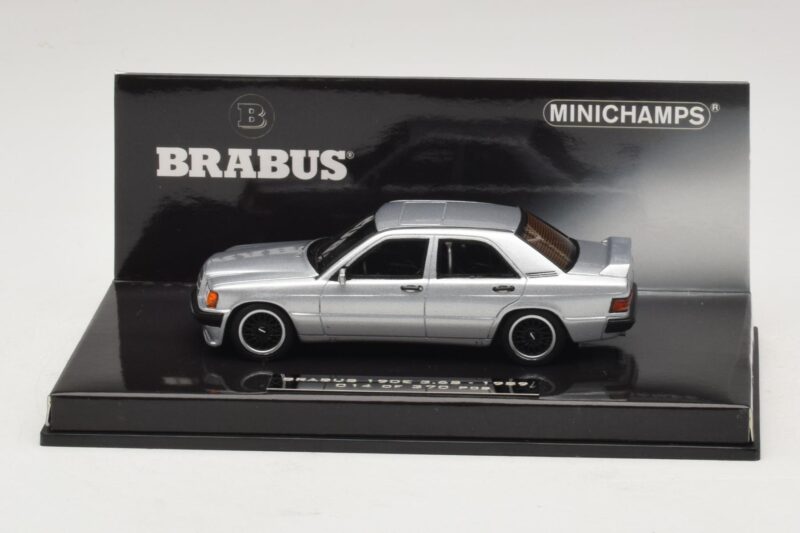
TL;DR: Minichamps' 1:43 diecast Mercedes Brabus 3.6S reproduces the tuner's late-1980s reworking of the compact W201 190E, dropping a larger six-cylinder engine into Mercedes' smallest sedan of the era. Cast in silver over a sealed one-piece body, it documents Brabus's earliest engine-swap formula in miniature.
Brabus made its name in the 1980s by treating Mercedes' model hierarchy as a suggestion rather than a rule, and the 3.6S took that furthest by fitting the 190E's compact body with the larger straight-six from the W124 E-Class. Minichamps' silver casting preserves that anomaly in a scale small enough to sit beside a full Mercedes chronology.
The W201, nicknamed the Baby Benz for being the smallest sedan in Mercedes' range through the 1980s, shipped from the factory with modest four- and six-cylinder engines suited to its compact footprint. Brabus saw an opportunity in that restraint and began fitting the W201 with the larger 3.6-liter straight-six normally reserved for the mid-size W124, a swap that gave the smallest Mercedes sedan performance its factory engine bay was never designed to produce. The resulting 3.6S became one of the defining examples of Brabus's early engine-displacement philosophy, the same logic that would later scale up to V12 conversions in bigger chassis.
This engine-swap approach, borrowing a larger unit from elsewhere in Mercedes' own range rather than building something from scratch, set the pattern Brabus followed into the W124 and beyond. Tracing that lineage from the 190E to later, larger-displacement builds gives a Brabus collection a coherent internal logic beyond simple model-year order.
Minichamps casts the 3.6S as a fixed one-piece shell, the standard approach at this scale, and the W201's boxy, upright greenhouse gives the tooling clean surfaces to hold sharp panel lines without a hinge to interrupt them. The silver finish sits with an even metallic gloss across the flat door panels and trunk lid, a color choice that echoes how many original 190E Brabus conversions actually left the workshop.
Getting the W201's proportions right matters more than it might seem, since the car's compact dimensions leave less room to disguise an inaccurate wheelbase or roofline. Brabus's lowered ride height and period-correct wheel design are both reproduced here, distinguishing this from a standard factory 190E casting wearing the same silver paint.
Of the Brabus subjects Minichamps has cast, the 3.6S represents the earliest chapter in the tuner's history, predating the V12 W124 builds and the modern AMG-based packages by several years. For a collector assembling a Brabus lineage in chronological order, this silver 190E is where the story properly starts. It also sits at a more modest scale of ambition than later, more extreme Brabus subjects, a straightforward six-cylinder swap rather than a full engine transplant, which makes it an accessible starting point for a themed shelf. Paired with later Brabus castings, it shows how far the tuner's ideas would eventually travel.