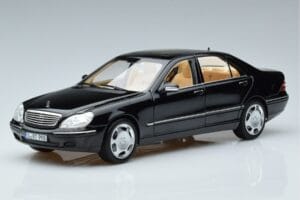
Mercedes S-Class W220 S600 Limited Edition Norev 1:18
Price:
91.00 €
This model is currently sold out. Enter your email and we'll let you know when it's back in stock.
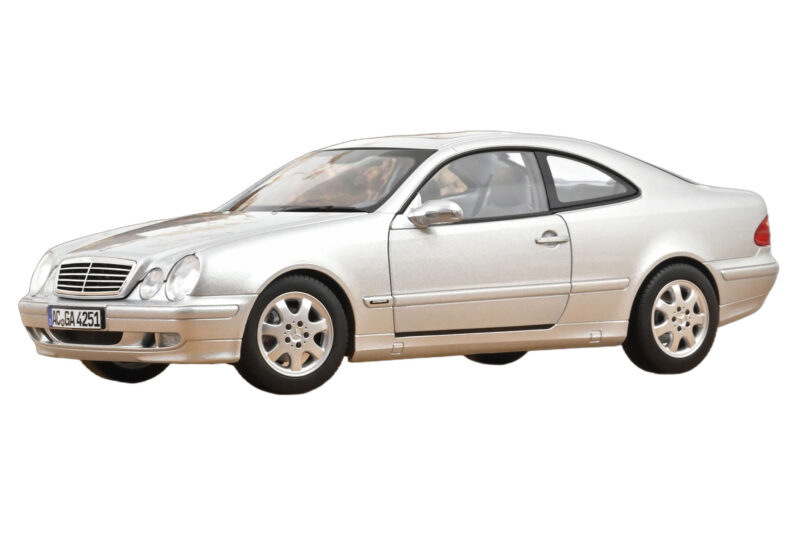
TL;DR: Norev's 1:18 Mercedes CLK C208 reproduces the 2000 coupe in Brilliant Silver diecast, with doors, hood, and trunk that open over a detailed cabin and engine bay. Built on the W210 E-Class platform, the C208 marked Mercedes' shift toward more expressive coupe styling. A mid-tier, licensed piece with genuine shelf presence.
Mercedes' compact coupe line spent the 1990s building a reputation for restrained elegance, and the C208 CLK carried that forward with a lower, sleeker roofline than the sedan it borrowed its underpinnings from. This 2000 example, finished in Brilliant Silver, represents the facelifted version that sharpened the coupe's headlamps and grille shortly before the next generation replaced it.
The first-generation CLK arrived in 1997 riding on the W210 E-Class platform, but Mercedes gave it a distinct identity: quad round headlamps borrowed from the SL roadster, a shorter wheelbase, and a roofline that traded sedan practicality for visual drama. It sold on proportion rather than raw performance, appealing to buyers who wanted E-Class comfort wrapped in something more expressive for daily use.
The facelift that ran from 1999 into 2002 sharpened those headlamps into a more angular cluster and revised the grille, a detail that helps date this casting to the car's later production years. The CLK name later carried real motorsport weight through the separate CLK-GTR and CLK-LM homologation racers, cars that shared styling cues with the street coupe without sharing its platform. That context matters, but this model reproduces the everyday grand tourer, not the race car wearing its badge.
Norev casts this CLK in zinc alloy, and the weight in hand is the first thing that separates it from a plastic toy at the same scale. Diecast at this price tier trades the razor-tight tolerances of hand-built resin for real mass and durability, and the panel gaps here sit wider than a resin equivalent but still read as clean, consistent lines rather than sloppy seams. That is the honest trade-off of series-produced metal: strength and heft over the very last word in shutline precision.
The doors, hood, and trunk all open on this casting, exposing a cabin with dashboard and seat detail and an engine bay laid out to resemble the E-Class-derived six-cylinder under the hood. That functional access is a genuine part of the product's appeal at this scale, letting a buyer pose the model open on a shelf or closed for a cleaner display silhouette depending on the space available.
Silver is arguably the hardest color to get right on a diecast Mercedes, because the metallic flake has to sit correctly under light or the whole model reads flat and generic rather than premium. Norev's Brilliant Silver on this CLK shows a cool, slightly blue-grey cast consistent with the factory shade rather than a warmer, cheaper substitute, and under a direct display lamp the flake catches unevenly across the door panels in a way that mimics how the real paint behaves outdoors. Chrome trim around the window line and grille is plated rather than painted, which holds a sharper highlight than a silver-painted equivalent would. At 1:18, the CLK's compact coupe dimensions put it at roughly 20 centimeters in length, a size that sits comfortably among other Mercedes coupes and sedans of the same era without dominating a cabinet shelf.
This CLK works best as a bridge piece in a Mercedes coupe chronology, sitting between the more conservative designs of the early 1990s and the bolder, more aggressive coupe language the brand adopted after 2002. Its accessible diecast tier makes it a sensible entry point for collectors who want a period-correct Mercedes without committing hand-built resin money, and the opening panels add a layer of display flexibility that a sealed body cannot offer. Paired with an earlier or later Mercedes coupe, it tells a clear story of how the brand's styling matured across a decade.