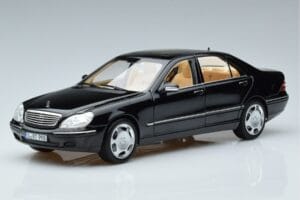
Mercedes S-Class W220 S600 Limited Edition Norev 1:18
Price:
91.00 €
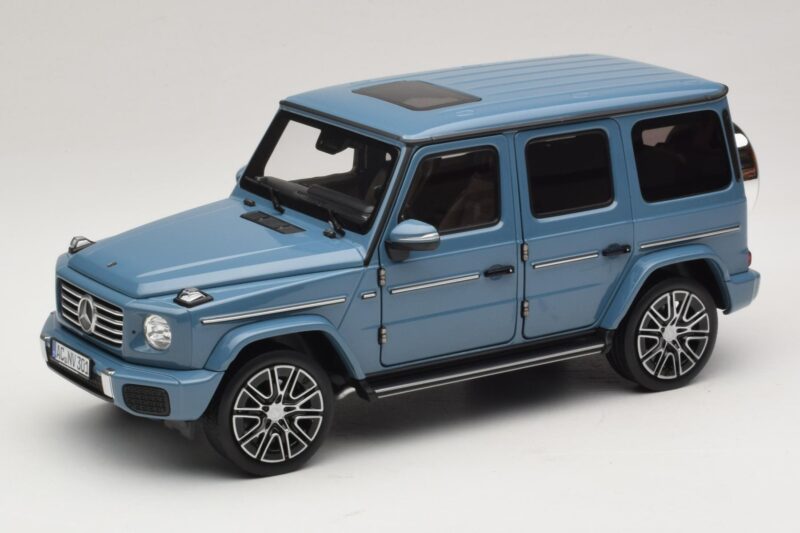
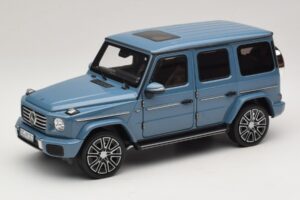
TL;DR: Norev's 1:18 diecast Mercedes G-Class W465 comes in Vintage Blue, a color choice that echoes decades of G-Wagen paint history on the newest generation of the body-on-frame off-roader. Doors and hood open, revealing the cabin and engine bay beneath a shape Mercedes has preserved since the vehicle's 1979 debut.
Vintage Blue is the kind of color name that tells you what a manufacturer is aiming for before the paint even goes on: a nod backward rather than a chase after the newest trend. Norev's 1:18 G-Class W465 wears the shade over a body whose flat panels and upright windshield have carried the same basic identity since Mercedes launched the vehicle in 1979.
The G-Class began as a joint project between Mercedes-Benz and Steyr-Daimler-Puch, engineered for military and civilian buyers who needed genuine off-road capability rather than a rugged appearance layered over a road-biased platform. Deep, slightly muted blues have appeared across the G-Class's model history from its earliest civilian years, often paired with the utilitarian trim levels that emphasized the vehicle's working-vehicle roots over luxury positioning. Naming a modern W465 color "Vintage Blue" is a deliberate signal that Mercedes wants buyers thinking about that lineage even as the underlying vehicle has grown considerably more sophisticated. Norev's casting keeps the boxy proportions the color is meant to complement, panel-for-panel recognizable against a G-Class from any of the previous four decades.
Deep, desaturated blues can read flat under poor lighting, but diecast's hard metal shell helps here: paint sits evenly across the surface and gloss carries real depth under a display lamp, letting Vintage Blue show subtle tonal shift rather than appearing uniformly dark. Against chrome trim and the G-Class's exposed door hinges, the blue sets up a contrast period G-Wagens relied on heavily in period photography. Diecast's zinc alloy construction also means the flat panels the G-Class is built from hold their shape well over years of display, resisting the warping a lighter material might show along such large, flat surfaces.
This model's doors and hood open, letting a collector examine the cabin and the engine bay beneath the boxy hood line. The G-Class's real-world appeal rests partly on visible, functional hardware rather than concealed styling, and an opening body suits that honesty better than a sealed shell would. Diecast panels carry genuine resistance when lifted, settling into position rather than swinging freely, a tactile quality that rewards handling as much as static viewing.
At 1:18, the G-Class measures roughly 24 centimeters long but stands taller and boxier than most sedans sharing the scale, so it needs a bit more vertical shelf clearance than a typical coupe. Vintage Blue pairs naturally alongside bolder G-Class colorways as a calmer anchor point, and building a run of W465 colors side by side highlights just how much personality Mercedes packs into a single body shape through paint alone. The opening doors and hood mean each piece in such a lineup rewards close inspection, not just a glance from across the room.
Yes. Both the doors and hood open on this casting, giving access to the cabin and engine bay beneath the G-Class's boxy body, a feature suited to a vehicle whose hardware is meant to be seen.
The name points to the G-Class's long color history, where deep, muted blues appeared frequently on earlier generations, connecting the newest W465 body back to the vehicle's utilitarian 1979 origins.
Large, flat panels show gloss and color evenness clearly, and diecast's rigid metal shell holds paint consistently across those surfaces, letting muted shades like Vintage Blue display subtle depth rather than appearing flat.
The model measures approximately 24 centimeters long at 1:18 but stands taller and more upright than most sedans of the same scale, so extra vertical clearance helps it display comfortably.