Last one
Used
This model is currently sold out. Enter your email and we'll let you know when it's back in stock.
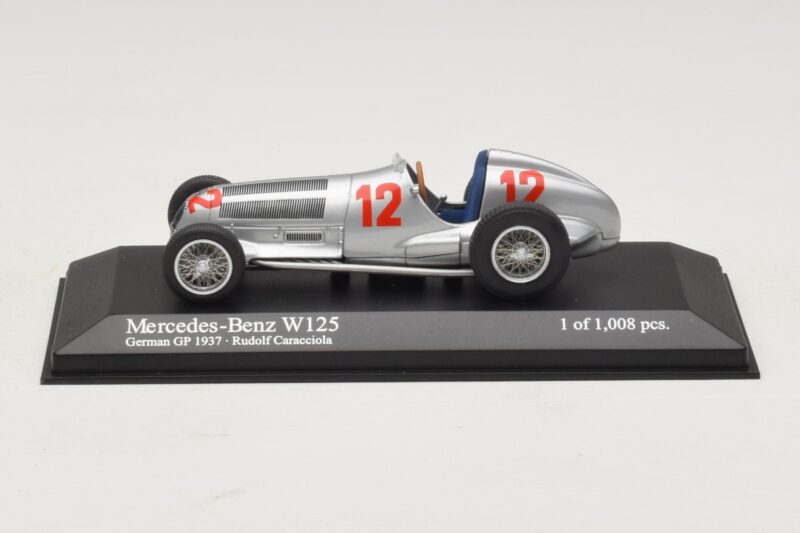
TL;DR: Minichamps' 1:43 diecast Mercedes-Benz W125 reproduces Rudolf Caracciola's 1937 Grand Prix Silver Arrow, the car that carried him to that year's European Championship. The sealed zinc alloy body holds an open cockpit and cast-in exhaust detail without livery decals, a pre-war anchor for a Grand Prix collection.
Grand Prix racing in 1937 belonged almost entirely to Mercedes-Benz and Auto Union, whose government-backed Silver Arrows dwarfed the budgets and horsepower of everyone else on the grid. Rudolf Caracciola drove the W125 to the European Championship that season, a title earned at the wheel of what remains one of the most powerful Grand Prix engines ever built.
Pre-war Grand Prix cars had no bodywork panels to open in the first place, no doors, no hood in the modern sense, just an exposed engine cowling and an open cockpit, which makes the sealed, one-piece construction here a natural fit rather than a compromise. The long exhaust pipes running along the flank, a signature look of the era's supercharged straight-eights, are cast as fine, raised detail rather than flattened into the body surface. The open cockpit shows a driver's seat and simple instrument cluster, and the narrow, cigar-shaped nose tapering to the exposed front axle captures the W125's distinctive silhouette accurately at this compact scale.
The W125 famously ran in bare, unpainted aluminum in period, a look the diecast reproduces through a silver finish rather than actual bare metal. That silver holds an even, deep sheen consistent with paint applied over a hard zinc alloy shell, and because pre-war Grand Prix cars carried no sponsor livery, there's no tampo work or decal registration to assess here at all, unlike the racing subjects from later decades. Wire wheels and the narrow period tires are cast with fine spoke detail, a small but important touch for a car whose visual identity depends heavily on its exposed mechanical elements.
The W125's supercharged 5.6-liter straight-eight produced power figures that wouldn't be matched by Grand Prix cars again for decades, a genuinely startling output for 1937 achieved through aggressive supercharging rather than displacement alone. Mercedes-Benz built the car with backing that dwarfed what independent teams could muster, part of a broader state-supported push to demonstrate German engineering superiority through motorsport during the period. That combination of resources and raw engine output made the W125 close to unbeatable when reliability held, and it remains one of the standout technical achievements of pre-war Grand Prix racing.
Rudolf Caracciola's 1937 season with the W125 delivered the European Championship, the effective equivalent of a modern world title, built on wins across the continent's biggest Grand Prix events including at the Nurburgring itself. Caracciola was already an established star by then, but the W125 season cemented his reputation as one of the defining drivers of the Silver Arrows era, a period German motorsport still references when talking about its early high points.
Pre-war Grand Prix subjects occupy a smaller, more specialized corner of the hobby than post-war Formula 1 or GT3 racing, which makes a well-executed W125 a genuine anchor piece rather than a common find. At 1:43, it pairs naturally with other Silver Arrows era subjects, building toward a display that traces Grand Prix racing back to its technical and political origins rather than starting the story in the 1950s. For collectors who already own plenty of modern GT3 and Formula 1 liveries, a W125 offers a different kind of history entirely, engine output as the headline story rather than aerodynamics or livery design. It's a subject that rewards knowing the background, and one that holds its own on a shelf regardless.