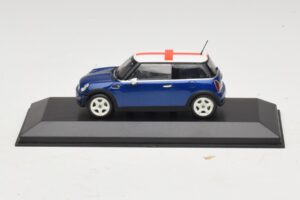
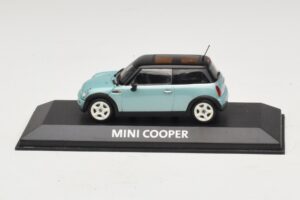
MINI Cooper R50 Black Minichamps 1:43
Price:
55.00 €
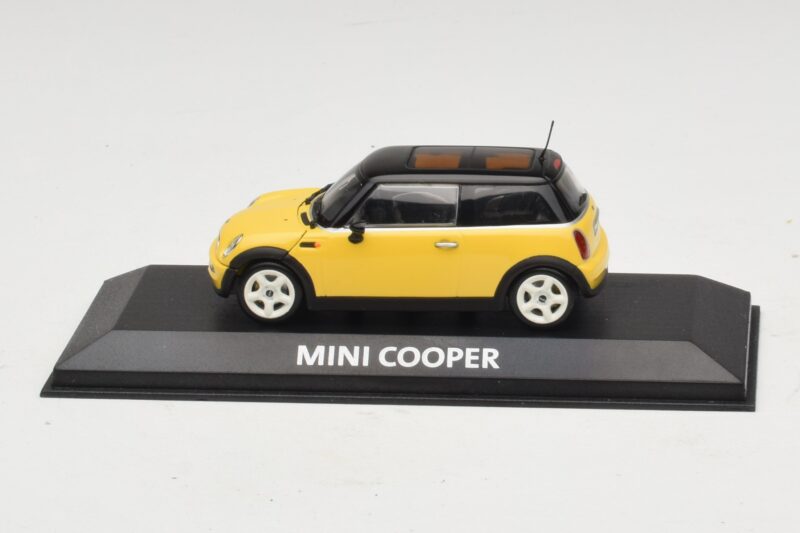
TL;DR: The Minichamps Mini Cooper S R53 in Yellow with a black roof is a 1:43 diecast replica of the 2002 supercharged hot hatch from BMW's relaunch of the marque. This model has opening parts for hands-on inspection. The contrast roof gives the shelf a two-tone focal point.
When the new Mini reached American showrooms in 2002, it looked like a joke that had turned into a serious car. Small, round, cheerful, and quick. The Minichamps Mini Cooper S R53 captures that mood at 1:43 in Yellow with a black roof, and it has parts that open.
The R53 generation was the first Mini built under BMW ownership, produced in England and styled to echo the original without copying it. The Cooper S was the sporting version, powered by a supercharged 1.6-litre engine that gave the small hatchback real pace. A bonnet scoop and sportier details set it apart from the base Cooper. That mix of retro looks and genuine performance explains why it became a favorite among hot-hatch fans on both sides of the Atlantic.
A contrast roof was part of the R53's charm, and it works especially well in Yellow. The black roof visually lowers the car and sharpens the outline of the greenhouse, while the bright body color emphasizes the round fenders. On a model, check where the two colors meet along the roof edge: the line should be clean and straight. Any bleed or wobble shows immediately, because the contrast is so strong. Look also at the stance, which should be short, wide, and planted.
This model has opening parts, so it can be shown closed for a clean outline or open for a closer look. A few habits keep it in good shape: move panels slowly, hold the body by its base rather than by an open panel, and close everything fully before storing it. When shut, the gaps should look even and consistent all around. Check this when you first unbox it, since uneven fit is easiest to spot before the model has been displayed.
Lift it and the zinc alloy is obvious: a small model with real heft. Metal holds its shape through years on a shelf, and gloss sits evenly on the hard shell, which suits a bright color like Yellow. The trade-off is that mass-produced diecast tolerances run slightly wider than cast resin, and parts built to move need a little more clearance than fixed ones, so shut lines are a touch broader. For a friendly hot hatch at 1:43, durability and function are a sensible pair.
At 1:43 a Mini is tiny, so a whole row of hot hatches fits easily in a small cabinet. Yellow with a black roof stands out against grey and silver neighbors and gives the lineup a lively center. It also makes a neat before-and-after with an older small car, showing how the Mini grew in size and presence across generations. Keep it out of direct sun, brush dust away gently, and avoid forcing panels. For anyone ready to order an easy, cheerful piece, it is a pleasant choice.