Used
This model is currently sold out. Enter your email and we'll let you know when it's back in stock.
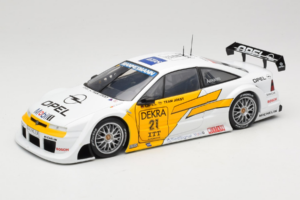
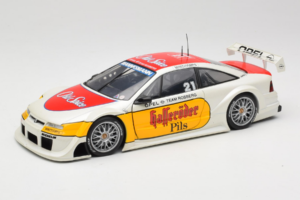
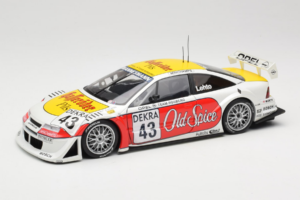
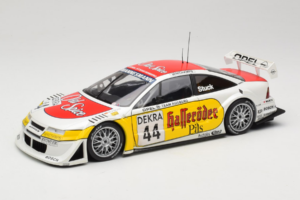
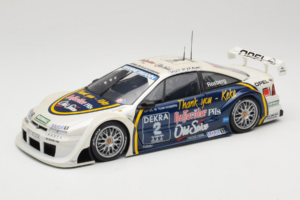
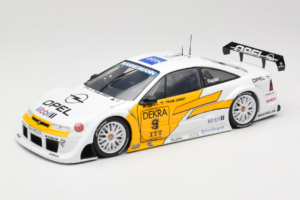
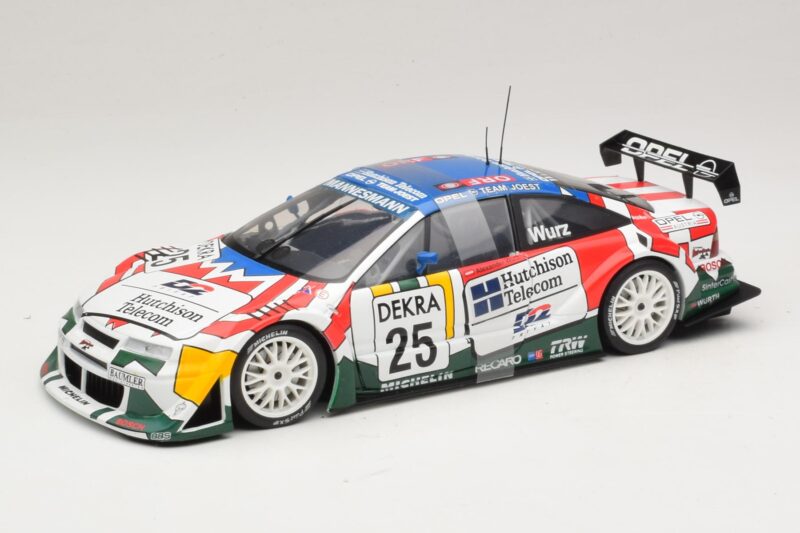
TL;DR: UT Models' 1:18 diecast reproduces the #25 Opel Calibra V6 4x4 raced by Opel Team Joest with Alexander Wurz during the 1996 International Touring Car Championship, the season Class 1 regulations pushed touring cars toward all-wheel drive and V6 power. The body opens, and the tampo-printed livery captures the Joest entry's sponsor graphics.
By 1996 the DTM had rebranded as the International Touring Car Championship, opening the series to European and Asian manufacturers under the same Class 1 rulebook: 2.5-liter V6 engines, four-wheel drive, and carbon-fiber bodywork disguised as production sedans. Opel's factory effort ran through Joest Racing, the same squad better known for Le Mans prototypes, fielding the Calibra V6 4x4 as its weapon in a grid that also carried Alfa Romeo and Mercedes.
The 1996 International Touring Car Championship marked the moment Germany's DTM stopped being a purely domestic contest and became a full international series, adding rounds in Italy, Spain, and beyond while keeping the same Class 1 technical rules that had defined the category since 1993. Those rules produced some of the most exotic-looking sedans ever to wear a manufacturer badge: 2.5-liter naturally aspirated V6 engines, mandatory four-wheel drive, and carbon-composite body panels stretched over box-shaped silhouettes that only loosely resembled the road cars they were named after. Opel entered the Calibra, a car that in showroom form was a front-drive coupe, and turned it into an all-wheel-drive touring car campaigner built to run with Alfa Romeo's 155 V6 TI and Mercedes-Benz's C-Class. The factory program was run not by Opel's own competition department but by Joest Racing, the Le Mans-winning squad Reinhold Joest built around endurance prototypes, brought in to manage the Calibra's chassis development and race operations. Opel's factory effort had already claimed the drivers' title the previous season, and the 1996 campaign carried that momentum into the newly expanded international calendar. This diecast reproduces one specific entry from that works program, the #25 car, tying a single livery to a season that decided a manufacturer championship.
UT Models built its reputation in the 1990s on faithfully reproducing European touring cars and GT machinery in zinc-alloy diecast, at a time when few manufacturers bothered with anything outside Ferrari and Porsche road cars. That heritage shows in how this Calibra is put together. The body opens, and lifting a door reveals a cockpit trimmed with the roll cage, harness, and stripped-out door card that a real Class 1 car carried once the sound insulation and rear seats came out for competition. The hinge holds its position rather than swinging loose, a small mechanical detail that matters once the model sits open on a shelf rather than closed in a box. Diecast construction brings real weight to a car this size, and that mass is part of what separates a well-built 1990s touring car reproduction from a lighter, cheaper toy-grade casting of the same subject. Panel gaps run tighter around the flared arches than a stock Calibra's factory tolerances would allow, which is accurate: the real race car's carbon-composite panels were built to tighter motorsport specifications than Opel's own production line ever needed. The wheels carry the wide racing offsets the Class 1 rules demanded, and the underbody shows the flat aerodynamic tray these all-wheel-drive touring cars ran beneath their skin.
Alexander Wurz spent the 1996 season racing for Opel Team Joest before Formula 1 called, part of a driver lineup the factory rotated through its Class 1 program during the championship's international expansion. The #25 car carried the sponsor graphics and number board that identified a specific chassis within that multi-car works effort, and reproducing that livery accurately is where a tampo-printed diecast either earns its price or falls short. UT Models prints rather than decals the sponsor logos and number roundels here, a technique that keeps the graphics flush with the body surface instead of sitting on top of it as a raised film would. Under a display light, that flush printing reads as part of the paint rather than an applied sticker, which matters on a car whose factory livery carried dense sponsor branding across nearly every panel. The Opel badge and Class 1-era wing mirrors are reproduced at a scale that holds up to close inspection, and the roof-mounted radio aerial, a small detail easy to omit, is present and correctly positioned. For a buyer assembling a specific driver's career in miniature, matching the livery to the season and the seat is the whole point of choosing this particular entry over a generic Calibra reproduction.
This Calibra pairs naturally with the Alfa Romeo 155 V6 TI and Mercedes-Benz C-Class touring cars that shared its Class 1 grid, three manufacturers chasing the same rulebook with three completely different engineering solutions to four-wheel drive and V6 power. UT Models built its catalog largely around this era, and the diecast sits at a mid-tier price point that reflects series production rather than hand-built limited runs, a fair trade for buyers who want an accurate 1990s Class 1 grid rather than a single museum piece. At 1:18, the Calibra's compact coupe proportions take up modest shelf space, leaving room to build out a full grid without needing a large cabinet. Displayed with its door open, the roll cage and stripped interior tell the Class 1 story at a glance, more effectively than any closed model could. Anyone building a 1990s touring car collection around this short-lived, spectacular category will find this Calibra a natural anchor piece.