Last one
Used
This model is currently sold out. Enter your email and we'll let you know when it's back in stock.
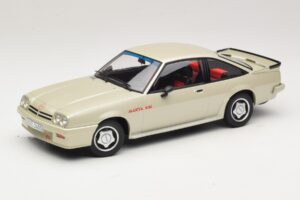
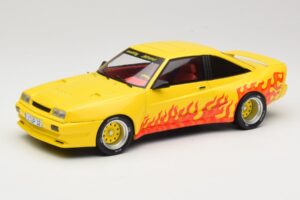
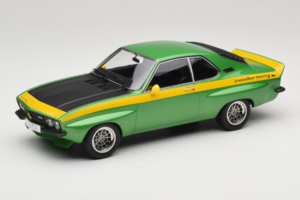
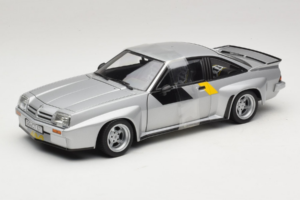
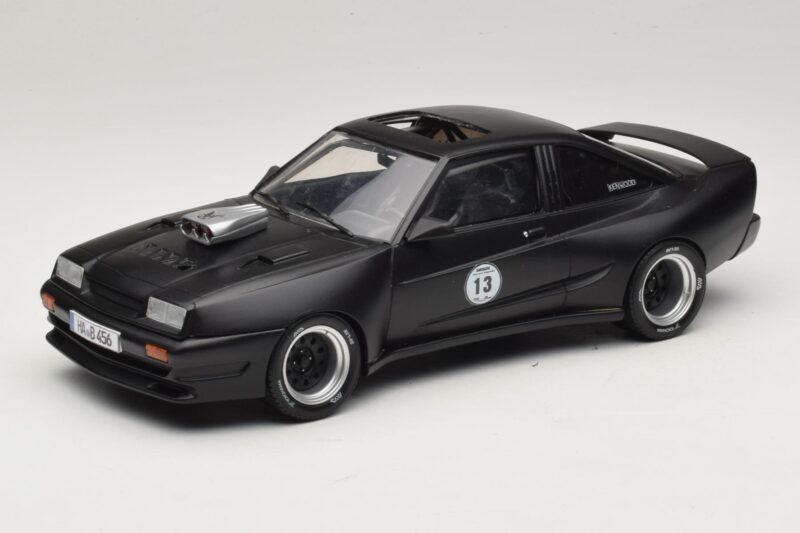
TL;DR: MCG's 1:18 diecast Opel Manta B reproduces a matte black Custom livery nicknamed Kenwood, built as a sealed one-piece body with tight, continuous shut lines rather than opening panels. Opel never sold the Manta B new through American dealers, making this German street-tuner coupe a genuine discovery for US shelves.
A matte black coupe stands out in a case usually filled with gloss reds and metallics, and that contrast is the point here. MCG's Manta B wears a "Kenwood" custom scheme, a nod to the boombox-and-bodykit look that defined 1980s German street tuning long before American import culture ever noticed the shape.
Opel built the Manta B from 1975 to 1988 as its rear-wheel-drive answer to the Ford Capri, sharing its floorpan and running gear with the Ascona B sedan. The coupe shape stayed simple: long hood, short deck, a low glass area that gave it a wedge profile years ahead of its badge. Buick sold the earlier Manta A through American dealers in the early 1970s, but that arrangement ended before the B generation arrived, so this shape never got an official US launch. Most American enthusiasts who know the Manta B at all know it from European car media rather than a dealer lot down the street.
By the early 1980s the Manta B had become a fixture of West Germany's street-tuning scene: flared arches, deep-dish wheels, spoilers, and car stereos loud enough to rattle the trunk lid. That look eventually turned into a punchline. The "Manta-Witze" joke cycle mocked the stereotype hard enough that it stuck, and the 1991 film "Manta, Manta" starring Til Schweiger made the association permanent in German pop culture, with a sequel following decades later. MCG's Custom livery leans into that history rather than away from it, and the "Kenwood" name nods to the era's audio-brand pride, when a serious stereo was as much a badge of identity as the paint job.
Lift this Manta B and the density registers immediately: zinc-alloy diecast carries real mass, the kind resin reproductions at this scale rarely match. MCG casts the body as one sealed piece, with no doors, hood, or trunk that open. That construction removes the hinge clearances a moving panel needs, so the shut lines around the roof pillars and the hatch stay tight and continuous rather than gapped. Everything a collector judges on this model happens on the outside of the shell: the roofline, the arch line, the way the glass sits against the body color.
Matte finishes are unforgiving in a way gloss is not. A glossy black coat refracts light and hides small surface texture; a matte coat flattens the light and exposes every imperfection in the casting underneath. Getting a clean, even matte across a body this size, without blotching around the arches or the roofline, takes more careful prep than a comparable gloss livery, and it is worth checking under a raking lamp before assuming quality. On this piece the black holds a consistent, chalky depth from the hood to the tail.
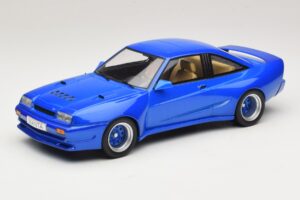
MCG builds this Manta B across a range of finishes, from OEM-style metallics to statement liveries like this matte black Custom scheme, and the spread says something about who the range is for. A metallic blue or red Manta B reads as the faithful factory shape; this one reads as the aftermarket era the car actually lived through on German streets. Neither approach is more correct than the other, they simply serve different shelves. For a collector building a themed run of period German tuners, the matte black earns its place as the outlier piece, the one that breaks up a row of gloss reds and blues with genuine visual contrast. Pricing sits in the same mid-tier diecast bracket as MCG's other Manta B liveries, so the choice comes down to which story a buyer wants told rather than which one costs more. The matte finish also photographs differently under display lighting than a gloss body would, holding detail without the reflective glare that can wash out a photo of a shinier car.
At roughly 20 centimeters long in 1:18, this Manta B sits comfortably in a standard cabinet row alongside period Capris, Kadetts, and other German coupes from the same tuning era. Its matte black surface works best under a single raking light rather than flat overhead lighting, since directional light is what reveals the flat, non-reflective depth of the finish. For US buyers, the appeal is straightforwardly one of discovery: this is a shape that never had an American showroom, and the scale model becomes the practical way to own one. It is a smaller purchase than the equivalent piece in a rally-liveried GT3, and a natural entry point into 1980s Opel history for a shelf that otherwise runs American muscle and modern GT3 cars.