Last one
Used
This model is currently sold out. Enter your email and we'll let you know when it's back in stock.
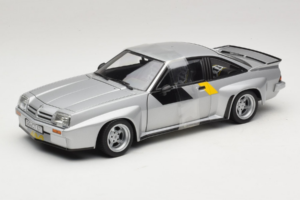
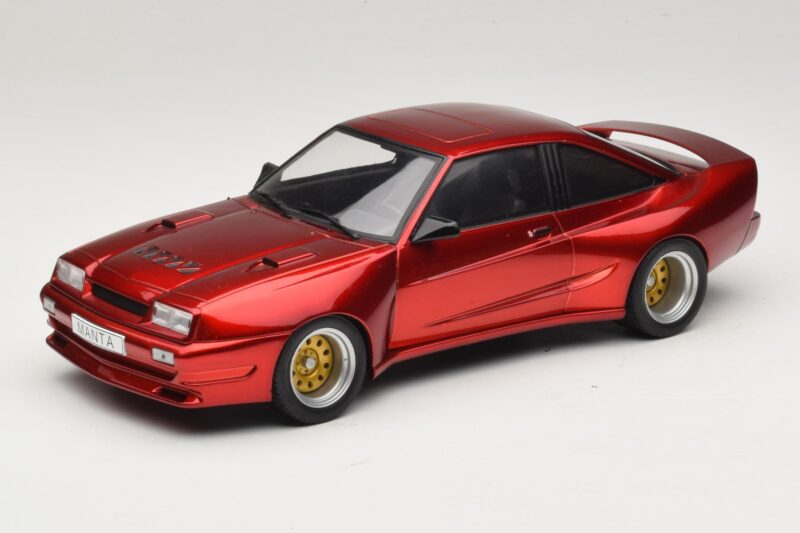
TL;DR: MCG's 1:18 diecast Opel Manta B reproduces Mattig's period widebody kit in red, built as a sealed one-piece zinc-alloy body with tight, continuous shut lines rather than opening panels. Mattig was a genuine German tuning house of the 1980s, and this casting carries its flared-arch look onto a coupe Opel never sold new in the US.
Mattig is not a fictional livery name invented for a model catalog. It was a real German tuning house through the 1980s, known for widening Opel coupes with flared arches long before "widebody" became an English-language buzzword, and this Manta B in red wears that history rather than a generic custom scheme.
Mattig built its reputation in West Germany on flared-arch bodykits for Opel's rear-wheel-drive coupes, the Manta B chief among them, at a time when few companies offered factory-quality widening kits rather than crude bolt-on flares. The appeal was straightforward: a Manta B already handled well for its class, and a wider stance with bigger wheels underneath let owners push that handling further while making a visual statement Opel's own catalog never offered. Mattig kits became common enough on the German show and track scene of the period that the name still carries weight among Opel specialists today, decades after the company's most active years in this niche.
Red is the color most associated with the period's tuner culture in general, a shade that photographed well at the shows and track days where widebody Mantas built their reputation. On this casting the color also does practical work: red is unforgiving of uneven panel fit, since a solid gloss color shows a crooked shut line more readily than a busy metallic would. The Mattig-inspired arches give the coupe a noticeably broader shoulder than the standard-bodied Manta B, and the red keeps that widened stance the visual focus.
MCG casts this Manta B as one sealed piece, zinc alloy, with no doors, hood, or trunk that open. That decision carries extra weight on a widebody subject, because the flared arches and the wider stance they create depend on a continuous, gap-free line where the flare meets the original bodywork. A hinged panel would need clearance around exactly that area, which is the hardest place on a widebody kit to hide a hinge gap cleanly. Building it sealed lets the casting hold a single unbroken line from the arch down to the sill.
The zinc body brings genuine heft, noticeably denser in the hand than a resin casting of the same size, and that mass reads as substance rather than excess once the model sits on a shelf. Paint depth on the red is even across the arch and the door skin, with no visible transition where the wider bodywork begins. Under a raking light, the arch line reads as a single continuous curve rather than two surfaces fighting each other.
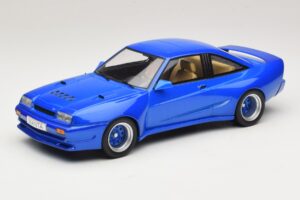
Set this Mattig-liveried Manta B beside a stock-colored example from the same range and the difference in stance is obvious even at a glance: the standard car reads as period-correct Opel, while this one reads as period-correct Opel tuning, a distinct but equally valid collecting angle. For a collector focused on the tuning side of 1980s European car culture rather than factory history, a genuine tuning-house reference like Mattig carries more weight than a generic "custom" livery with no real-world basis, because it ties the model to a documented aftermarket business rather than an invented aesthetic. Pricing for this variant sits in the same accessible diecast bracket as MCG's other Manta B colorways, so a buyer is not paying a premium for the history. Displayed next to a factory-blue Manta B from the same range, the pair makes the tuning transformation visible in a way that neither piece can show alone, a detail that rewards a collector who already knows the Manta B's history.
At roughly 20 centimeters in 1:18, the widened arches on this Manta B occupy slightly more visual width than the standard-bodied version, worth accounting for when planning cabinet spacing. The red gloss photographs cleanly under a single directional light, which shows off the arch line without the glare a flatter overhead source can create. Because Mattig's kits never reached American Opel dealers any more than the Manta B itself did, this model introduces two layers of German car culture at once. That makes it a strong centerpiece for a themed row of European tuner-era pieces, especially alongside period Capri or BMW E30 tuners that shared the same show-and-track scene.