Last one
Used
This model is currently sold out. Enter your email and we'll let you know when it's back in stock.
TL;DR: MCG's 1:18 diecast Opel Manta B arrives in classic red, built as a sealed one-piece zinc-alloy body with tight, continuous shut lines rather than opening panels. This rear-wheel-drive German coupe became a cult fixture of 1980s tuning culture, yet it never reached American Opel dealers new, making the model a genuine discovery piece.
Red is the color that comes to mind first when the Manta B enters a conversation, thanks to decades of German tuning culture and the pop-culture jokes that followed it. MCG's plain red example strips that history back to the shape itself, the simplest and most classic way to own the car.
Opel built the Manta B from 1975 to 1988, positioning it as a rear-wheel-drive rival to the Ford Capri and sharing its platform with the Ascona B sedan underneath the coupe body. It sold well across West Germany on the strength of straightforward mechanics and handling that rewarded a confident driver, at a price well below more exotic sports coupes of the same period. The car's reputation shifted over the following decade as it became the default canvas for German street tuning, a shift that eventually turned affectionate into satirical. By the time the Manta B left production, its name carried as much cultural baggage as automotive credibility.
The "Manta-Witze" joke cycle of the late 1980s and 1990s mocked a stereotype of the Manta driver hard enough that the car became shorthand for a certain kind of blue-collar tuning enthusiasm, cemented further by the 1991 film "Manta, Manta" and its later sequel. What the jokes never managed to do was kill genuine affection for the car. Decades on, the Manta B has settled into the same space as other formerly-mocked cult classics: taken seriously by specialists and increasingly sought after by a younger generation of collectors who recognize the shape from car culture media rather than a punchline.
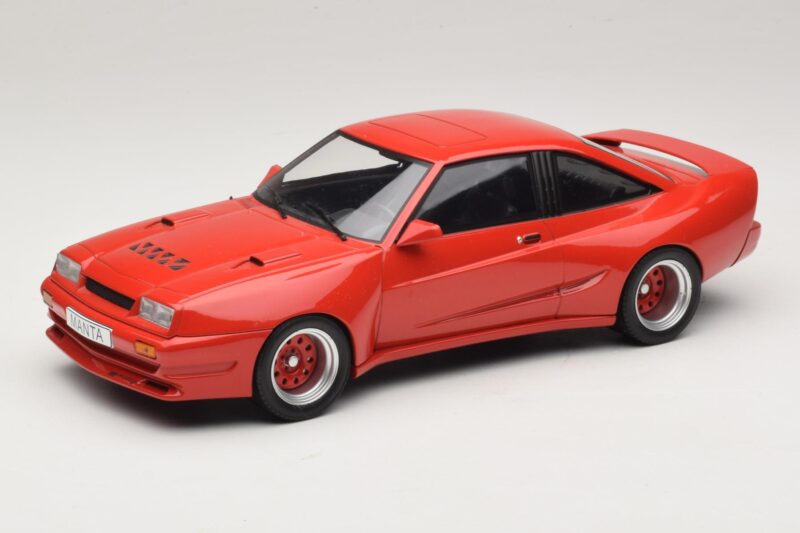
MCG casts this Manta B as one sealed piece, zinc alloy, with no doors, hood, or trunk lid that open. The weight in hand is the first clue to that construction: a diecast body at this scale carries genuine density, noticeably heavier than a resin casting of the same size, and that mass is part of what makes the model feel substantial on a shelf rather than like a toy. Because there are no hinge tolerances to design around, the shut lines stay tight and continuous around the roof pillars, the hatch, and the door openings.
On a plain red livery like this one, that precision is the whole story, since there is no custom wheel or widebody detail competing for attention. The gloss holds an even depth from the hood to the tail under a single raking light, and the panel gaps around the wheel arches read as consistent rather than uneven, which is exactly the kind of detail a collector should check first on any diecast body. That consistency is worth confirming with a fingertip along the door line, where a fixed body should read as one uninterrupted groove.
MCG's Manta B range spans this plain red alongside factory metallics and tuning-inspired custom liveries, and the plain red arguably carries the most straightforward appeal of the group: it tells the Manta B's own story without layering an aftermarket narrative on top of it. For a first Manta B in a collection, that simplicity is an advantage, since it gives a new collector the baseline shape to compare every other variant against later. Red was also a genuinely common factory and aftermarket color on real Manta Bs throughout the 1980s, so choosing it is not a compromise against historical accuracy. Pricing sits in the same accessible diecast bracket as MCG's other Manta B colorways, meaning the decision here is purely about which story a shelf is meant to tell first. That sequencing also makes any later widebody or custom addition read as a deliberate transformation rather than an arbitrary color choice.
At roughly 20 centimeters in 1:18, this Manta B fits any standard cabinet shelf without demanding special accommodation, and its plain red finish photographs consistently under most lighting setups. For American collectors, the appeal here is less about nostalgia and more about discovery: this is a shape most US car culture never encountered new, and a plain, honest example is the clearest way to understand what made it worth remembering. Paired with a Ford Capri for the direct period rival or with one of MCG's tuned Manta B liveries for the cultural aftermath, this red example works as the steady reference point the rest of a themed shelf can be built around. It is a reasonable, unglamorous way to start a European coupe collection with real substance behind it.