Last one
Used
This model is currently sold out. Enter your email and we'll let you know when it's back in stock.
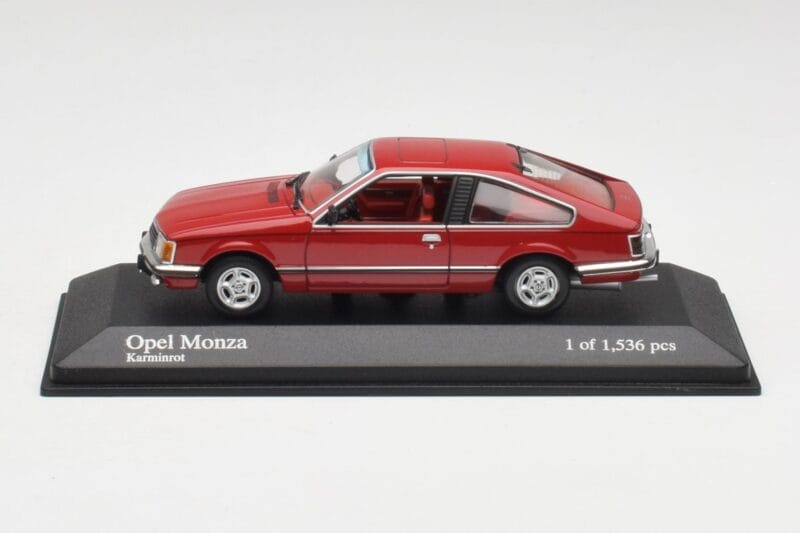
TL;DR: Minichamps's 1:43 diecast reproduces the Opel Monza A from 1980 in red. Built as Opel's upscale grand touring coupe, the Monza shared its platform with the Senator sedan and represented GM's most ambitious German coupe of the period.
The Monza was Opel's answer to premium German coupes from rival marques, offering a long-nosed, hatchback-tailed shape that leaned toward comfort-oriented grand touring rather than outright sportiness.
At 1:43, a coupe's long, low proportions read primarily through overall stance rather than fine panel texture, and Minichamps's tooling captures the Monza's sloped rear hatch and long hood proportions accurately within that scale's limits. Red shows the smooth 1980s bodywork cleanly, and the chrome window surrounds, a period-correct styling detail, need crisp definition to keep the front end from looking flat. Diecast construction at this scale typically means a sealed, non-opening body, appropriate given how little interior detail would be visible at 1:43 anyway. This is honest, accurate small-scale work on a subject rarely reproduced by other manufacturers, which raises the value of getting it right.
The Monza rarely gets the collector attention its BMW and Mercedes contemporaries receive, making this a genuinely useful find for anyone building a broader German coupe display beyond the usual suspects. At roughly 10cm in 1:43, it fits easily alongside other compact-scale European classics, and red gives it enough visual presence to hold its own next to more commonly collected marques from the same period.