Last one
Used

Peugeot 908 HDI FAP LMP1 #9 F. Montagny / R. Zonta / N. Kilen 3rd Place 24 Hours of Le Mans 2008 Minichamps 1:18
Only 1 left
Price:
81.00 €
This model is currently sold out. Enter your email and we'll let you know when it's back in stock.
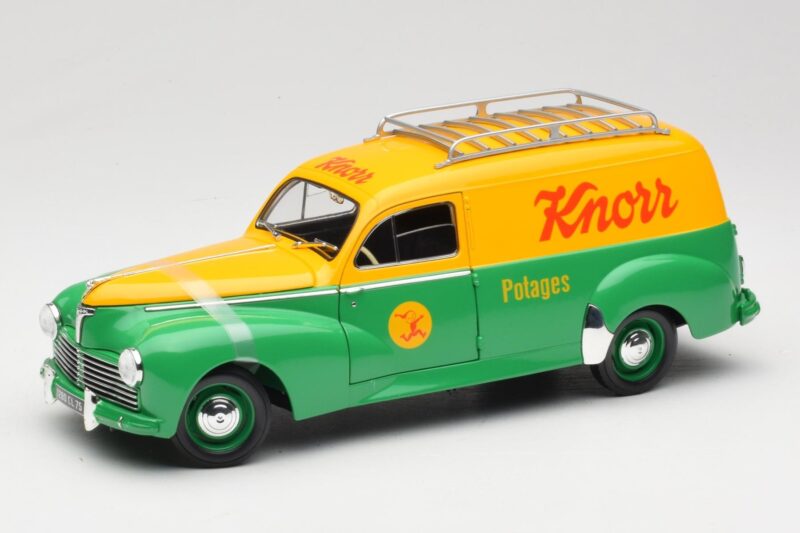
TL;DR: Solido's 1:18 diecast Peugeot 203 Break reproduces the postwar French estate wagon in a Knorr delivery livery. Zinc alloy construction and simple opening panels give an honest, affordable read on a commercial-vehicle subject that rarely gets scale-model attention outside French collecting circles.
The 203 was Peugeot's first clean-sheet postwar design, and the Break estate variant did the unglamorous work of hauling goods and passengers across a rebuilding country. The Knorr livery on this piece points straight at that working-vehicle identity.
Zinc alloy gives the model believable weight, and the 203's boxy, upright estate roofline is reproduced with enough flat surface area for the Knorr branding to read clearly along the sides. Opening rear panels are a sensible feature on a delivery-vehicle subject, since that access point is part of the car's actual working purpose rather than decoration. The paint sits at entry-tier gloss rather than deep clear coat, and the interior is simplified, consistent with a model built to represent a common working vehicle rather than a hero road car. None of that undercuts the piece. A liveried commercial wagon earns its keep through subject novelty, not paint depth, and this one delivers a genuinely unusual body style most 1:18 catalogs skip entirely.
Delivery and commercial liveries are a small, specific corner of the hobby, and the 203 Break fills it with a car most buyers have never seen reproduced at 1:18. It works best grouped with other 1950s European wagons and vans rather than next to sports coupes, where its blunt shape reads as a deliberate contrast rather than a mismatch. For a collector chasing the working side of postwar Europe rather than its glamour, this is a genuinely distinctive, low-cost pickup.