Last one
Used
This model is currently sold out. Enter your email and we'll let you know when it's back in stock.
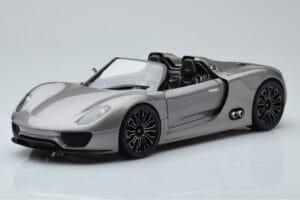
TL;DR: Minichamps' 1:43 Porsche 918 Spyder in Grey Metallic reproduces the plug-in hybrid hypercar's open-top shape as a sealed-body diecast. First shown as a concept in 2010 and built in a strictly limited run, the 918 paired race-derived hybrid power with a Nürburgring Nordschleife lap record.
Porsche introduced the 918 concept at Geneva in 2010, a plug-in hybrid hypercar built around lessons learned from the RS Spyder Le Mans program. It arrived with genuine racing DNA rather than badge-engineered speed, and its production version later set a Nürburgring lap time that redefined what a road-legal hybrid could do.
Porsche built the 918 Spyder around technology it had already proven on track: the naturally aspirated V8 shares its architecture with the RS Spyder that won its class at Le Mans, and the hybrid system drew directly on lessons from Porsche's early hybrid racing prototypes. Two electric motors, one per axle, combined with the V8 to give the 918 genuine all-wheel-drive hypercar performance while still allowing electric-only running around town, a combination few rivals attempted at this level in the early 2010s. Porsche built the car in a strictly limited production run rather than an open-ended one, which keeps demand for well-preserved examples, and their diecast replicas, consistently strong.
The production 918 went on to set a Nürburgring Nordschleife lap time of under seven minutes, a benchmark that redefined what a hybrid road car could achieve and put the 918 in direct conversation with dedicated track specials that carried none of its everyday usability. Grey Metallic was one of several launch colors Porsche offered, sitting alongside examples in Liquid Metal Chrome Blue and Rennsport-inspired Martini-style liveries that recalled the RS Spyder's racing roots. This grey example leans into understated presence rather than the louder launch liveries, letting the 918's own proportions, the low nose, the flying buttresses, the mid-mounted engine bay, carry the visual weight instead of a race-inspired paint scheme.
An open-top hypercar presents an interesting case for a sealed-body diecast: the roof is already absent by design, so the cabin and low-slung cockpit sit exposed regardless of construction method, while doors and the rear engine cover remain cast shut as a single zinc alloy shell. That approach keeps the 918's complex rear deck, with its exposed engine architecture and prominent flying buttresses, as one continuous, accurately proportioned casting rather than a collection of separate opening panels that could compromise the tight surfacing Porsche's designers worked to achieve.
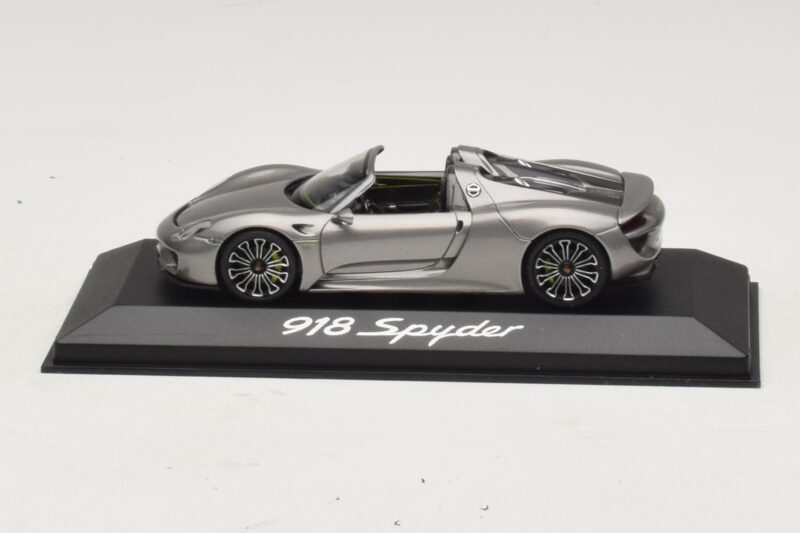
Grey Metallic paint sits well on this kind of subject, showing the depth of the flake under direct light without the visual noise a busier livery would introduce, and the sealed casting keeps that finish continuous across the body sides where the 918's dramatic side intakes and buttress lines meet. The zinc alloy build gives the model genuine weight for its compact hypercar footprint, and the exposed cockpit reveals molded seat detail, a mapped dashboard, and the car's distinctive steering wheel-mounted controls, since nothing here is hidden behind closed doors regardless of construction. Badge printing on the rear deck stays crisp under magnification, a small but reliable sign of tampo quality at this tier. At 1:43, the 918 occupies a compact footprint of roughly 10cm, a size that lets a hypercar-focused shelf group several generations, Carrera GT, 918, current-era hybrids, side by side without the space commitment a 1:18 collection would require.
A 918 Spyder anchors a hypercar shelf the way few other Porsches can, bridging the brand's endurance-racing heritage with its most technologically advanced road car to date. Minichamps prices this release within reach of most 1:43 collectors, a practical alternative to chasing an actual 918 or a premium resin tribute from specialist producers. Paired with the earlier Carrera GT or later hybrid hypercars from rival manufacturers, it tells a coherent story about how performance engineering shifted toward electrification. The sealed body suits a subject whose engine bay and cabin are already exposed by design, keeping the focus on stance and proportion rather than opened panels that a true open-top car never needed in the first place. That honesty about construction matters more here than on a closed coupe.