Used

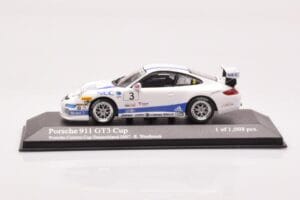
Porsche 911 997 GT3 Cup #124 Mattheus / Geoffroy / Vanbellingen / Fumal 24 Hours of Spa 2005 Minichamps 1:43
Only 3 left
Price:
33.00 €
This model is currently sold out. Enter your email and we'll let you know when it's back in stock.
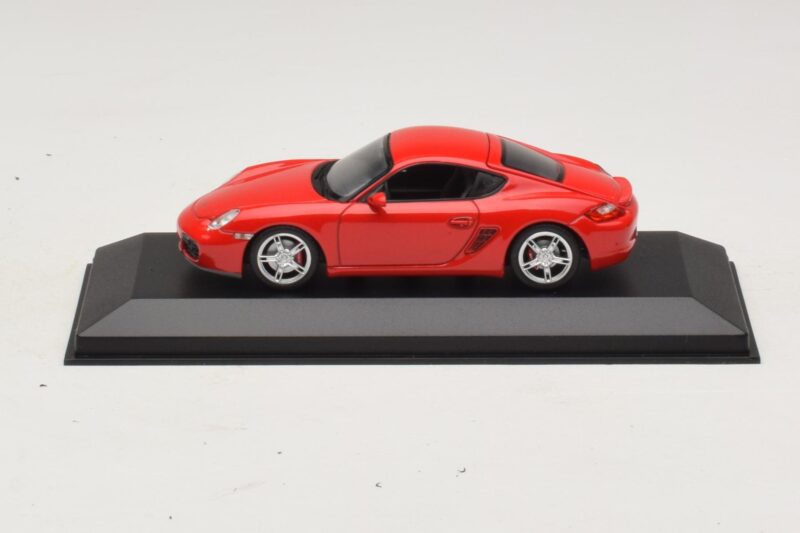
TL;DR: Minichamps' 1:43 diecast Porsche Cayman 987 S in red reproduces Porsche's 2005 mid-engine coupe, the fixed-roof companion to the Boxster. The body is a sealed one-piece diecast casting with correct 987 proportions, priced at the entry tier for a genuinely underrated sports car.
The Cayman never got the fanfare Porsche gave the 911, and that undersells it. Introduced in 2005, the 987-generation Cayman S took the Boxster's mid-engine platform and wrapped it in a fixed hardtop, producing a stiffer chassis that some drivers preferred to the open car. Minichamps renders that shape at 1:43.
At this scale, Minichamps works in zinc alloy diecast, and the Cayman comes as a sealed one-piece body with no opening doors, hood, or hatch. That is standard practice at 1:43, where casting tolerances shrink along with everything else, and a fixed shell lets the tooling hold sharper roof and greenhouse lines than a hinged equivalent could manage at this size. Lifted from its case, the model still carries real heft for its footprint, the density that separates zinc alloy from resin or injection-molded plastic regardless of scale. The red paint sits on that hard metal shell, so it reads with genuine depth under a shelf light rather than the flatter finish smaller-scale plastic kits tend toward. Wheel design, the distinctive Cayman side air intake ahead of the rear arch, and the coupe's tapered rear deck all come through despite the compact footprint, one measured in centimeters rather than the tens of centimeters a 1:18 Cayman demands. What the scale gives up in cast-in detail around the cabin, it recovers in shelf economy: a 1:43 Porsche range covering a full decade of models takes a fraction of the space a 1:18 equivalent would need, and it keeps the per-unit price low enough that filling out a marque collection stays realistic rather than aspirational.
Porsche built the Cayman as a hardtop derivative of the Boxster roadster, sharing the mid-engine platform but gaining torsional rigidity the open car could not match. The 987-generation S arrived with a 3.4-liter flat six, positioned as an entry sports car beneath the 911 in Porsche's own hierarchy, yet respected among drivers for a chassis balance the heavier, rear-engine 911 does not replicate. That positioning matters for a collector building a model range: the Cayman is not a watered-down 911, it is a distinct engineering answer to the same question of where the engine should sit. Porsche introduced the Cayman name in 2005 specifically to fill a gap between the Boxster and the 911, giving buyers a fixed-roof mid-engine option without asking them to step up to the flagship car's price or its rear-engine handling quirks. The 987 generation, produced through the second half of the 2000s, established the nameplate's identity before Porsche expanded it further with faster S and R variants in later generations. A red example, Porsche's most recognizable sports-car color, photographs and displays with more presence than the car's modest reputation might suggest, filling a genuine gap for anyone assembling the full spread of Porsche's 2000s lineup rather than only its headline models.
At 1:43, a run of Porsche models sits comfortably on a single shelf tier, and the Cayman's compact proportions make it an easy neighbor for a Boxster or an early 911 without dominating the row. It works best as part of a marque-wide display rather than as a standalone centerpiece, the entry point for a collector who wants Porsche's range covered honestly rather than reduced to its most famous names. The price reflects that role: accessible, unpretentious, and a fair value for what the casting actually delivers. Displayed next to a Boxster or an early water-cooled 911 at the same scale, it also makes a useful point of comparison for how Porsche varied one platform across a decade, a small but genuine piece of the brand's story rather than an afterthought.