Last one
Used

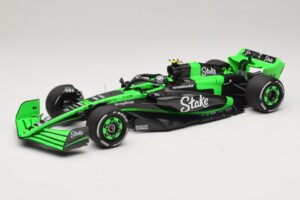
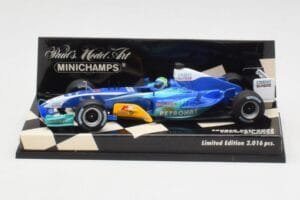
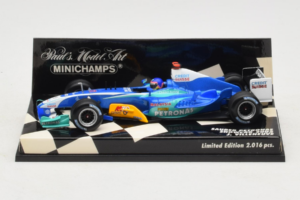
Stake F1 Team Kick Sauber C44 #77 V. Bottas Emilia Romagna GP 2024 Minichamps 1:18
Only 1 left
Price:
189.00 €
This model is currently sold out. Enter your email and we'll let you know when it's back in stock.
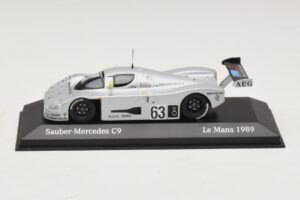
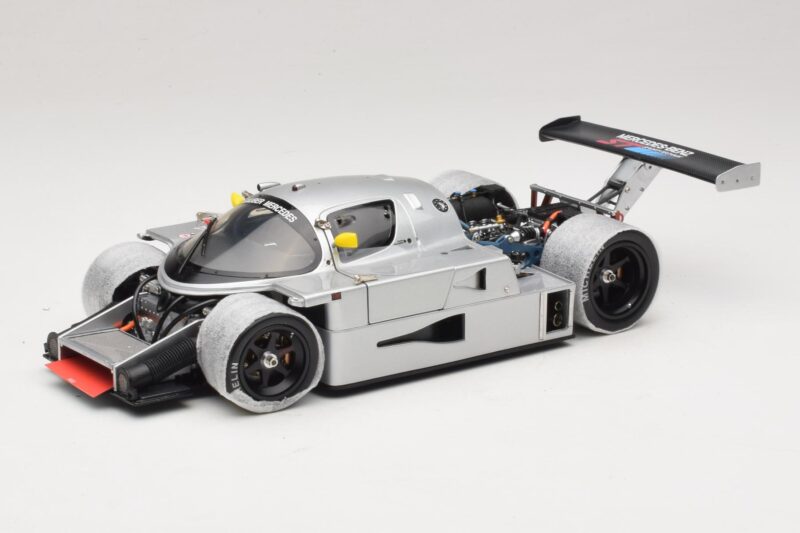
TL;DR: Exoto's 1:18 diecast Sauber C9 reproduces the Ice Silver Group C prototype that revived Mercedes' Silver Arrows livery and won the 1989 24 Hours of Le Mans outright. This casting features genuine opening panels, and Exoto's premium diecast tier matches a car remembered as one of the fastest prototypes ever to run the Mulsanne Straight.
Mercedes-Benz had stayed away from top-level motorsport for decades when the Silver Arrows livery reappeared on the Sauber C9, and the sight of that color returning to Le Mans in 1989 carried real historical weight. The C9 didn't just look the part; it won outright, and period reports of the car's Mulsanne Straight speeds still circulate as some of the fastest ever recorded on that stretch of road.
The Silver Arrows name belongs to Mercedes-Benz's pre-war and 1950s grand prix cars, uncovered in bare aluminum rather than painted, a livery that became shorthand for German motorsport dominance decades before the Sauber C9 ever existed. When Mercedes returned to top-level sports car racing through its partnership with the Swiss Sauber team, reviving that silver look on the C9 was a deliberate connection to that history rather than a coincidental color choice. The car's success made the callback feel earned rather than nostalgic marketing, and the Silver Arrows name has stuck to Mercedes' motorsport programs in the decades since, right through to its later Formula One efforts.
The Sauber-Mercedes C9 won the 1989 24 Hours of Le Mans outright, a result built on a car that combined a 5.0-liter twin-turbocharged V8 sourced from Mercedes with a chassis Sauber had spent years refining in Group C competition. That victory also delivered the 1989 World Sportscar Championship, cementing the C9 as one of the definitive prototypes of Group C's final, most technically advanced seasons before the category was phased out in the early 1990s. Reports from the period describe the C9 and its sister cars reaching speeds approaching 400 kilometers per hour on the Mulsanne Straight, a figure still cited today as one of the fastest ever recorded in endurance racing, whether treated as verified fact or enduring period legend.
Exoto casts this C9 in diecast with genuine opening panels, a feature that matters on a Group C prototype whose enclosed bodywork hid a mid-mounted V8 and turbocharger plumbing most casual observers of the real car never got to see. Lifting those panels on the model reveals a level of engine detail that a sealed body simply cannot offer, and it is one of the clearer reasons a manufacturer known for exhaustive research chooses to engineer a model this way. The Ice Silver finish demands the same discipline the Silver Arrows livery always has: an even, bright metallic surface without the warm cast that a poorly matched silver introduces, since the real car's paint was meant to evoke bare polished metal rather than a conventional automotive color. Exoto has built its reputation at the premium end of the diecast market, known for painstaking research on racing subjects and a slower, more deliberate production pace than mass-market manufacturers. That combination of opening bodywork and a historically important livery is exactly the kind of subject where Exoto's reputation for depth over speed pays off most visibly.
At 1:18, a Group C prototype the C9's size comes out to a model in the 26 to 27 centimeter range, among the longer subjects a collector will place on a motorsport shelf, reflecting the real cars' emphasis on aerodynamic length over compact packaging. Group C's long-tail prototypes demand a different kind of cabinet planning than a road car collection, since the low, wide, and stretched proportions eat more shelf width than their footprint alone suggests. For a collector building a Group C display, the C9 belongs beside the Porsche 962 and Jaguar XJR-9, the category's other dominant late-era prototypes, and setting them side by side shows just how converged prototype aerodynamics had become by the category's final seasons. The opening bodywork here rewards a display approach that shows off the engine detail at least part of the time, since a Group C car's exposed V8 and turbo plumbing is a genuine visual highlight most road car engine bays cannot match. Ice Silver against a lineup of red Jaguars and Rothmans-liveried Porsches gives this piece real standout value.
The Sauber C9 earned its place in Group C history through a genuine outright Le Mans victory, not just a distinctive livery, and Exoto's diecast treats that achievement with the depth it deserves: opening bodywork, careful silver matching, and the premium construction the manufacturer is known for across its racing catalog. For a collector assembling a Group C shelf, or simply drawn to the Silver Arrows story returning to endurance racing after decades away, this C9 anchors that display with real competitive history behind it rather than styling alone. Displaying it with the hood raised even occasionally lets that history speak for itself, engine and all, rather than staying hidden behind a closed shell.