Used

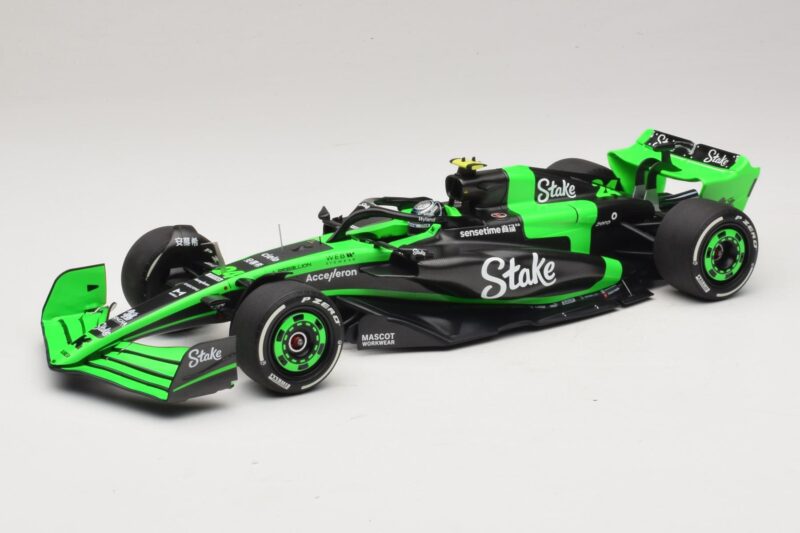
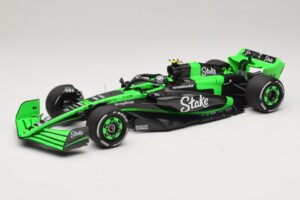
TL;DR: Minichamps' 1:18 resin Sauber C44 reproduces Zhou Guanyu's Stake F1 Team Kick Sauber livery from the 2024 Emilia Romagna Grand Prix at Imola. The sealed one-piece resin body holds the team's dark livery sharp across a complex surface, a mid-tier resin piece for Sauber followers and collectors of Zhou's tenure as F1's first Chinese driver.
Sauber entered 2024 racing under a title-sponsor name built from two very different backers, Stake and Kick, ahead of its full transition to Audi ownership. Zhou Guanyu, still the only Chinese driver to start a Formula 1 race, carried that livery to Imola for the Emilia Romagna Grand Prix. Minichamps preserved the pairing in 1:18 resin.
Zhou Guanyu made history simply by reaching the grid in 2022, becoming the first Chinese driver to start a Formula 1 race, and by 2024 he had three full seasons of experience navigating a midfield team in flux. Sauber's ownership was already committed to becoming Audi's works team from 2026, which made 2024 and 2025 transitional years, run under sponsor-driven names like Stake F1 Team Kick Sauber rather than a settled long-term identity. Zhou's C44 that season carried both the weight of representing a massive untapped fan base and the uncertainty of a team mid-transformation.
The Autodromo Enzo e Dino Ferrari at Imola is one of the oldest circuits still on the modern calendar, first hosting F1 in 1980 and returning to the schedule in 2020 after a long absence. Its tight, undulating layout rewards precise car placement more than raw power, a different challenge from the street circuits that dominate much of the current calendar. For a midfield team like Sauber, a technical, low-drag-friendly track like Imola offered a genuine chance to punch above its usual grid position.
The Stake Kick Sauber livery packs multiple sponsor identities onto a dark base color across a body with almost no flat surfaces, and Minichamps casts the C44 as a sealed, one-piece resin shell to keep that surfacing consistent from nose to rear wing. There is no engine cover or cockpit hatch to open on a subject like this, and resin's tighter casting tolerances hold the thin bargeboards and floor edges sharper than a stamped diecast process typically manages on parts this delicate.
Sponsor-dense liveries like this one are genuinely harder to reproduce accurately than a simple two-tone scheme, since logos have to continue believably across sidepod undercuts and floor edges without drifting out of register. Minichamps applies its decals with attention to that alignment, and under a raking display light the dark body holds real paint depth rather than the flat sheen that budget replicas often show on cars with this much graphic density.
A 1:18 Formula 1 car runs close to 30 centimeters nose to rear wing, considerably longer and lower than most road-car models at the same scale, and its open cockpit favors overhead lighting over a side spotlight that would leave the underfloor detail in shadow. Dark liveries like this one photograph well under a single focused light source, since the contrast between the deep body color and any lighter graphic elements shows up more clearly than it would under flat ambient lighting. For collectors, Zhou's Sauber years occupy a specific niche: followers of the driver himself, who track his progress as F1's first Chinese representative, and Sauber completists building out the team's identity through its final independent seasons before the Audi takeover reshapes everything about the operation.
Sauber's transitional years rarely produce podium results, which keeps demand for its liveries modest compared to a front-running team, but that same scarcity of alternatives makes a specific race-weekend piece like this one easier to place with confidence in a themed collection. Zhou's presence on the grid matters to a growing base of Chinese motorsport fans, giving this piece relevance well beyond typical Sauber followers. At a mid-tier resin price, it sits above mass-market diecast in surface finish while remaining well short of factory-commissioned limited runs. Paired with an earlier Alfa Romeo-branded Sauber car from Zhou's rookie season, it traces the team's identity changes through the cars that actually carried them.