Last one
Used
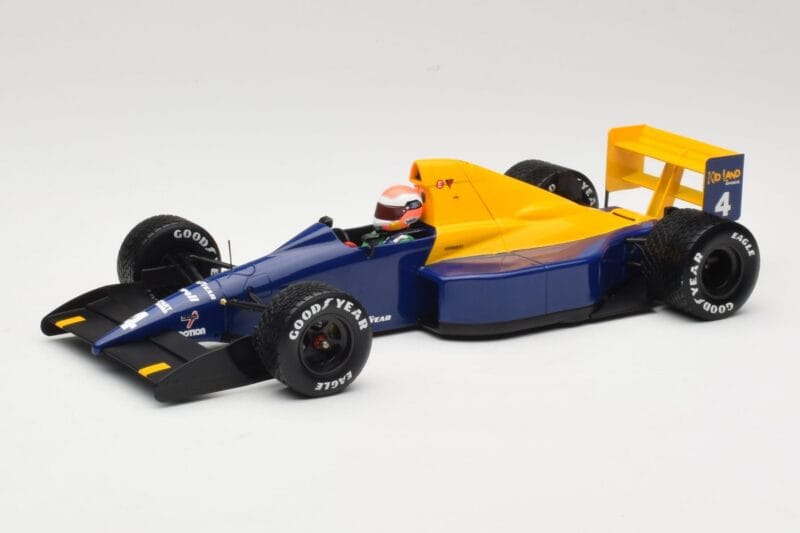
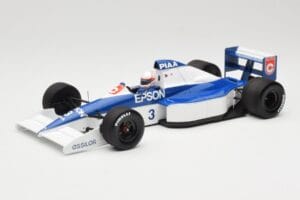
TL;DR: Minichamps' 1:18 diecast Tyrrell Ford 018 reproduces Johnny Herbert's #4 car from the 1989 Formula 1 season, built around the open cockpit, exposed suspension, and Cosworth-Ford V8 power that defined the era. It marks a rookie season Herbert drove weeks after a near career-ending Formula 3000 crash.
Some Formula 1 cars matter less for what they won than for who was driving them. The Tyrrell 018 belongs in that category, carrying Johnny Herbert through a rookie season nobody expected him to start, let alone finish.
Formula 1 cars from the late 1980s expose almost everything, the pushrod suspension, the sidepod radiators, the bargeboards, in a way a road car body never does, so a diecast replica lives or dies on how convincingly it renders those open components. Minichamps casts the 018's front and rear wing assemblies as separate, finely proportioned pieces rather than blunt moldings, and the exposed suspension arms sit at the correct rake instead of flattened against the tub. The narrow Cosworth-Ford DFR V8 sits visible at the rear, detailed enough to read as a period racing engine rather than a generic block filling space.
The team livery wraps the narrow monocoque and sidepods in tight registration, with the number 4 and sponsor graphics placed correctly rather than stretched to fit a simplified body. On a car this small, the tub barely runs 12 centimeters long, print quality matters more than it does on a road car, because there is so little surface area to carry the detail. Minichamps holds sharp decal edges here, which keeps the livery legible rather than smudged into a vague color block.
Johnny Herbert arrived in Formula 1 in 1989 only months after a severe Formula 3000 crash at Brands Hatch that badly damaged both his legs, injuries serious enough that his return to racing at all was genuinely in doubt. Tyrrell signed him regardless, and Herbert took the 018's cockpit that season while still recovering, racing through pain that would have ended most careers before they started.
He scored points in his very first Grand Prix that year, a result that became one of the period's enduring underdog stories and turned the rest of his rookie campaign, including this Belgian Grand Prix entry, into a continuing test of resolve rather than just a search for results. The 018 itself, designed under Harvey Postlethwaite and powered by the Cosworth-Ford DFR V8, was a competitive midfield car for 1989, giving Herbert a machine capable enough to reward the effort he was putting into every lap.
At 1:18, open-wheel models take up far less shelf depth than a road car of the same scale, since there is no roof or cabin volume to display, which lets a collector line up several Grand Prix cars in the footprint a single SUV would need. This Tyrrell suits a grid built around late-1980s Formula 1 rather than a single-marque collection, sitting naturally alongside contemporaries from that same era. It is a mid-tier diecast, not a museum-grade commission, and its value lies less in rarity than in the story Herbert's presence in the cockpit tells every time it catches a visitor's eye on the shelf.