Used

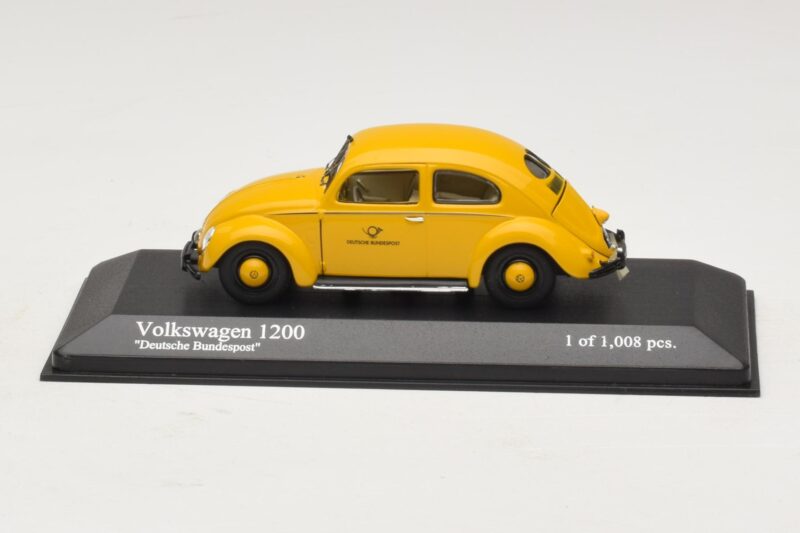
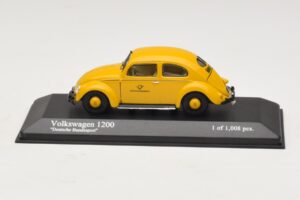
TL;DR: Minichamps' 1:43 diecast reproduces the Volkswagen 1200 Export in Deutsche Bundespost livery, documenting the early-1950s Beetle as it served West Germany's postal service during the country's postwar recovery. The sealed body carries the postal livery in printed detail, a niche service-vehicle subject built on the Beetle's earliest export-grade specification.
Postal liveries occupy a specific corner of diecast collecting, valued less for glamour than for the honest documentation of everyday service vehicles doing unglamorous, essential work. This Beetle's 1951 Export specification and Deutsche Bundespost markings capture West Germany's postwar reconstruction in miniature, and Minichamps' 1:43 casting treats a genuinely humble subject with the same care usually reserved for sports cars.
The 1200 Export designation marked a step up from VW's most basic postwar Beetle specification, adding chrome trim and better-finished interior appointments aimed at buyers, including institutional fleets, who wanted a more presentable vehicle than the stripped-down standard model. Minichamps casts this replica as a single sealed shell, appropriate at 1:43 where separately hinged doors would add fragility without meaningfully improving the display experience at this smaller size. The Deutsche Bundespost's distinctive yellow livery, West Germany's postal service color scheme, is applied in printed rather than decal form, and the boundary between the yellow body and any black or chrome trim holds clean registration despite the compact scale. Postal service badging and any period-correct markings sit legibly on the doors and rear panels, small details that matter enormously to specialists who collect service and emergency vehicle liveries specifically. The rounded rear window styling correct to this early production period, along with the period-correct bumper and headlight design, ties the casting to a specific, narrow production window rather than a generic later Beetle shape. Wheel design follows the correct steel wheel pattern for the era, and the chrome trim around the windows carries a bright, distinct finish from the body paint. For a subject defined almost entirely by livery accuracy rather than mechanical drama, a clean sealed body focuses attention exactly where a service-vehicle specialist wants it directed: the paint and the badging.
By 1951, the Volkswagen Beetle had become a genuine symbol of West Germany's economic recovery, a low-cost, durable, easily serviced car built in growing numbers at the Wolfsburg plant as the country rebuilt its economy after the war's end. Institutional buyers, including government agencies and service organizations like the Deutsche Bundespost, adopted the Beetle in large numbers precisely because of its low running costs and mechanical simplicity, qualities that mattered enormously in a country still rebuilding its infrastructure. The Bundespost's postal vehicle fleet used liveried Beetles for decades across various body configurations, and a passenger-sedan example like this one represents the postal service's use of standard passenger cars for lighter delivery and administrative duties rather than the larger vans used for bulk mail. This livery genre, service and institutional vehicles rather than private cars, occupies a specific niche within Beetle collecting, appealing to enthusiasts interested in documenting how ordinary vehicles served extraordinary social functions during a pivotal historical period. The early 1950s Export specification also marks a transitional moment for VW itself, as the company began shifting from pure postwar recovery production toward the export-focused growth that would define its next several decades. A postal Beetle from this specific window captures both stories at once: a nation's rebuilding and a manufacturer's earliest steps toward becoming a global export success.
This Bundespost Beetle suits a collection built around service and institutional vehicles specifically, a genre distinct from private passenger-car Beetles and often overlooked by collectors focused purely on performance or design history. At 1:43, several liveried service vehicles fit comfortably on one shelf, making this a practical scale for anyone building breadth across postal, police, or emergency-service subjects from different countries and eras. Compared to a standard civilian-colored Beetle casting, a correctly liveried service vehicle commands a genuine specialist interest and can be harder to source once out of production. This 1951 Export specification, an early and specific production window, adds further precision for collectors who track Beetle history by exact production year rather than by generation alone.