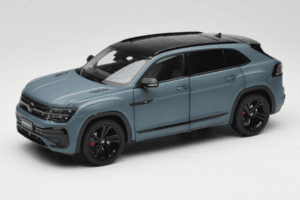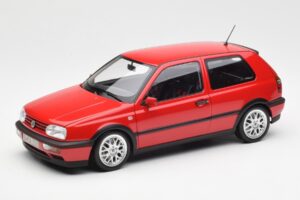
Volkswagen Golf GTI Mk8 Blue Norev 1:18
Price:
115.00 €
This model is currently sold out. Enter your email and we'll let you know when it's back in stock.
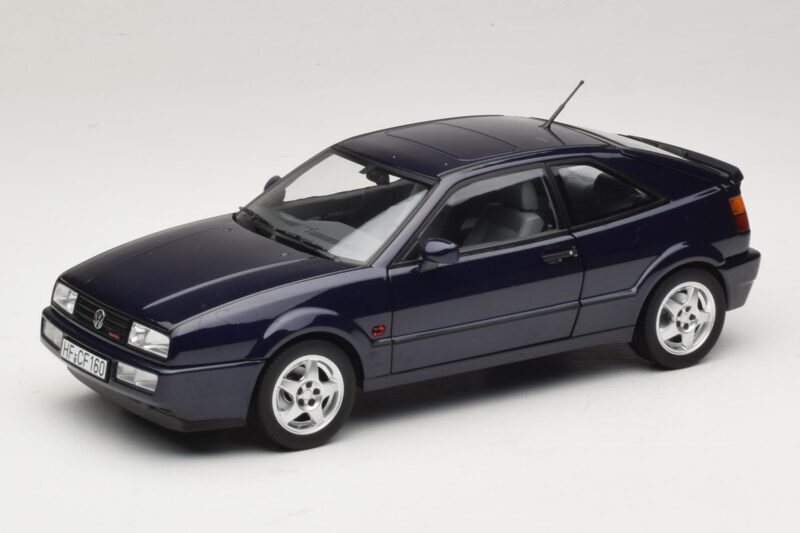
TL;DR: Norev's 1:18 diecast reproduces the Volkswagen Corrado VR6 in Aqua Blue Metallic, marking the model that introduced the world's first narrow-angle V6 engine in 1992. This limited edition zinc alloy casting includes opening panels, built to the standards that made the Corrado VW's most technically ambitious coupe of its time.
When Volkswagen wanted a flagship for its sportiest coupe, engineers found room for a V6 by inventing one: the VR6's narrow fifteen-degree cylinder bank angle let a six-cylinder engine fit where only a four had fit before. The Corrado VR6 arrived in 1992 as that engine's debut car, and this Aqua Blue Metallic diecast reproduces it as a limited-edition Norev casting built with opening panels.
Volkswagen's engineers faced a real packaging problem: the Corrado's engine bay was designed around four-cylinder engines, and a conventional V6 needs more width than that space allowed. Their solution set the cylinder banks just fifteen degrees apart, narrow enough that both banks could share a single cylinder head, shrinking the whole unit down to roughly the footprint of an inline engine. The result, a 2.9-liter VR6 producing around 190 horsepower in European tune, gave the Corrado genuine performance to match its aggressive styling, and the layout proved so effective that Volkswagen carried the VR6 concept into later Golfs, Passats, and even some Audi applications for years afterward.
The Corrado launched in 1988 alongside the Scirocco rather than strictly replacing it, positioned as a more expensive, more capable coupe built on a stiffened version of the platform underneath. Early cars used a supercharged four-cylinder, capable in its own right, but it was the VR6's arrival in 1992 that turned the Corrado into something closer to a baby GT car, a status the earlier engines never quite reached. That upgrade came late in the car's life, which is part of why VR6 Corrados carry a stronger following today than the model's overall sales figures might suggest, and why a well-presented example still draws attention at any Volkswagen gathering.
Diecast at 1:18 means a zinc alloy body, and that material brings real weight to a coupe-sized casting, along with the structural stability to support opening panels without the whole shape sagging out of true over years on a shelf. Building panels that open adds real complexity around a compact coupe's tight shut lines, since there is less body surface to absorb a slightly uneven gap than on a longer sedan. Norev's Corrado holds those lines reasonably tight for the price point, and lifting a panel reveals the cabin trim and dashboard detail that a sealed body would keep hidden entirely, a genuine advantage for anyone who wants to inspect the interior rather than take the exterior on faith.
Aqua Blue Metallic was one of the more distinctive shades Volkswagen offered on the Corrado, a cooler, greener blue than the deeper tones more common on German coupes of the period, and it is a color that photographs differently depending on the light hitting it. Metallic paint on a diecast body needs a hard, even base to show its flake properly, and zinc alloy provides exactly that, letting the blue read with real depth under a shelf spotlight rather than looking flat the way a poorly finished repaint often does. Paired with the limited-edition status Norev assigns this casting, the color is as much a reason to seek this particular Corrado out as the VR6 badge is.
At 1:18, the Corrado's compact coupe proportions come out to roughly 22 centimeters long, noticeably shorter than a contemporary sedan and a size that fits easily into a single cabinet slot without crowding its neighbors. That footprint makes it an easy piece to group with other early-1990s German coupes, and the VR6's mechanical significance gives it a stronger claim to a spot in a themed engineering display than most coupes from the same era can make. Diecast at this price segment typically means solid exterior tolerances and opening panels rather than a fully detailed underbody or engine bay, and that is a fair trade for a limited-edition run rather than a flagship resin piece costing several times as much. Judging fidelity on a model like this starts with the greenhouse proportions, since the Corrado's fastback roofline and short rear deck are easy to get subtly wrong, and continues with the wheel design, since Volkswagen ran several distinct alloy patterns across the car's production run. A dust-free shelf and indirect lighting keep the metallic finish looking correct for years, since direct sun will fade a blue shade faster than most other colors in a collection.
Limited-edition status on a Norev Corrado matters more than it might on a mainstream model, because Volkswagen's own production numbers for VR6 cars were modest to begin with, and a scale reproduction that specifically marks the color and trim combination narrows the field further for anyone chasing a particular variant. Norev sits in the middle of the diecast market: not the cheapest mass-market option, but priced well below hand-built resin competitors, which makes a limited run like this a reasonable target for a collector who wants genuine scarcity without paying investment-tier money for it. Set beside a base Corrado or the supercharged G60 version, this VR6 in Aqua Blue Metallic tells the more complete story of the car's engineering. For anyone building a Volkswagen performance shelf, it is worth buying while a well-finished example is still findable.