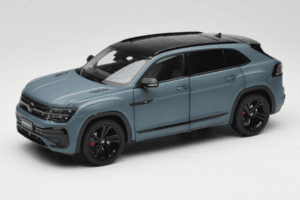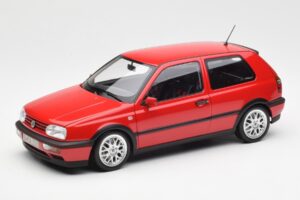
Volkswagen Golf GTI Mk8 Blue Norev 1:18
Price:
115.00 €
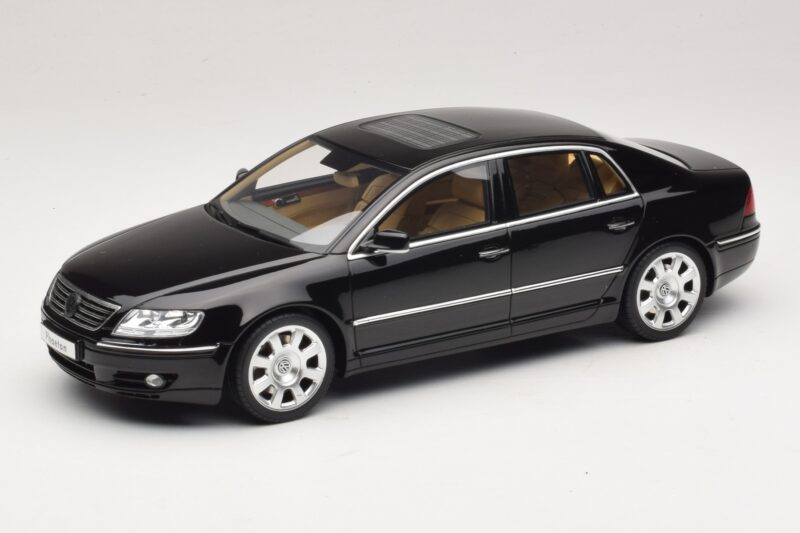
TL;DR: Otto's 1:18 resin Volkswagen Phaeton W12 reproduces VW's flagship luxury sedan in black, the range-topping engine variant with a sealed one-piece body. Built during the Piech era at Dresden's Transparent Factory, the Phaeton remains a quietly ambitious replica for collectors who value engineering over marque prestige.
VW never fully explained the Phaeton to American buyers, and the sales figures proved it. Built to rival Mercedes and BMW's flagships with a Bentley-sourced platform underneath, the W12 version carried the most ambitious engineering VW ever put in a sedan. Otto's black resin replica captures that quiet overreach, one piece bodywork and all.
The Phaeton launched in 2002 as Volkswagen's attempt to build a car that could sit beside a Mercedes S-Class or BMW 7 Series, an audacious move for a brand known for the Golf and Beetle. Underneath, it shared its D1 platform with the Bentley Continental Flying Spur, meaning the humble VW badge covered genuinely upmarket engineering: air suspension, a permanent 4Motion all-wheel-drive system, and a chassis tuned for autobahn stability at sustained high speed. The 6.0-liter W12 sat at the top of the engine range, two banks of six cylinders arranged in a narrow "W" configuration rather than the wider vee a V12 would need, letting VW fit serious displacement under a hood not designed to accommodate one.
Every Phaeton, including this W12, was hand-assembled at the Glaeserne Manufaktur, the "Transparent Factory" VW built in Dresden with glass walls so visitors could watch technicians build the car on a floor more reminiscent of an atelier than an assembly line. Ferdinand Piech, then chairman of the Volkswagen Group, pushed the Phaeton through as a statement of what the brand's engineers could achieve when cost targets loosened. American buyers largely ignored the result, and VW withdrew the model from the US market by 2006, but production continued in Europe and found lasting success in China, where the badge carried less baggage.
Otto casts this Phaeton in resin rather than diecast zinc, a choice that suits a subject whose original panels were pressed to unusually tight factory tolerances. Resin holds sharper edges and tighter, more consistent shut lines than a die allows, and the casting is markedly lighter in the hand than a metal body of the same size. This Phaeton is built as a one-piece sealed shell, so nothing on it opens. That is a normal, deliberate construction choice for a resin subject at this scale, and it means the entire account of quality plays out on the exterior: the crease along the shoulder line, the depth of the rear roofline, and the flush fit of the greenhouse glazing.
Black is an unforgiving color on any scale model, since it shows every inconsistency in surface prep that lighter shades hide. Under a direct shelf lamp, a well-applied black clear coat should show genuine depth rather than a flat, dead finish, with the metallic Phaeton badge and chrome trim reading crisply against it. Because the body is sealed, there are no hinge lines to interrupt that black surface, and the roofline runs as one unbroken curve from the A-pillar to the trunk lid. That continuity is precisely what a fixed-body resin casting is meant to deliver, and it rewards close inspection more than a hurried glance.
At 1:18, a car with the Phaeton's nearly 5.1-meter length translates to a model in the 28 to 29 centimeter range, noticeably longer than a compact executive sedan and a real test of cabinet depth. That size matters for anyone building a themed shelf of 2000s German luxury sedans, since the Phaeton sits at the tall end next to an S-Class or 7 Series of the same era. Because this segment rewards subtlety over drama, the details that separate a good Phaeton replica from a mediocre one are quiet: the correct proportion of greenhouse to body, the low beltline VW gave the car to soften its size, and the wheel design specific to the W12 trim. Otto's positioning in the resin segment tends toward accessible, focused runs rather than museum-tier pricing, which suits a subject like the Phaeton well. This was never a car built to be flashy, and a replica priced and finished to match that sensibility, rather than dressed up as something grander, is the more honest fit.
The Phaeton never built the following of a 911 or an M3, and that is exactly its appeal for some collectors: a flagship that VW built with genuine ambition and the market simply declined to reward. Placed beside a Passat W8 or an Audi A8 of the same period, it tells a specific story about how far Volkswagen was willing to push its engineering before pulling back. This W12 black example represents the top of the original lineup, and Otto's resin casting treats that history with the same restraint the car itself displayed. It is not a piece that will dominate a shelf through spectacle, but one that rewards a collector who already understands why a company builds a car nobody asked for.