Used

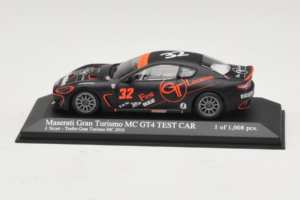
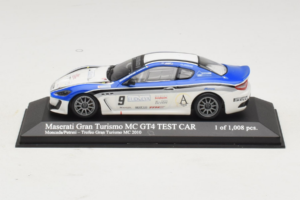
Maserati GranTurismo MC GT4 #6 Goldstein / Sumberg Trofeo GranTurismo 2010 Minichamps 1:43
Only 2 left
Price:
37.00 €
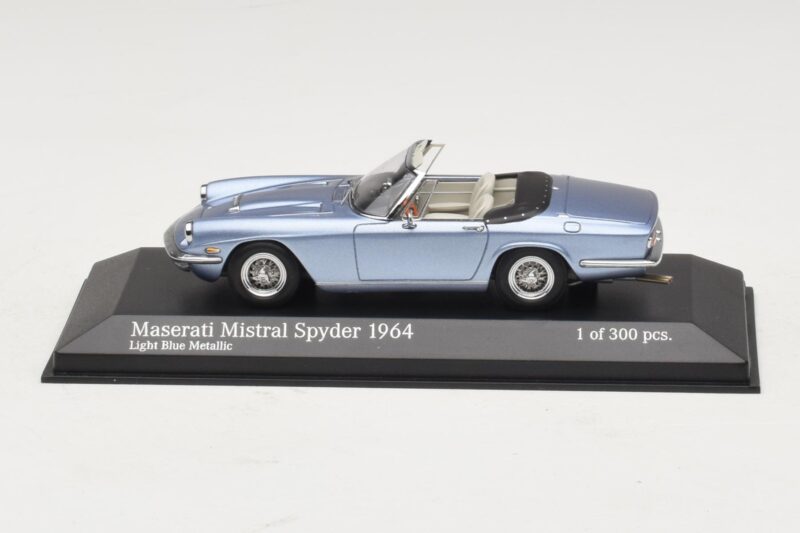
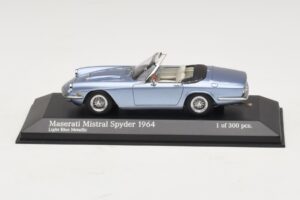
TL;DR: Minichamps' 1:43 diecast Maserati Mistral Spyder reproduces the 1964 open-top grand tourer in Light Blue Metallic, the convertible built in far smaller numbers than the Frua-styled coupe. Cast as a sealed one-piece diecast body, the Spyder's low, flowing lines and paint depth carry the model, with no opening panels.
Pietro Frua's design for the Mistral gave Maserati its first car named after a wind, a naming convention the factory would follow for decades afterward with the Ghibli, Bora, and Khamsin. The Spyder variant, built in noticeably fewer numbers than the coupe, stripped away the roof to expose that low, tapering shape completely. Minichamps' 1:43 reproduction wears Light Blue Metallic, a period-appropriate shade that suits the car's understated Italian elegance.
Maserati commissioned Pietro Frua to design the Mistral in the early 1960s, and the result became historically significant well beyond its own sales figures: it was the first Maserati road car named after a wind, in this case the strong, dry wind that blows down the Rhone valley toward the Mediterranean. That naming convention stuck, and Maserati would return to it repeatedly over the following decade with the Ghibli, the Bora, and the Khamsin, making the Mistral the car that started a tradition.
Frua's body sat on a chassis borrowed from Maserati's racing programs, with a straight-six engine descended from the company's competition engines, giving the Mistral genuine performance credentials rather than styling alone. The coupe came first, offered with a distinctive glass hatch over the rear luggage area. The Spyder followed, removing the roof entirely to create an open-top variant built in visibly smaller numbers than the coupe, since converting a closed grand tourer to a proper open body without compromising rigidity is never a simple exercise.
Light Blue Metallic is a color that flatters the Mistral's low, tapering lines in a way a darker shade would obscure, letting the eye follow the body's long hood and gently sloping tail without the visual weight a black or deep red would add. On the Spyder specifically, removing the roofline changes how that color reads entirely, running in one continuous sweep from the raked windshield to the tail.
Metallic finishes reward careful diecast work more than solid colors do, since inconsistent flake distribution shows up immediately under direct light, and this casting keeps the flake reading uniform across the whole exposed body. The windshield needs to sit at a lower, more raked angle than the coupe's, and the beltline has to drop slightly to compensate for the missing roof structure. Minichamps gets that lowered, open-body stance correct, distinguishing this Spyder clearly from its coupe sibling rather than treating it as a roof removed from an unchanged shape.
Minichamps casts this Mistral Spyder in zinc-alloy diecast as a sealed one-piece body, with no doors, hood, or trunk that open on this particular model. That construction decision puts full weight on the exterior surfaces, which matters especially on an open-top car, since there's no roofline to distract from the body's proportions and every curve is fully visible from above. Diecast brings genuine heft to a 1:43 casting, a density that signals metal construction immediately, and that mass comes with casting tolerances a touch wider than resin would allow, an inherent material trade-off rather than a specific shortcoming here. A sealed body actually suits an open-top grand tourer reasonably well: without hinge clearances to plan around, Minichamps holds the door lines and the low beltline running the Spyder's full length without interruption, letting the Light Blue Metallic read as a single unbroken skin exactly where an open car's lack of roof makes that skin most visible. Buyers hoping to explore the straight-six under the hood or the cabin in detail will need a larger scale or an opening-panel alternative. This is a piece built to be studied from every angle on a shelf rather than opened and handled.
At 1:43, the Mistral Spyder pairs naturally with the coupe from the same generation, and displaying both together tells the more complete story: one shared chassis and engine, two very different bodies, with the open Spyder representing the rarer, more exclusive half of that pair. Minichamps' diecast execution reflects the subject's standing as a genuine 1960s Italian grand tourer, with finish quality appropriate to a car whose real-world examples now command serious money among collectors of the marque. For anyone building a themed shelf around Frua's design work or Maserati's wind-named cars specifically, the Spyder is the harder variant to find and arguably the more rewarding one to own in miniature. Its rarity relative to the coupe is exactly what makes it worth seeking out first.

You save 38.00 €
Lowest price in the 30 days before the reduction: 189.00 €



You save 16.00 €
Lowest price in the 30 days before the reduction: 123.00 €