Used

Maserati GranTurismo MC GT4 #6 Goldstein / Sumberg Trofeo GranTurismo 2010 Minichamps 1:43
Only 2 left
Price:
37.00 €
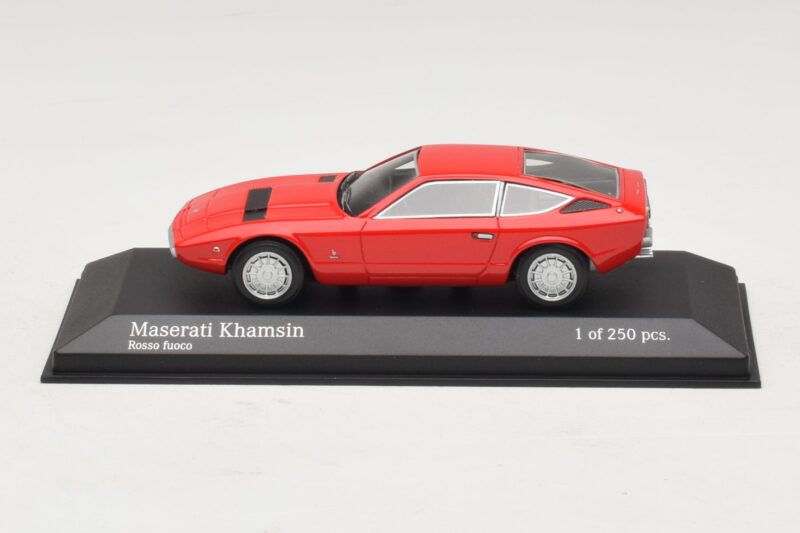
TL;DR: Minichamps' 1:43 Maserati Khamsin in red pairs Marcello Gandini's angular Bertone wedge design with Maserati's traditional red livery, cast in diecast with a sealed one-piece body. Built around a front-mounted V8 during the marque's De Tomaso ownership transition, this Khamsin makes a bolder shelf statement than its grey metallic sibling from the same range.
Red carries different weight on a Maserati than on almost any other marque, tied as it is to the trident badge's racing heritage even on road cars that never saw a circuit. This Khamsin wears that red over Gandini's uncompromising wedge shape, and Minichamps' sealed diecast body keeps the glass-paneled tail and sharp fender creases as crisp as the grey metallic version cast from the same tooling.
Beneath Gandini's angular bodywork, the Khamsin carried a conventional front-mounted V8 driving the rear wheels, a layout Maserati had used since well before the Bertone design arrived and would continue using after Citroën's involvement ended. That mechanical conservatism sat in deliberate contrast to the body's radical styling, giving buyers a genuinely modern-looking GT without asking them to trust an unfamiliar drivetrain layout. The V8's front-mounted position also preserved the long-hood, short-deck proportions that had defined Maserati road cars since the Frua era, a silhouette this casting reproduces faithfully in the sweep from the leading edge of the hood to the base of the windshield.
Maserati's ownership shifted from Citroën to Alejandro de Tomaso partway through the Khamsin's production run, a transition that affected the marque's broader direction more than it changed this particular model's specification. The Khamsin continued largely unaltered through that ownership change, a survivor of corporate upheaval that claimed other contemporary Maserati projects. Its persistence through two ownership regimes, first Citroën's hydraulic-focused engineering culture and then de Tomaso's more traditionally Italian approach, makes the Khamsin a useful marker of just how turbulent Maserati's 1970s really were behind the glamour of a red GT coupe on a showroom floor.
As with the grey metallic version cast from the same tooling, this Khamsin has no working hood, door, or trunk, and that sealed construction serves Gandini's wedge design particularly well. The fender crease running the length of the car stays a single unbroken line, and the glass tail panel covering the rear lamps sits flush against the surrounding bodywork rather than floating on a hinge. A design this dependent on clean geometry benefits directly from a one-piece body's dimensional consistency, since there is no assembly tolerance anywhere along the car's length to soften a line Gandini intended to stay sharp.
Where the grey metallic Khamsin reads as understated and design-focused, this red version leans into the trident's traditional color and reads as the bolder, more emotionally direct choice of the two. Red holds less of a metallic flake than the grey option, giving it a flatter, more saturated finish that suits Maserati's traditional racing-red heritage more than a modern metallic sheen would. Because the body is sealed and cast as one piece, that red runs continuously from the nose to the glass tail panel, with no gap or seam breaking the color along the car's longest sightline, the same structural benefit the grey version shares from identical tooling.
At roughly eleven centimeters in 1:43, this red Khamsin occupies the same footprint as its grey metallic sibling, which makes displaying the two side by side an easy way to compare how differently color treats the same Gandini design. Red tends to read as more aggressive under a shelf spotlight, catching attention from across a room in a way the grey version's quieter finish does not, even though both castings share identical panel lines and the same glass tail treatment. Detail at this scale is necessarily simplified relative to 1:18, so fine elements like the door handles and grille mesh present as relief rather than separately molded parts, a trade every 1:43 collector accepts for the format's compact footprint. Collectors building a color study of a single subject, seeing how a manufacturer's paint choices change the character of an identical casting, find this Khamsin pair a straightforward and affordable way to make that comparison without needing two separate tooling investments. Fidelity here is best judged against the fender crease and the rear glass panel, the two Gandini signatures that separate a genuine Khamsin from a generic 1970s wedge silhouette.
Owning both color versions of the same casting is a small, specific kind of collecting pleasure, less about completing a manufacturer's catalog and more about understanding how a single design reads under two different finishes. This red Khamsin makes the louder statement of the pair, better suited to a shelf position where it needs to draw the eye rather than blend into a broader Maserati survey. Paired with the grey metallic version, the two together demonstrate Gandini's wedge design more thoroughly than either could alone, since the eye picks up different details depending on how the paint catches available light. At this scale and diecast construction, assembling the pair costs a fraction of what two 1:18 resin alternatives would demand, making the comparison an accessible entry point for a collector curious about design study rather than committed to a single hero piece, a modest investment for a genuinely instructive shelf lesson.