Last one
Back in stock
This model is currently sold out. Enter your email and we'll let you know when it's back in stock.
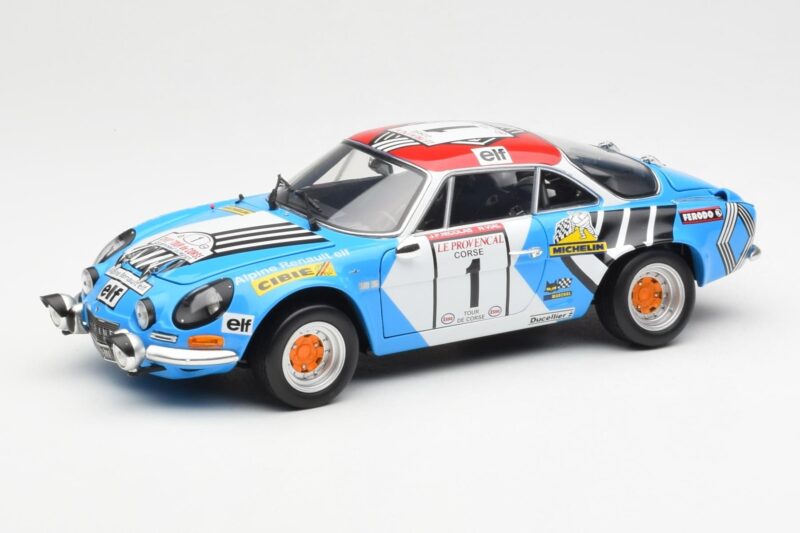
TL;DR: Kyosho's 1:18 diecast reproduces the Alpine A110 1600S as driven by Nicolas and Vial to victory at the 1973 Tour de Corse, part of the season that earned Alpine-Renault the inaugural World Rally Championship manufacturers' title. The model captures the lightweight rear-engine rally car's period livery and stance.
Alpine's little rear-engined A110 punched well above its weight through the early 1970s, and this Kyosho build reproduces the number 1 car that Nicolas and Vial drove to victory on home ground at the 1973 Tour de Corse.
The number 1 door graphics and sponsor lettering sit flat and correctly registered against the A110's rounded, bug-eyed nose, a shape defined by curves that make crisp livery application harder than on a flat-sided sedan. Kyosho reproduces the round driving lamps mounted ahead of the grille and the rally-spec roof aerial as separately applied parts rather than molded stubs, and the model's paint carries the correct period color blocking without bleeding across the character lines that run along the A110's rear haunches.
The real A110 weighed remarkably little for a rally car of its era, a fiberglass body over a steel backbone chassis that let Alpine chase agility over brute power. Kyosho's diecast body, naturally heavier than the original given the metal construction, still nails the compact proportions and low, rounded roofline, and the doors open on metal hinges to reveal a stripped rally cabin with a roll cage and bucket seats appropriate to a genuine works entry rather than a road-trim interior with a number pasted on top.
The Tour de Corse's mix of narrow, twisting Corsican tarmac roads demanded precision over horsepower, conditions that suited the A110's light weight and agile handling far better than they suited heavier, more powerful rivals. Nicolas and Vial's win there in 1973 was one of several results that season that built Alpine-Renault's case as the strongest manufacturer team in rallying, a reputation the marque earned through consistent finishes across a variety of surfaces rather than a single standout result.
Alpine's decision to mount the engine behind the rear axle, unusual for a rally car even then, gave the A110 a distinctive weight distribution that rewarded a specific driving style built around trail-braking and controlled oversteer. That same 1973 season saw the FIA formalize the World Rally Championship's manufacturers' title, and Alpine-Renault claimed the inaugural crown, making this a car present at the literal founding of the championship as a defined, unified series rather than a loose collection of national rallies.
The A110's whole competitive identity rested on being lighter than its rivals, which creates an interesting tension for a diecast model: the real car's featherweight fiberglass body is exactly the opposite construction philosophy from a zinc-alloy scale replica. A sealed resin version could chase that lightness more literally, but would give up the opening doors and cabin access that let a collector actually see the roll cage and stripped interior a genuine rally car carried. Kyosho's diecast leans into weight as a display virtue instead, a model that feels substantial in the hand even though the original it represents famously did not. That inversion is worth knowing going in: the appeal here is tactile presence and mechanical access, not a literal recreation of how light the real A110 felt to drive.
This Tour de Corse winner sits naturally at the start of a broader World Rally Championship timeline, the point where the sport moved from scattered national events into a unified series Alpine-Renault dominated in its opening year. At around 19 to 20 centimeters, the compact A110 needs less shelf depth than larger rally silhouettes from later Group B era cars, making it easy to fit several period Alpine liveries into a tight display. Collectors tracing the WRC's earliest seasons, or specifically following French motorsport history through Alpine's works program, will find this a foundational piece rather than a footnote.