Last one
This model is currently sold out. Enter your email and we'll let you know when it's back in stock.
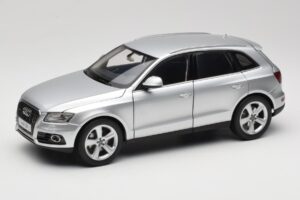
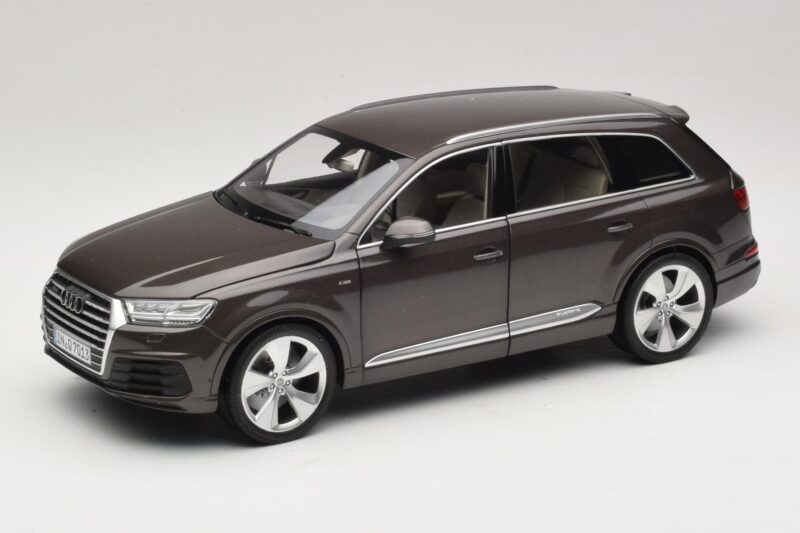
TL;DR: Minichamps' 1:18 diecast Audi Q7 4M reproduces the second-generation Q7, the lighter MLB-platform SUV Audi introduced in 2015 to replace its heavier original flagship. Finished in Argus Brown with an opening body, the diecast's zinc-alloy weight and full-size proportions anchor a modern luxury SUV shelf.
Audi replaced its first-generation Q7 in 2015 with a second version built on the MLB Evo platform shared with the Porsche Cayenne and Volkswagen Touareg, shedding weight while growing the interior and expanding the technology fitted throughout the cabin. The 4M-generation Q7 shifted Audi's flagship SUV from a heavy, imposing family hauler into a more refined luxury vehicle without giving up any of the size buyers expected from Audi's largest model.
Audi's decision to move the second-generation Q7 onto the MLB Evo platform in 2015 reflected an industry-wide shift toward reducing SUV weight without shrinking passenger space, a platform the Q7 shared with the Porsche Cayenne and Volkswagen Touareg under Volkswagen Group's modular architecture strategy. Aluminum body components and a revised chassis layout cut a meaningful amount of mass compared to the outgoing first-generation Q7, translating into sharper handling and improved efficiency despite the SUV's genuinely large footprint. The Q7 4M competed directly against the BMW X5 and Mercedes-Benz GLE in a segment that had become one of the most commercially important in the American luxury market, where buyers increasingly chose three-row SUVs over traditional sedans for exactly the space and comfort a Q7 provided. Audi positioned the Q7 as its flagship SUV, the largest and most feature-laden model in the American lineup, aimed at buyers who wanted genuine luxury-sedan refinement without giving up cargo capacity or seating for six or seven. That positioning made the Q7 one of Audi's most important US-market models through the second half of the 2010s, a volume seller rather than a niche halo car. Reproducing this generation in scale form captures the moment Audi's flagship SUV matured from a heavy first attempt into a genuinely refined, technically current luxury vehicle.
Minichamps builds this Q7 as a diecast body with genuine weight in the hand, a quality that matters even more on a large SUV than on a smaller sedan or coupe, since a hollow-feeling casting is far more obvious across a body this size. The doors and rear hatch open, revealing a cabin trimmed to follow the Q7's three-row layout, with the raised center console and rotary controller that defined Audi's interior design language through this period. Panel gaps run tight around the doors and tailgate, holding consistent tolerances across the SUV's tall, flat side panels where an uneven gap would be immediately visible against the large, unbroken surfaces. The Singleframe grille, wider and more upright on this generation than on the outgoing Q7, is reproduced with correct proportions and mesh pattern rather than a simplified flat panel, and the running boards and roof rails, standard fitment on most American-market Q7s, are present as separate, correctly positioned pieces rather than molded flush into the body. The wheel design carries Audi's period five-spoke pattern, filling the arches at a scale that matches the real car's stance. For a large SUV where the overall silhouette does most of the visual work, getting the grille and glass proportions right matters more than any single interior detail.
Argus Brown belongs to the understated earth-tone palette that became popular across European luxury SUV lineups during the mid-2010s, a shade that reads as tasteful and expensive rather than flashy, suiting a vehicle whose target buyer wanted quiet confidence over attention. Diecast paint sits on a hard metal shell, and under direct light this brown shows a subtle warmth that separates it from a flat, single-tone finish, catching highlights differently across the SUV's tall hood and long roofline. The Q7's LED daytime running lights and taillight signature, distinctive design elements Audi used to differentiate its lineup at a glance even in traffic, are reproduced in the diecast's lighting details rather than simplified into plain clear or red lenses. Compared to a more common black, white, or silver Q7 reproduction, this Argus Brown example stands out on a shelf specifically because it matches how many actual owners specified their cars, buyers who wanted their large luxury SUV to look distinguished without shouting for attention. That restraint is part of the Q7's broader identity, a flagship built to project confidence quietly rather than aggressively, and the color choice reinforces exactly that.
SUVs remain underrepresented in scale model collecting relative to their real-world sales volume, since manufacturers have historically favored sports cars and sedans as more visually dramatic subjects, which makes a well-detailed Q7 4M a genuinely useful piece for anyone building a modern Audi lineup shelf. Minichamps sits at a mid-premium tier reflecting its detail-focused approach without the cost of a fully hand-built limited edition, appropriate for a mainstream luxury model rather than a halo performance car. At roughly 28 centimeters long in 1:18, the Q7's proportions demand real shelf space, worth planning for before adding it to a crowded cabinet. Paired with an RS6 Avant or A6 from the same Audi lineup, this Q7 fills out a brand-focused collection with the model that actually represented Audi's best-selling body style through this era.