Last one
Back in stock

This model is currently sold out. Enter your email and we'll let you know when it's back in stock.
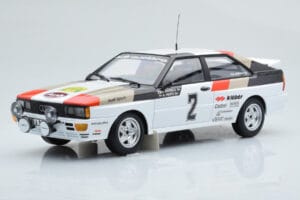
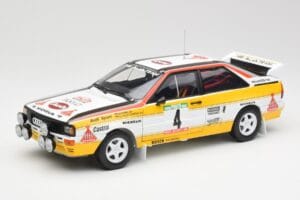
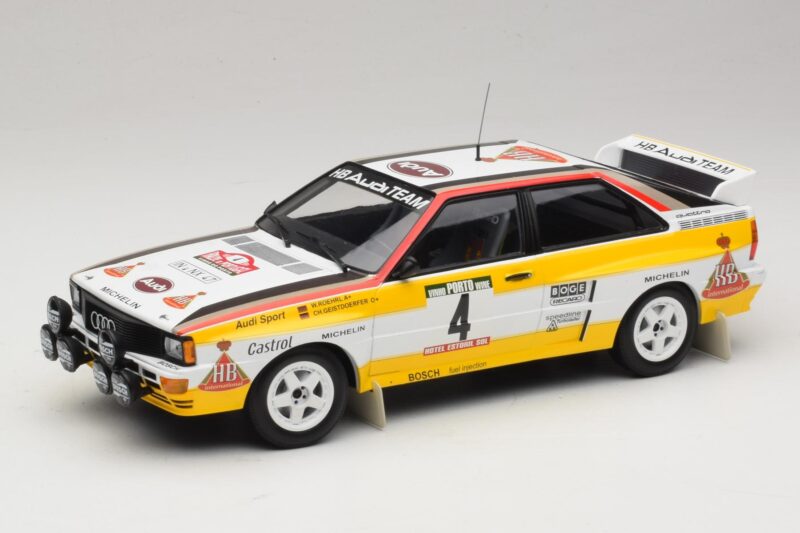
TL;DR: Minichamps' 1:18 diecast Audi Quattro A2 reproduces Walter Röhrl and Christian Geistdorfer's #4 entry at the 1984 Rally Portugal. The sealed one-piece body carries the flared arches and auxiliary lighting of Audi's Group B four-wheel-drive rally car, a machine that changed the sport permanently.
Audi's Quattro did not just win rallies, it made every rival's two-wheel-drive car look obsolete overnight. Minichamps' Röhrl-liveried A2 captures that competitive weapon in sealed diecast, arches flared and spotlights mounted exactly as the gravel-stage cars ran.
Walter Röhrl arrived at Audi already a two-time World Rally champion, and pairing his precision driving style with co-driver Christian Geistdorfer and the Quattro's revolutionary four-wheel-drive traction gave the team one of the sport's most feared lineups through the mid-1980s. The Quattro A2 evolved the original road-based rally car with wider arches and updated aerodynamics to stay competitive as Group B regulations pushed manufacturers toward ever more extreme machinery. Rally Portugal, run largely on demanding gravel and tarmac mountain stages, was a proving ground for the four-wheel-drive advantage that made the Quattro the car every rival manufacturer scrambled to copy.
This model is a sealed one-piece diecast body with no opening doors, hood, or hatch. Rally liveries carry dense sponsor graphics and precise number panel placement, and a sealed body lets Minichamps hold those decals flat and correctly registered across the Quattro's flared arch extensions without a hinge line breaking the surface mid-graphic. The auxiliary spotlights mounted ahead of the grille, a rally-specific fitment absent from any road-going Quattro, are cast as fixed exterior detail, and the arch flares themselves read as a distinct, boxier silhouette compared to the standard road car's cleaner lines.
Group B's brief, spectacular era before its 1986 ban has left a lasting mark on rally collecting, and Quattro liveries from named driver pairings like Röhrl and Geistdorfer carry more specific historical weight than a generic factory scheme. At 1:18 scale, the Quattro's compact coupe body with flared arches measures roughly 22 to 23 centimeters, a size that suits a dedicated Group B rally shelf alongside period Lancia, Peugeot, and Ford rivals. This is a subject with genuine motorsport documentation behind it, not a livery applied for visual variety.
When evaluating a rally Quattro, look at the arch flare edges and spotlight mounting brackets first, since these rally-specific modifications are where lesser castings often lose sharpness. Diecast's structural strength suits the wider, flared rally body well, holding its shape better over years of handling than a lighter material might. Named-driver Group B liveries from this era typically command a premium tier over generic rally schemes, reflecting the documentation and decal accuracy required to reproduce a specific historic event correctly.
No. The body is a sealed one-piece diecast casting, with the spotlights and arch flares cast as fixed exterior detail on the closed shell.
Its four-wheel-drive system gave it a traction advantage over two-wheel-drive rivals on loose gravel and mixed-surface stages, forcing every competing manufacturer to develop their own all-wheel-drive cars.
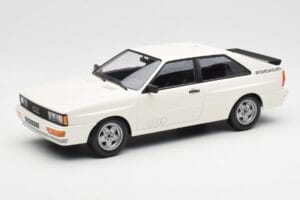
The A2 rally version carries wider flared arches and auxiliary spotlights not fitted to the standard road car, giving it a noticeably boxier and more purposeful stance.
Yes, named-driver liveries like Röhrl and Geistdorfer's carry documented historic weight that pairs well with rival Lancia, Peugeot, and Ford Group B models from the same era.