Last one
Back in stock

This model is currently sold out. Enter your email and we'll let you know when it's back in stock.
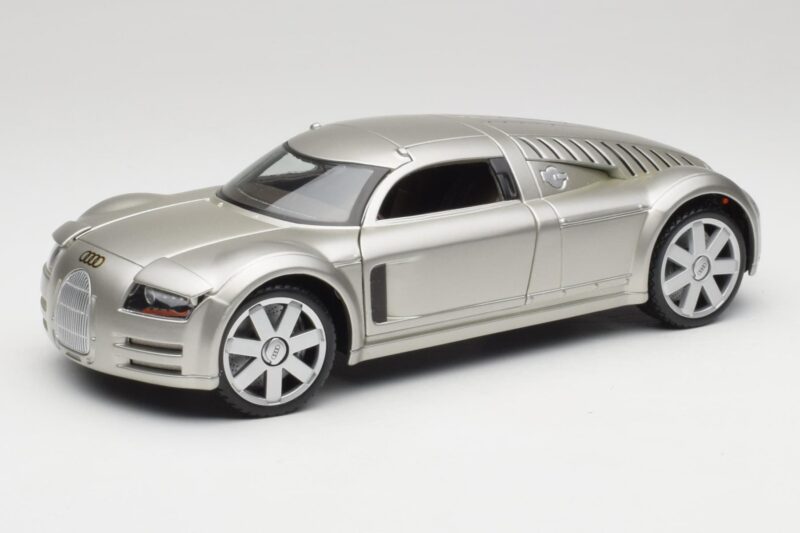
TL;DR: Maisto's 1:18 diecast Audi Rosemeyer in silver reproduces the 2000 concept car Audi named after pre-war Auto Union driver Bernd Rosemeyer. The flowing, low-slung bodywork translates well into entry-tier diecast, making a distinctive shelf piece rarely found in production-car diecast lineups.
Concept cars rarely make it into diecast at all, which makes a production-run model of the Audi Rosemeyer worth noticing before its history even enters the conversation.
The Rosemeyer's flowing fenders and long, low hood present a different challenge than a production sedan, and Maisto's zinc alloy casting handles the compound curves reasonably well for its price tier. Panel separation is largely molded rather than true opening seams, since the concept's continuous bodywork does not lend itself to opening doors the way a road car does. The silver finish suits the car's futuristic, retro-inspired design, catching light along the pronounced wheel arches in a way that shows off the shape's sculptural intent. For an entry-tier diecast, the proportions and stance stay faithful to a design meant to evoke pre-war Grand Prix racers rather than modern Audi styling cues.
Audi unveiled the Rosemeyer concept in 2000 as a design study powered by a W16 engine, named in tribute to Bernd Rosemeyer, one of the standout Auto Union racing drivers of the 1930s whose exploits helped define the brand's motorsport heritage. The concept deliberately echoed the streamlined shapes of pre-war Grand Prix cars, translating that era's aesthetic into a modern supercar silhouette rather than referencing any contemporary Audi production model.
This Rosemeyer stands out best displayed alongside other concept or show-car diecast rather than blended into a production Audi lineup, since its silhouette and story diverge from anything Audi actually sold. Collectors interested in design studies or Auto Union heritage will find this piece fills a niche most catalogs skip entirely, and its continuous bodywork holds up well under regular dusting since there are few crevices to trap grime.