Last one
Used
Back in stock
This model is currently sold out. Enter your email and we'll let you know when it's back in stock.
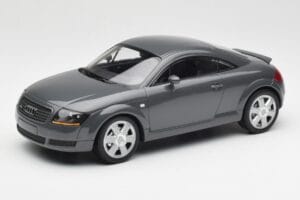
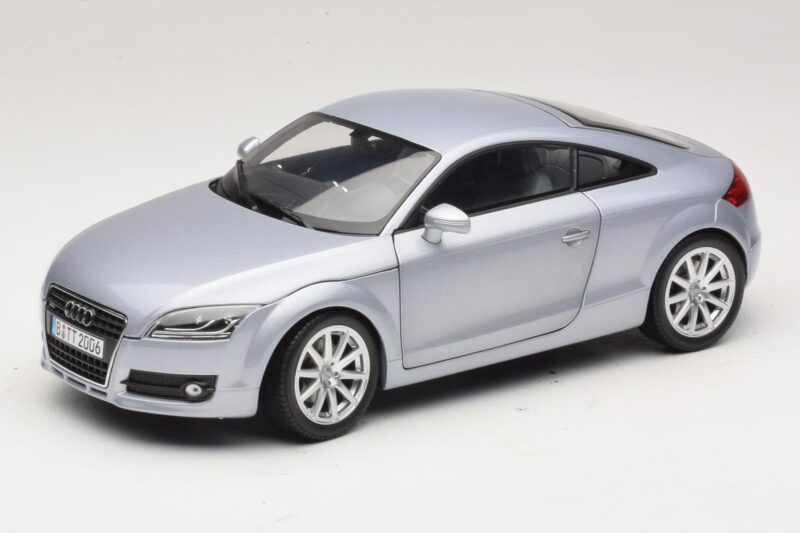
TL;DR: Minichamps' 1:18 diecast Audi TT 8N reproduces the Mk1 coupe in Silverblue Metallic, one of the factory shades that shows off Peter Schreyer's Bauhaus-inspired surfacing. The zinc alloy body carries doors that open onto the TT's distinctive cabin, and the model captures the rounded proportions that made the original TT an instant design landmark in 1998.
When the Audi TT arrived for the 1998 model year, its rounded, almost toy-like proportions looked unlike anything else on sale, a design study turned production car with barely any changes made along the way. The 8N chassis code marks this first-generation TT, built before Audi's early stability concerns forced a mid-life update, and Silverblue Metallic remains one of the shades that best captures the original design brief.
Few production cars carry as much of their concept-car DNA as the original TT. Designers Freeman Thomas and Peter Schreyer built the shape around Bauhaus principles, pure geometric forms, minimal ornamentation, and a cabin that echoed the exterior's rounded, almost architectural language rather than following contemporary automotive trends. When Audi greenlit production, the changes from concept to showroom were unusually small, mostly regulatory necessities rather than styling compromises. That rare fidelity to the original vision is a large part of why the 8N TT still reads as distinctive today, more than two decades after its debut.
Early 8N TTs, particularly higher-powered examples, developed a reputation for high-speed instability that led to a documented series of incidents and, ultimately, an Audi-issued update adding a rear spoiler and revised electronic stability control. That safety story is now a well-known chapter of TT history, discussed in period motoring press and enthusiast circles alike. This 2006 example represents the later, corrected version of the car, built once Audi had already addressed the issue, placing it toward the end of the 8N's production run rather than the earliest, design-pure but mechanically riskier cars.
Minichamps built its reputation across both diecast and resin work, covering everything from motorsport liveries to production road cars with the same attention to proportion. On the TT, zinc alloy construction gives the model real heft, appropriate for a design defined by dense, rounded volumes rather than sharp creases. Those curves are harder to cast cleanly than a car with flat panels and straight shut lines, since any softness in the tooling shows up immediately on a shape this geometrically pure. The model holds those rounded surfaces well, with the wheel arches and roofline reading as continuous curves rather than a series of flattened facets.
Silverblue Metallic sits between a cool grey and a genuine blue depending on the light, a factory shade that shows off the TT's surfacing better than a flatter color would, since reflections travel across the rounded panels in long, unbroken sweeps. Diecast paint sits on a hard metal shell, so the gloss reads deep and consistent, and under a direct display lamp the metallic flake catches unevenly across the curved hood and roof in a way that mirrors how the real paint behaves. The doors open onto the TT's signature cabin, with its baseball-stitched leather-look trim and drilled aluminum-style details.
The TT occupies an unusual position in Audi's lineup: a halo design piece built on shared Volkswagen Group underpinnings rather than a bespoke sports car platform, which let Audi bring the concept to market at a price ordinary buyers could actually reach. That accessibility, combined with the design's purity, made the 8N TT a genuine sales success rather than a low-volume curiosity, and it remains one of the most visually influential coupes to come out of the early 2000s, referenced by designers well beyond Audi's own lineup. A model built around Silverblue Metallic captures the shade most associated with the TT's press photography and early advertising, arguably more representative of the car's original identity than some of the brighter, later colors Audi added to the range. For a collector building a design-history shelf, cars chosen for shape rather than horsepower or racing pedigree, the 8N TT belongs alongside other era-defining coupes as a genuine turn-of-the-millennium design statement.
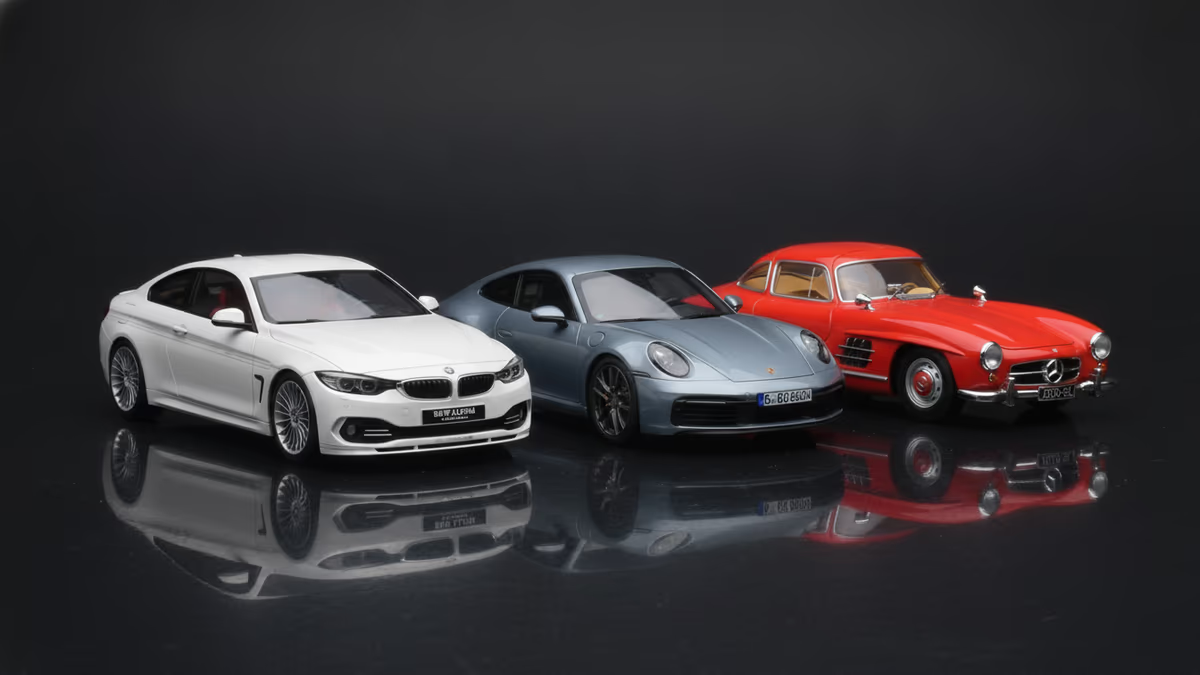
At 1:18, the TT's compact dimensions translate to a model around 21 centimeters long, small enough that its rounded shape reads clearly from across a room rather than getting lost among longer, more conventional coupes. Diecast construction suits a design this geometrically clean, since the material's weight and durability match a car defined by dense, simple forms rather than intricate surfacing that would demand resin's finer tolerances. Set beside period rivals from BMW or Porsche, the TT stands out precisely because it doesn't chase the same design language, an argument for including it in a broader 2000s German coupe collection rather than treating it as a niche outlier. For anyone tracking design-led rather than performance-led collecting, this Silverblue example is a reasonable, accessibly priced entry point.