Last one
Used

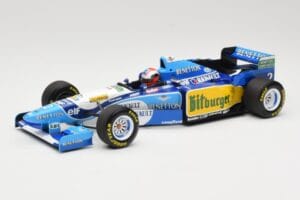
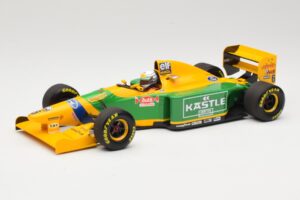
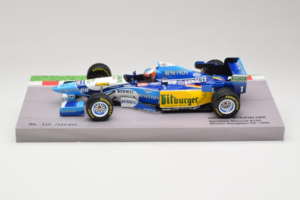
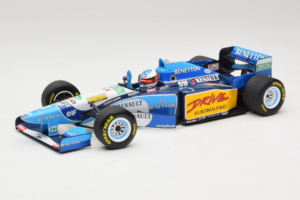
Benetton B195 Renault #1 M. Schumacher Winner Japanese GP 1995 Minichamps 1:18
Only 1 left
Price:
161.00 €
This model is currently sold out. Enter your email and we'll let you know when it's back in stock.
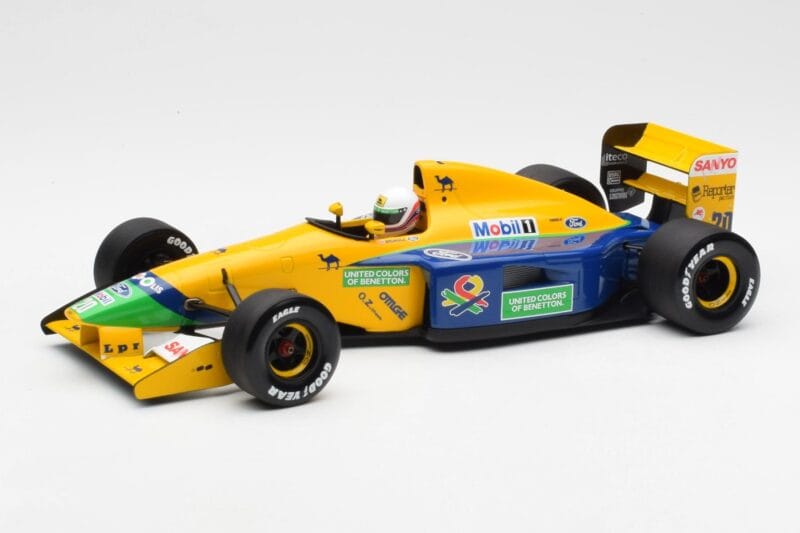
TL;DR: Minichamps' 1:18 Benetton B191B reproduces Martin Brundle's early-1992 season car, the interim chassis Benetton ran before the B192 arrived. Diecast metal construction with separately fitted wings and mirrors captures the Camel-liveried #20 Brundle drove opposite Michael Schumacher's breakout rookie season.
Brundle arrived at Benetton for 1992 already a seasoned campaigner, and his season opened in a chassis built as a stopgap between two eras. The B191B carried the team through early rounds before the definitive B192 took over, and this diecast fixes that transitional window in miniature.
The Camel sponsorship scheme defined Benetton's early-1990s look, and Minichamps renders it with tight tampo-printed edges rather than the soft-edged decals that mark cheaper diecast. Yellow and blue separate cleanly along the sidepods, the number 20 sits correctly on the nose and airbox, and sponsor logos stay legible even at this scale. Front and rear wings are molded and fitted as separate pieces rather than cast into the body, standard practice for open-wheel diecast, letting the endplates and mirror stalks read as thin, accurate components instead of thick simplified stubs.
Formula 1 cars have no doors or hood to open, so the collecting focus shifts entirely to bodywork shape, wing geometry, and wheel fitment rather than hinge mechanisms. Minichamps casts the tub in diecast metal, and lifting the model off its display base makes that choice obvious. The heft sits noticeably heavier than a resin equivalent, a density that signals genuine metal construction rather than a lightweight composite shell. Paint depth under direct lighting shows the yellow holding an even gloss without dulling near the edges, a detail that separates careful factory finishing from inconsistent runs.
Benetton paired Brundle with Michael Schumacher for 1992, and the B191B was the machine both drivers used before the definitive B192 replaced it partway through the year. For Brundle, an experienced hand who had already raced for several front-running teams, the B191B represented a chance to prove himself against a teammate the paddock was watching closely. The chassis itself was a refined evolution of the 1991 car rather than an all-new design, built to keep Benetton competitive while the new machine was finished.
Brundle's 1992 campaign is often remembered as among his best in Formula 1, built on consistent points finishes rather than a single headline result. Racing alongside a teammate who would go on to dominate the sport for a decade gave the season a comparative weight it might not otherwise have carried. For collectors, that context matters: a Brundle diecast from this year sits at the intersection of his own solid form and the earliest chapter of Schumacher's Formula 1 story.
This B191B works best alongside a Schumacher-liveried #19 teammate car, letting a collector display Benetton's full 1992 garage rather than a single entry. The Camel livery era also gives the model a natural place in any collection organized around early-1990s sponsorship liveries, a period when tobacco branding still dominated Formula 1 paint schemes before later restrictions changed the sport's visual identity. At roughly 22 centimeters long, the model holds its own on a standard cabinet shelf without dwarfing smaller-scale companions. Collectors who also run 1:43 versions of the same livery can use this 1:18 piece as the display anchor, since the larger scale carries wing and sponsor detail the smaller format compresses. For a driver-focused collection built around Brundle's career, this interim chassis marks a distinctive, transitional entry rather than a routine one.