BMW X6M F86 Red Norev 1:18
Price:
94.00 €
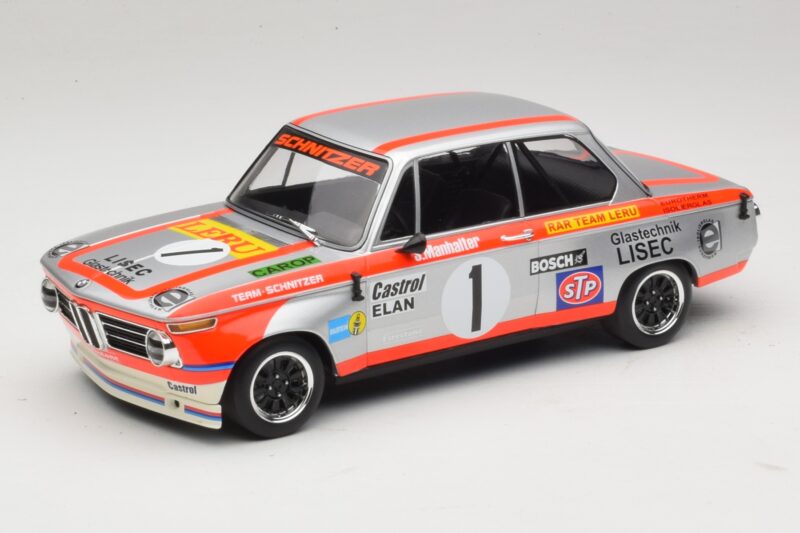
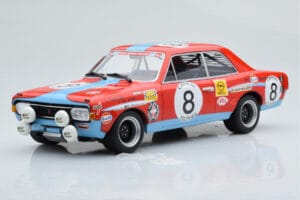
TL;DR: The Minichamps BMW 2002 Ti 1:18 is a diecast replica of the #1 Team Leru car, credited to S. Manhalter as 1000 km Osterreichring winner in 1974. A sealed one-piece body puts the focus on the compact sedan's stance, shut lines and race graphics, making it a lightweight counterpoint to larger 1970s touring models.
Winning a 1000 km race in a small two-door sedan is the sort of result that keeps the BMW 2002 in conversation. This Minichamps BMW 2002 Ti 1:18 records that win in Team Leru's livery, and the compact proportions give it a different shelf character from the big-engined touring cars of the same decade.
The 2002 is a short, upright two-door with a large glasshouse, and the casting keeps that airy cabin profile. The body is sealed, so panel lines read as continuous grooves instead of hinged seams, and the door and trunk cuts hold a consistent width. Window frames stay slim, trim sits crisp and the roofline keeps its gentle curve without a wobble. On a car this small, a millimeter of ride-height error is obvious, so check that the wheels sit centered in the arches and the car looks planted rather than perched. Small cars punish casual casting. This subject rewards the careful kind.
Race livery is where a touring-car replica earns its keep. The number 1 roundels, team lettering and sponsor marks should sit square to the body lines, with edges clean enough to read at arm's length and still hold up under a magnifier. Printed graphics on diecast land on a hard, even surface, which keeps color boundaries sharp. Look at how lettering follows the door curve, how evenly each number is spaced inside its roundel and whether the glazing and lights look right for a competition car. Detail like this separates a faithful replica from a road sedan wearing stickers.
Launched in 1968, the 2002 paired a light two-door body with a lively four-cylinder engine, and that balance made it a natural touring-car base. Light cars brake later, turn in faster and are gentler on tires across a long race. The Ti badge marked a sportier version of the line. BMW replaced the 2002 with the first 3 Series in the mid-1970s, so a 1974 winner belongs to the late years of the original formula, when the car had a long record behind it and plenty of development.
Beside a big-engined sedan racer from the same decade, the 2002 tells the touring-car story in one glance: displacement against agility. A winner's result adds a collecting reason of its own, because a 1000 km race rewards reliability as much as speed. For hobbyists who follow BMW, the model also forms an early chapter of a lineage that leads straight to the 3 Series, which makes the shelf logic easy to explain to anyone who stops at the cabinet.
At 1:18 this is a small car for the scale, so it sits comfortably on a standard cabinet shelf and leaves room for neighbors. Minichamps casts it in diecast, which means mass in the hand, durable paint and graphics that tolerate handling, with slightly wider tolerances than resin. The price sits at mid-tier for a licensed race replica at this scale. Judge it against period photos by checking ride height, wheel position and lettering placement. Keep it away from direct sun to protect printed graphics, and dust it with a soft brush. Anyone building a 1970s touring row can add it as a lighter counterweight to larger machines, and the winner's livery gives it more presence than a plain road car would. Order it for the shelf, not the glovebox.