BMW X6M F86 Red Norev 1:18
Price:
94.00 €
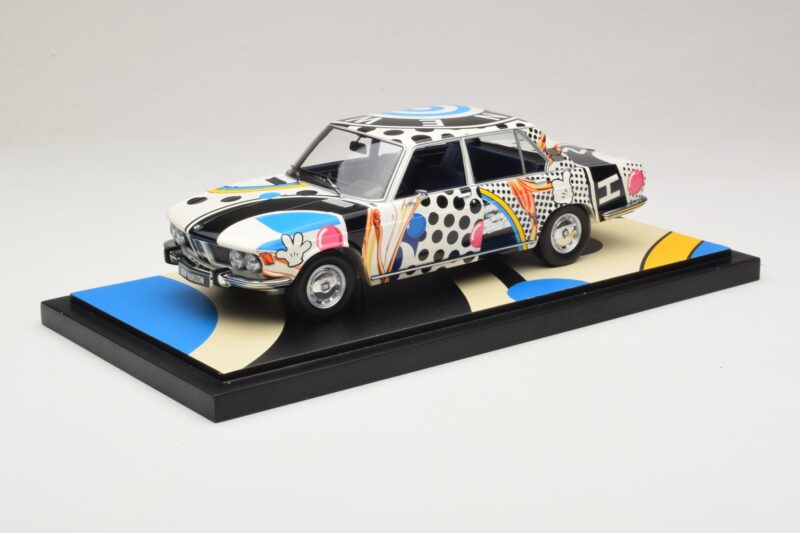
TL;DR: Minichamps' 1:18 resin BMW 2500 E3 reproduces the 1969 New Horizon sedan, the model that expanded BMW upward from its compact Neue Klasse cars into genuine luxury saloon territory. The sealed one-piece body preserves the E3's upright greenhouse and clean period trim without any opening panels.
Before BMW built 7 Series flagships, it needed to prove it could build a proper luxury sedan at all, and the E3 was that proof. Minichamps' resin casting brings that transitional car back in the New Horizon color that marked its 1969 model year.
BMW's Neue Klasse sedans of the early 1960s had rescued the company from near-collapse by offering compact sporting sedans with genuine driving appeal, but they were never intended to compete with Mercedes-Benz at the top of the market. The E3, launched in 1968 as the 2500 and 2800 series, changed that ambition by stretching the platform into a larger, more formally styled sedan aimed squarely at executive buyers who had previously looked only to Stuttgart. The New Horizon designation for 1969 reflects a specific model-year color and trim update rather than a mechanical change, giving this particular casting a documented, period-correct identity rather than a generic E3 color choice.
This model is a sealed one-piece resin body with no opening doors or hood. The E3's chrome-heavy trim, quad headlight surrounds, and the tall, glass-forward greenhouse that defined late-1960s German luxury styling all benefit from resin's ability to hold crisp, separate-looking trim lines even when they are cast as part of a single continuous shell. Paint depth matters more on a formal sedan like this than on a sporting coupe, since the flat door panels and long hood offer nothing to distract from an uneven finish, and resin's smooth surface takes a factory-correct gloss evenly across those large panels.
Collectors building a complete BMW lineage often reach for the more famous 3.0 CSL or the later 7 Series flagship, overlooking the E3's role as the bridge between them. At 1:18 scale a full-size 1960s luxury sedan like the 2500 measures roughly 26 to 27 centimeters, giving it genuine shelf presence among smaller sporting coupes from the same brand. Placed ahead of a 3.0 CSL and behind a Neue Klasse sedan on a BMW timeline shelf, the E3 completes a coherent story of the brand's steady climb upmarket through the late 1960s and 1970s.
Check the chrome trim around the windows and grille for crisp separation from the body color, since this is where a formal sedan's detail quality shows most clearly. Resin's lighter weight makes it easier to reposition on a crowded shelf, though the large flat panels mean fingerprints show readily and a dust-free display case is worth the investment. Period luxury sedans in documented model-year colorways like New Horizon typically sit at a moderate price point, reflecting a smaller production run than the brand's more famous sporting models.
No. It is a sealed one-piece resin casting, with the chrome trim and greenhouse detail cast into the fixed exterior body.
It was BMW's first move into genuine luxury saloon territory, stretching the compact Neue Klasse platform into a larger sedan that competed directly with Mercedes-Benz for the first time.
It refers to a specific 1969 model-year color and trim designation for the E3, giving this casting a documented period identity rather than a generic colorway.
It bridges the compact Neue Klasse sedans and the later 3.0 CSL or 7 Series, making it a useful chronological anchor for a BMW brand-history shelf.