Last one
Used

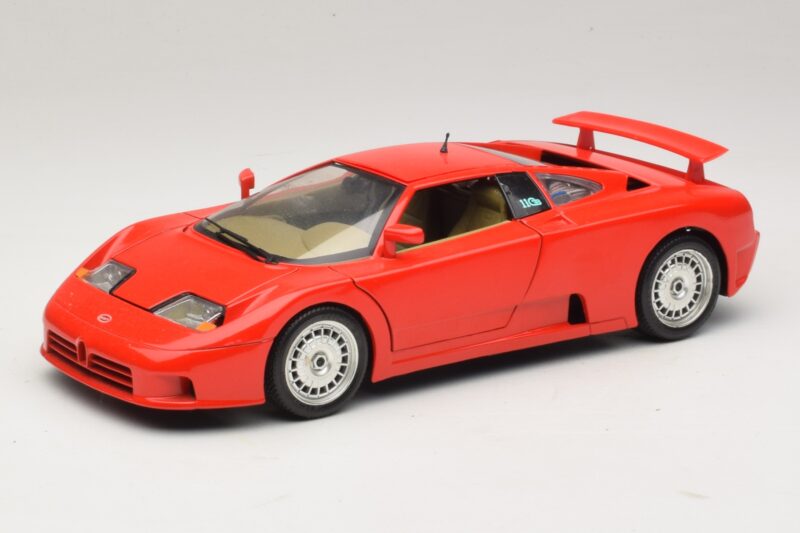
TL;DR: Bburago's 1:18 Bugatti EB110 reproduces the 1991 revival supercar launched on Ettore Bugatti's 110th birthday, built around a carbon fiber monocoque and a quad-turbocharged V12. Finished in red diecast with opening doors, this model documents one of the era's most ambitious, short-lived automotive comebacks.
Romano Artioli revived the Bugatti name in 1991 with a car built to prove the brand could still set the pace in engineering: carbon fiber construction before most supercars dared attempt it, four turbochargers, and all-wheel drive. The EB110 was audacious engineering wrapped in a short, turbulent company history, and this diecast tells both halves of that story.
The doors open on this casting, revealing a cabin that, on the real EB110, sat atop one of the first production carbon fiber monocoques in automotive history. Bburago simplifies the cockpit's technical character into a recognizable but not exhaustive interior, appropriate for the model's accessible price point. Panel gaps run on the wider side typical of mass-market diecast, but the EB110's distinctive scalloped side intakes and low, wide stance come through clearly in the casting's proportions, giving the model a genuinely aggressive presence despite its modest price tier.
Red suits the EB110's purposeful, slightly angular design language, a departure from the rounder Italian supercars of the same period. The quad round taillights and the gold-tinted OZ wheels, where reproduced, are details worth checking closely since they are among the car's most recognizable visual signatures. Paint depth on this diecast reads reasonably well under direct light, holding up the car's dramatic surfacing without flattening its creases.
The EB110 launched on September 15, 1991, exactly 110 years after Ettore Bugatti's birth, a date chosen deliberately to frame the car as a genuine continuation rather than a mere licensing exercise. Its carbon fiber monocoque chassis was a radical choice for a road car at the time, paired with a 3.5-liter V12 fed by four turbochargers and all-wheel drive, a specification sheet that outpaced most of its contemporaries on paper. The engineering ambition behind the car was genuine, not simply marketing dressed up as substance.
Romano Artioli's revived Bugatti built the EB110 at a purpose-built factory in Campogalliano, Italy, producing only a limited run across the standard and later SS variants before financial troubles forced the company into bankruptcy in 1995. That short production life, barely four years, is part of why genuine examples remain scarce and expensive today, and why a well-executed diecast is the practical way most collectors will ever own one in any form.
This EB110 suits a shelf built around 1990s engineering ambition rather than outright racing pedigree, sitting naturally alongside other short-lived or financially troubled supercar ventures from the same decade. Bburago's accessible diecast construction keeps the entry price reasonable while still capturing the car's aggressive stance and distinctive detailing. For a brand whose story is as much about collapse as comeback, owning this version in diecast is a fitting, low-risk way to engage with it.