Last one
Used

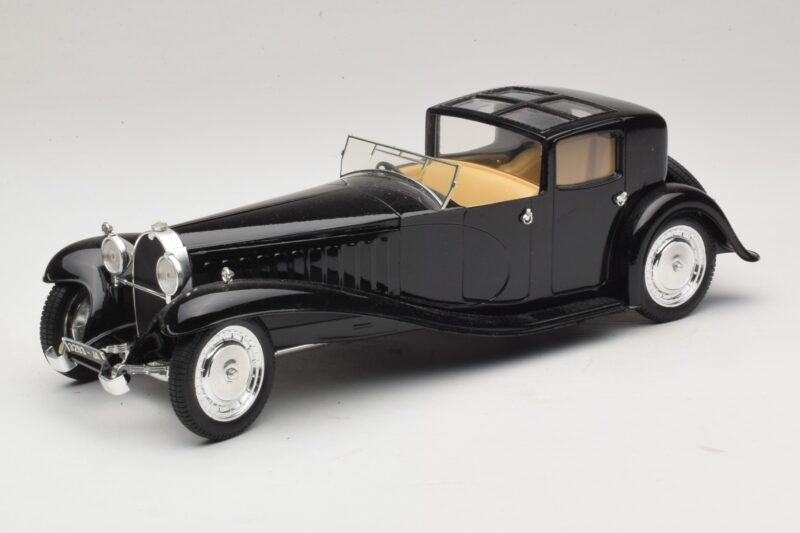
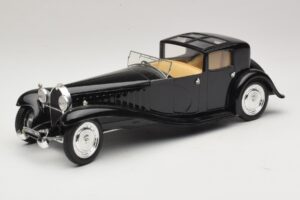
TL;DR: The Solido Bugatti Royale 1:18 is a Black diecast replica of the enormous pre-war Bugatti luxury car from 1930, with opening parts and the long, upright proportions of a coachbuilt giant. Built in metal for weight and stability, it suits collectors of vintage classics and grand pre-war automobiles.
Ettore Bugatti set out to build the grandest car in the world, and the result was so large that scale reproductions behave differently from ordinary models. The Solido Bugatti Royale 1:18 stretches well past the length of a typical 1:18 sports car, and its upright, formal proportions make it unlike anything else on a modern shelf.
The Type 41 Royale was powered by a straight-eight engine of roughly 12.7 liters, an enormous size even by pre-war luxury standards. Bugatti aimed the car at royalty and the wealthiest buyers, but the timing was poor: the Depression arrived just as the car reached the market, and only a handful of examples ever found customers. That backstory is what gives the Royale its collecting weight. It is a car that existed more as an ambition than as a product, and its rarity on the road translates directly into curiosity on the shelf, where a model is the only practical way most enthusiasts will ever see one up close.
Royales were coachbuilt, so the bodies varied from car to car, and this model carries the sedan form given in its data along with a Black finish. Black is a demanding choice on a long, formal body: it shows reflection and surface flow clearly, and any ripple or dust speck stands out. A tall radiator, long hood and upright cabin create the strong vertical lines that define pre-war luxury, and black paint turns those lines into silhouettes. Check the radiator area first when you inspect a Royale model, since that is where the car's identity is most concentrated.
At 1:18 the Royale is among the longer cars you can buy in this scale, well over 30 cm, and the zinc-alloy body reflects that with real heft. Lifting it, you feel a balance toward the center that suits a long-wheelbase car. Diecast brings structural strength to a design with thin, upright elements, and it resists the knocks that come with handling a big model. The trade-off is slightly broader tolerances than a resin casting would allow, so shut lines and panel gaps are a touch wider. At this tier that is expected, and on a pre-war body with its visible seams and separate fenders the effect is faithful to the original look.
This model has opening parts, which adds an inspection dimension to a car whose engineering was its main selling point. Move any hinged panel slowly and check that it returns to a flush position without twisting. On a body this long, hinged sections have more leverage acting on them than on a compact car, so lift the model from underneath rather than by a panel. Open parts are best used for occasional inspection or photography; leaving them closed between sessions keeps the black paint at the edges cleaner and protects the hinges from unnecessary wear.
A model this long demands planning. Measure your cabinet depth and width before you order, because the Royale needs more clearance than any ordinary sports car in the same scale. Placed on a shelf of its own, or with a smaller pre-war car beside it, the size contrast tells the story without a caption. A small car next to it, such as a compact period sedan, makes the Royale's proportions obvious in a way a photograph never could.
Lighting should graze the long flanks, which brings out the curves of the fenders and the line of the hood. Black reflects the room, so position the cabinet away from windows to avoid distracting highlights. Dust a soft brush lightly over the upper surfaces, and avoid handling the radiator area, where fingerprints show quickly on the dark finish.
The Royale belongs in a pre-war luxury grouping, alongside other grand automobiles of the 1920s and 1930s, and it gives that grouping a clear top end. Solido's diecast puts it in the accessible mid tier: more substantial than entry-level pieces, and priced well below hand-built work. For buyers who want the sheer presence of the car rather than microscopic detail, that is the right balance. Anyone looking to buy should check shelf dimensions first, then enjoy having one of the strangest and most ambitious cars of its era in the cabinet.