Last one

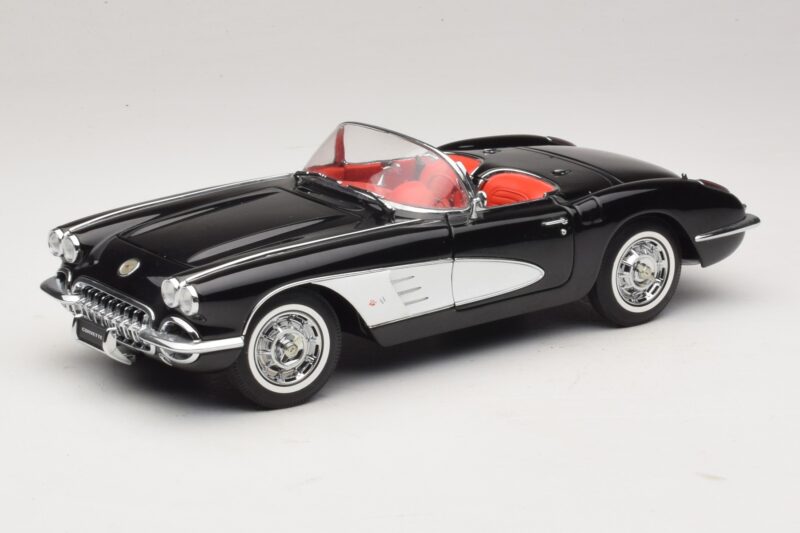
TL;DR: The AUTOart Chevrolet Corvette C1 1959 1:18 in Tuxedo Black is a diecast replica of the fiberglass-bodied American roadster, with opening parts and a deep black finish that sets off its chrome. A hands-on centerpiece for collectors of 1950s American sports cars and classic Corvette history.
By 1959 the Corvette had settled into its identity: a fiberglass body, a V8 under the long hood, and a chrome-trimmed nose that said American sports car. This AUTOart 1:18 version in Tuxedo Black gives that late-1950s presence a metal body, and black is the color that makes chrome earn its place.
Black is the honest color for a chrome-rich car. It hides nothing: ripples in the paint show as distorted reflections, and any dust looks like frost. That is why a good black finish is a mark of careful work. Under a lamp, check the sweep of the front fenders and the long hood for even gloss, then look at the bumpers, grille, and trim, where bright metal should sit crisp against the paint with clean edges. A chrome-heavy 1950s car lives or dies by those contrasts, and 1:18 is large enough to show them.
This model has opening parts, so the construction can be studied from the open side. A zinc alloy body gives the roadster the mass its subject deserves and keeps its shape across years of display. Classic-car interiors are simple compared with modern cockpits, which makes the seat shape, dashboard, and steering wheel easy to compare against photographs of a real C1. Diecast tolerances mean panel gaps run a little wider than a resin casting would hold, a fair price for durability. Open the parts gently and do not force them.
The first-generation Corvette, built from 1953 to 1962, was the American answer to the European sports car, and its fiberglass body was unusual for the time. The 1958 car had added quad headlights and decorative hood louvers and trunk strips; for 1959 those extras were trimmed away, leaving a cleaner look. A V8 sat under the hood, and the small-block V8 gave the Corvette the performance to match its looks. Tuxedo Black was one of the colors of the period and suits the cleaner 1959 lines.
American collectors often specialize by marque, and the Corvette rewards that approach with a family tree that runs generation by generation. AUTOart also lists a C5 Commemorative Edition at the same 1:18 scale, so a C1 and C5 pair, half a century apart, is possible on one shelf. That pairing shows how the Corvette moved from fiberglass roadster to modern coupe while keeping the V8 and the sports-car stance. Classic American road-trip culture is part of the appeal, and a black roadster fits that picture naturally.
Black shows dust and fingerprints fastest of any color, so keep a soft brush and clean cotton gloves near the cabinet. Light from above and to the side brings out the paint depth and the chrome contrast; avoid direct sunlight, which can dull finishes over time. At 1:18 a roadster of this length needs a standard shelf with clearance at the nose and tail. The honest trade-off is that metal tolerances run wider than resin, but the weight and durability suit a car that was always meant to be driven. For a collector of 1950s American sports cars, it is a sound one to buy.