Last one

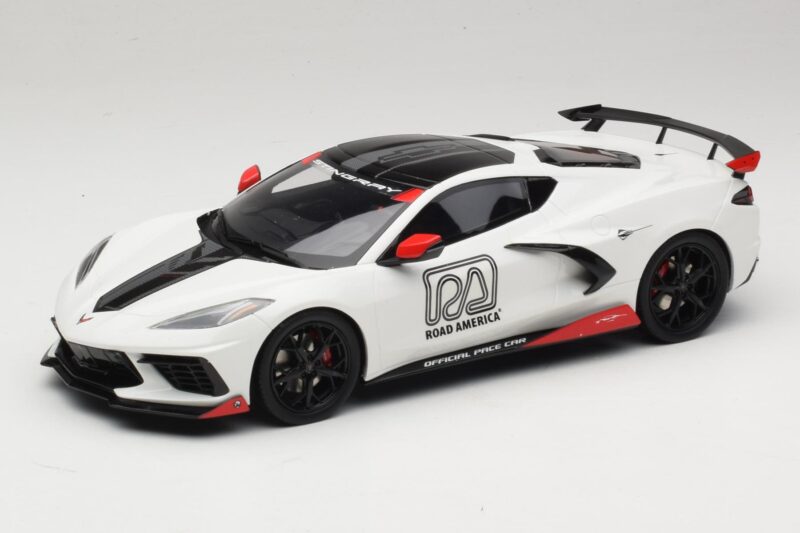
TL;DR: GT Spirit's 1:18 resin reproduces the Chevrolet Corvette C8 as IMSA's 2020 pace car, the first mid-engine Corvette marking the model's biggest generational shift in nearly seven decades. The sealed body carries pace car graphics and light bar detail across a proportion no earlier Corvette shared.
Seven generations of Corvette kept the engine up front, so when Chevrolet moved it behind the driver for the C8, the change reshaped nearly every proportion the nameplate had carried since 1953. IMSA selected the new C8 to pace its road racing series in 2020, a fitting choice given how closely its mid-engine layout mirrors the racing cars it leads onto the grid. GT Spirit's resin casting captures that specific pace car livery.
Every Corvette generation from the original 1953 C1 through the C7 kept its engine ahead of the driver, a layout choice that shaped the car's entire proportion for over sixty years even as the styling evolved dramatically across generations. The C8 broke that tradition entirely, moving the V8 behind the cockpit in a configuration borrowed more from exotic European sports cars than from any previous Corvette. That single change reshaped the hood, the cabin position, and the rear deck all at once, giving the C8 a silhouette that reads as genuinely different from its predecessors rather than an evolution of the same basic shape.
IMSA's road racing series runs cars built around performance and visual spectacle, and selecting the new mid-engine Corvette to pace those events made sense on both counts: a genuinely fast production car whose layout now echoed the prototype and GT machinery racing behind it rather than standing apart from it. Pace car duty also puts a production model in front of an audience already primed to care about performance credentials, making the C8's selection a natural marketing moment for Chevrolet as much as a functional pace-lap assignment. GT Spirit's casting reproduces that specific 2020 livery rather than a generic Corvette color scheme.
The C8's mid-engine layout creates compound curves around the door and rear haunch that a resin casting handles more precisely than a stamped diecast body typically can, since resin takes tighter tolerances and holds sharper transitions between panel sections. GT Spirit builds this pace car as a sealed, one-piece body, which means the entire shape reads as continuous rather than broken by hinge lines around a door or the rear hatch, letting the mid-engine profile's dramatic character lines run uninterrupted from the front fender through to the rear deck.
Pace car liveries typically carry a light bar, door graphics, and often a windshield banner, all elements that need to sit precisely against a body's contours to read correctly at 1:18 scale. A sealed body gives GT Spirit a continuous surface to register those graphics against, without a door seam interrupting the design partway through a logo or stripe. The light bar detail on the roof is picked out with its own separate finish rather than painted flat, and the pace car's identifying graphics carry the crisp edge that tampo printing or careful masking produces on a resin shell without the interruption a hinge line would introduce.
Resin construction gives this Corvette a noticeably different feel in the hand than a diecast model of the same size, lighter overall but capable of holding sharper edges and finer surface detail because the casting process allows tighter tolerances than pressing metal into a die. That precision matters specifically on the C8's shape, where the character lines running from the front fender to the rear haunch are sharper and more angular than anything the front-engine Corvettes wore, and a softer casting process would round those edges in a way that dulls the car's actual design. GT Spirit finishes the body in a factory-correct gloss that holds evenly across the car's larger flat surfaces, the hood and door panels where uneven paint shows first under a display lamp. The rear deck's exposed engine cover louvers, one of the C8's most distinctive design cues and a direct visual signal of the mid-engine layout underneath, are picked out in fine relief rather than smoothed into a flat panel. Wheels sit at the correct, wide rear-biased offset the mid-engine chassis demands.
The C8's mid-engine shift makes it one of the more historically significant Corvette releases in decades, and a pace car livery adds a second layer of interest beyond the base color options most buyers see first. It sits naturally alongside earlier Corvette generations for a collector tracing the nameplate's full evolution, offering a clear visual break from the C7 and everything before it. At 1:18, the resin casting's sharper edges and lower weight distinguish it in the hand from diecast Corvettes of earlier generations, a difference worth noting for buyers used to metal models. For someone building a modern American sports car or IMSA-adjacent racing theme, this pace car edition offers a documented, date-specific entry rather than a standard production color.