Back in stock
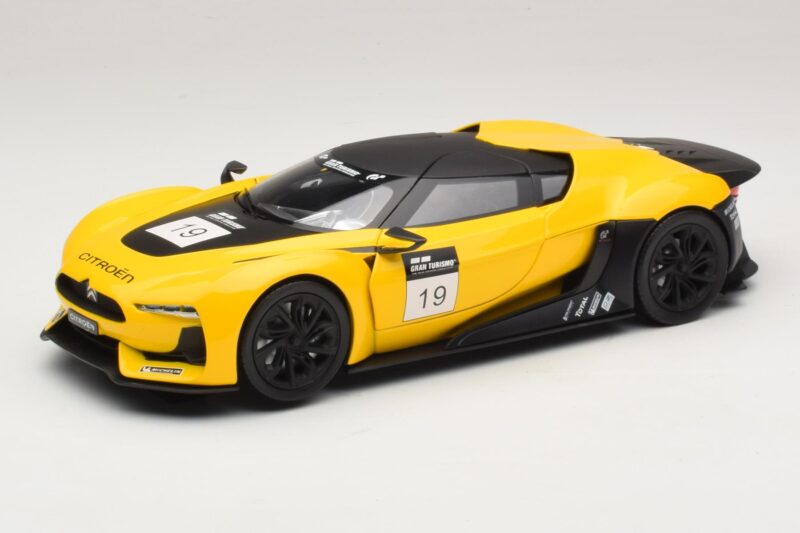
TL;DR: Norev's 1:18 diecast reproduces the Citroën GT, the dramatic supercar concept created in partnership with the Gran Turismo video game franchise and shown as a running prototype at the 2008 Paris Motor Show. This Yellow and Black casting includes opening panels that expose the cockpit, built to display the concept's low, faceted surfacing.
Few concept cars begin life inside a video game, but the Citroën GT did exactly that, designed for the Gran Turismo franchise before Citroën built a running prototype and unveiled it at the 2008 Paris Motor Show. The low, angular body looked more like a stealth aircraft study than a road car, and this Yellow and Black diecast captures that surfacing at 1:18, with opening panels revealing the cabin below.
Citroën and Polyphony Digital, the studio behind the Gran Turismo racing series, developed the GT as a virtual car years before any metal was cut. The response to the digital design pushed Citroën to build it for real, and the finished prototype debuted at the 2008 Paris Motor Show as a fully running car rather than a static mockup. That path, screen first and showroom second, was unusual even by concept-car standards, and it gave the GT a fan base among gamers who had never set foot in a Citroën showroom. Norev's diecast follows the physical prototype's proportions, the version most collectors actually recognize from the Paris unveiling rather than the earlier digital renderings.
The GT's low nose, sharply creased flanks, and cab-forward glasshouse previewed design cues that filtered into later Citroën concept work, even though the GT itself never approached production. Norev's diecast includes an opening panel that gives access to a cabin styled with the same aircraft-inspired language as the exterior, a detail that rewards a closer look beyond the bodywork alone. At barely over a meter tall in real terms, the GT sat lower than most production supercars of its era, and that proportion is exactly what a 1:18 casting has to nail to look right on a shelf: a wide, flat stance rather than a tall, narrow one.
Diecast construction on a body this angular has to manage sharp creases without losing definition at the panel edges, and zinc alloy handles that well because it holds a crisp line even where a resin cast might round it slightly under demolding. The opening panel adds real assembly complexity to a shape with almost no flat surfaces to hide a hinge line, so the shut line around the cabin opening is worth checking closely against the surrounding bodywork. Lifted out of its packaging, the model carries the weight zinc alloy is known for, a density that signals real metal rather than a lightweight promotional toy.
Yellow and black is a bold combination for a concept car diecast, and it works because the GT's surfacing breaks into enough distinct facets that a two-tone scheme reads as considered design rather than a random accent. Color splits on concept liveries typically follow body panel breaks and character lines rather than a simple top-and-bottom division, using contrast to sharpen the shape's angularity instead of quietly covering it. Under direct light, the yellow should hold enough depth against the black to avoid reading flat, and that contrast is part of what makes this variant stand out next to a more conservative single-color GT, or against the many white and silver concept-car diecasts crowding most collections.
At 1:18, a car with the GT's real-world footprint comes out somewhere around 22 to 24 centimeters long, shorter than a typical modern supercar because the concept's proportions favor width and low height over sheer length. That low stance means the model rewards being viewed from slightly above rather than dead-on, since a straight-ahead angle hides the roofline's aircraft-canopy shape that makes the GT immediately recognizable. With the cabin panel able to open, display options widen: closed, the car reads as a single sculpted wedge; open, the cabin's stripped, functional interior becomes visible, a detail worth showing off given how few concept-car diecasts allow that kind of access. Concept cars generally sit apart from a themed brand chronology, since they never entered production and have no model-year lineage to slot into, so this piece works best as a standalone statement or grouped with other design-study diecasts rather than filed among a run of production Citroëns. Few running GT prototypes were ever built, period reporting suggests, which makes a faithful diecast about as close as most collectors will get to experiencing the car in three dimensions.
Norev built its reputation on accessible, well-detailed diecast across mainstream French and German marques, and a concept car like the GT is something of an outlier in that catalog, which is part of why finding one in decent condition matters to specialist buyers rather than general collectors. The price sits closer to a standard production-car diecast than to a limited resin concept reproduction, which makes this an approachable way to own a piece of Citroën's more experimental design history without paying collector-tier premiums for the privilege. It will not anchor a themed Citroën production lineup the way a DS or a 2CV would, but it earns its spot as a conversation piece, the diecast a visitor actually asks about. For anyone building a shelf around concept and show cars rather than showroom history, this is a reasonable one to track down and buy.