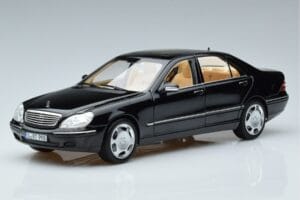
Mercedes S-Class W220 S600 Limited Edition Norev 1:18
Price:
91.00 €
This model is currently sold out. Enter your email and we'll let you know when it's back in stock.
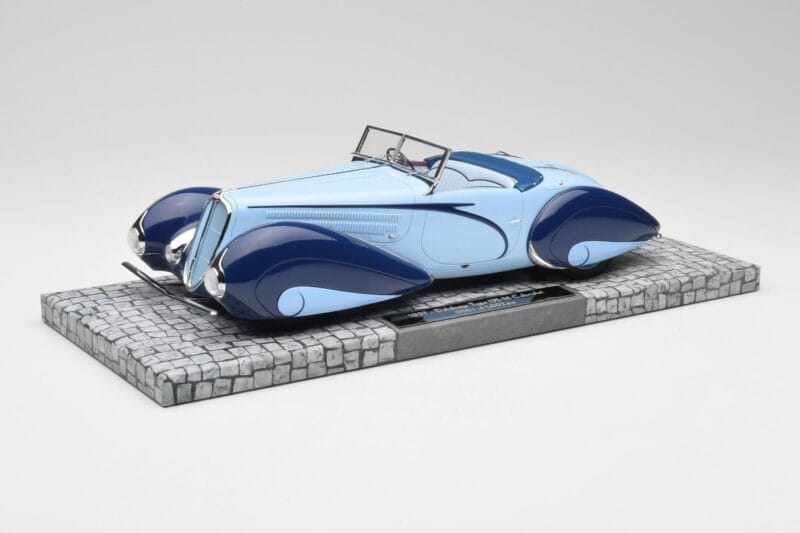
TL;DR: Minichamps' 1:18 diecast Delahaye 135M Cabriolet reproduces the French grand routière whose flowing coachwork is celebrated in the Mullin Museum's Art Deco collection. Zinc alloy build, opening doors and hood, and a mapped cockpit give collectors a substantial pre-war centerpiece for a 1930s coachbuilt display.
The Delahaye 135M carried French luxury coachbuilding to its Art Deco peak, and few surviving examples wear that history as visibly as the cars housed at the Mullin Museum. Minichamps' 1:18 diecast interpretation gives collectors a way to bring that pre-war elegance home.
Delahaye introduced the 135 chassis in 1935, and by 1937 the M-series carried a stronger six-cylinder engine beneath coachwork built by houses such as Figoni et Falaschi and Chapron. Cabriolet bodies on this chassis favored long, sweeping fenders and a low windscreen, the visual language that defines French Art Deco motoring. The Mullin Museum in California has assembled one of the world's most respected collections of these pre-war French cars, and the institution's name attached to this diecast signals a connection to that curatorial standard rather than a claim about one specific chassis.
The 135 series also raced, and a 135-based car took a class win at Le Mans before the Second World War, proof that Delahaye's chassis handled both boulevard cruising and endurance competition. That dual identity, elegant tourer and capable racer, is part of what makes the 135M a serious subject for a pre-war display rather than a decorative curiosity. Collectors drawn to this era value cars that carry both provenance and performance pedigree, and the 135M offers a credible claim to both.
Minichamps casts this Delahaye in zinc alloy, the material that gives pre-war models the density collectors expect when lifting a 1:18 cabriolet from its box. The doors and hood open on metal hinges, exposing a mapped engine bay and a cockpit finished in contrasting upholstery tones rather than a single molded color. Diecast construction suits a car like this precisely because opening panels let a collector show off the engine and cabin, the parts of a 1930s grand routière that period owners cared about most. Some pre-war subjects appear in sealed resin instead, which can hold marginally sharper lines on compound curves but sacrifices exactly this kind of engine and cabin access.
Panel gaps stay tight along the long hood line, a detail that matters more on a car with this much unbroken bodywork than on a modern hatchback with shorter panels to align. The convertible top detail and fender edges read cleanly under direct light, showing the surface care a coachbuilt subject demands. Chrome trim around the headlamps and grille is picked out distinctly rather than left flat, and the wire wheels carry fine spoke detail that separates a considered pre-war casting from a simplified one.
At roughly 24 centimeters long, this Delahaye occupies more shelf depth than a compact postwar sports car, a reminder that grand routière proportions were never meant to be modest. It pairs naturally with other 1930s coachbuilt subjects, Bugatti, Talbot-Lago, or period Mercedes, rather than with sports cars from later decades, since matching an era's design language across a shelf reads more convincingly than matching by marque alone. Pre-war diecast at this scale is a smaller segment than postwar or modern subjects, which makes a well-detailed 135M a genuine anchor piece rather than one of many similar options. For a collector building toward a coherent Art Deco or coachbuilt theme, this model rewards the investment with detail that holds up under close inspection years into ownership.